
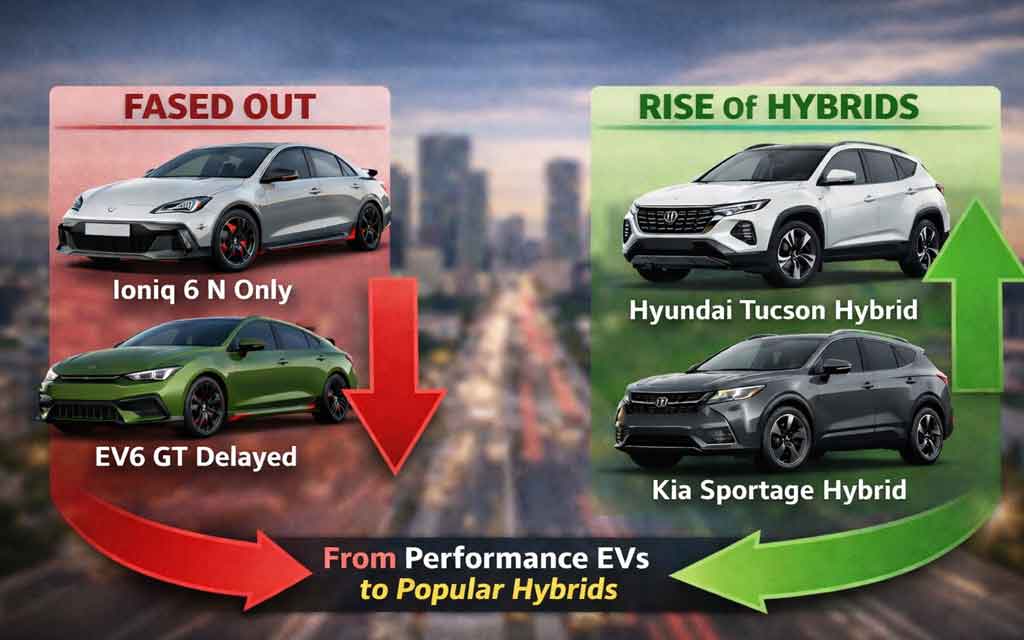
Hyundai and Kia, once EV trailblazers with strong U.S. momentum, are recalibrating their pure-electric lineups amid softening demand, policy shifts (like the end of federal tax credits), tariffs on imports, and a clear consumer pivot toward hybrids and crossovers. In early March 2026, Hyundai confirmed it will discontinue the standard (non-N) Ioniq 6 sedan in the U.S. for the 2026 model year, offering only the high-performance Ioniq 6 N in limited quantities. Kia has delayed the 2026 EV6 GT “until further notice” due to “changing market conditions,” while regular EV6 trims (U.S.-assembled) remain available. These moves highlight broader industry challenges and a strategic shift toward hybrids—here’s what it means for buyers shopping EVs in 2026.
Hyundai Ioniq 6: Standard Model Dropped, N Version Limited
The sleek, aerodynamic Ioniq 6—praised for its efficiency (up to 361 miles EPA range in prior trims) and fast charging—saw sharp sales declines. U.S. figures dropped 77% in recent months (e.g., just 229 units sold in one reported period), with 2025 totals down 15% year-over-year to around 10,478 units, and early 2026 even weaker (e.g., 563 units so far, a 70% drop). Hyundai cited declining sedan demand (a decade-long trend), competition from crossovers/SUVs like the Ioniq 5, and tariffs on South Korean imports.
- What’s happening: No refreshed 2026 standard Ioniq 6 arrives in the U.S. (a facelifted version exists elsewhere). Only the track-focused Ioniq 6 N (expected later 2026, ~$60,000+ starting) will be offered in limited numbers.
- Impact on buyers: Affordable, long-range EV sedans lose a strong contender. Remaining 2025 inventory offers deals, but stock is dwindling. The Ioniq 6 N appeals to enthusiasts seeking 641+ hp performance, but it’s pricier and rarer—not a direct replacement for mainstream buyers.
Kia EV6 GT: High-Performance Trim Paused
The EV6 GT—one of the quickest production EVs (0-60 mph in ~3.4 seconds, 641 hp)—joins the pause list. Built in South Korea (unlike U.S.-made standard EV6 trims), it’s hit by import tariffs (e.g., 25% on certain models) and weak overall EV6 sales (down 53% in spots, with low early-2026 volumes). Kia stated: “Due to changing market conditions, the 2026 EV6 GT will be delayed until further notice,” but non-GT EV6 models stay on sale.
- What’s happening: GT trimmed from configurators; no firm return timeline. Regular EV6 (including AWD variants) continues, with Georgia-built production avoiding some tariff pain.
- Impact on buyers: Performance EV fans miss a top-tier option (rivaling Porsche Taycan in fun). Standard EV6 remains competitive for everyday use (up to ~310 miles range, fast charging), but the halo GT’s absence reduces excitement and prestige.
Broader Industry Recalibration: The Hybrid Surge
These pauses aren’t isolated—they reflect a market shift post-federal EV tax credit expiration (late 2025), rising tariffs, inventory buildup, and consumer preferences. Hyundai/Kia hybrids exploded (e.g., 60%+ growth in some months), with models like Santa Fe, Palisade, Sportage, and Telluride hybrids setting records. Globally, the group surpassed 1 million hybrid sales in recent periods, offsetting EV softness.
- Why the shift? Buyers favor hybrids for no range anxiety, quick refueling, lower upfront costs, and real-world efficiency without full infrastructure reliance. Sedans lag SUVs/crossovers in demand.
- EV market context: Pure EV sales slumped industry-wide after incentives ended, with Hyundai/Kia EVs hit harder on imports. Competitors (e.g., Ford, GM) also emphasize hybrids while scaling affordable EVs.
What It Means for EV Buyers in 2026
- Fewer choices in sedans/performance EVs: Standard Ioniq 6 and EV6 GT gaps leave Tesla Model 3, Polestar 2, or BMW i4 as alternatives—but at potentially higher prices.
- Deals on remaining stock: Clear 2025 Ioniq 6/EV6 inventory for discounts, especially as dealers move old models.
- Hybrids as bridge: If full EV commitment feels risky, Hyundai/Kia hybrids offer electrified efficiency with proven reliability—many buyers delay pure EVs.
- Long-term outlook: Hyundai/Kia invest heavily in U.S. production (e.g., Georgia plants) for future EVs like refreshed Ioniq 5/9. Pauses buy time to align with demand, tariffs, and next-gen platforms.
- Advice: If eyeing these models, act on 2025 leftovers soon. For performance, watch Ioniq 6 N availability. For value/range, consider U.S.-built EV6 or Ioniq 5 alternatives.
This recalibration signals EV realism: growth continues, but not uniformly—hybrids bridge the gap while pure EVs adapt.
I’m Ethan, and I write about the tech that’s actually going to change how we live — not the stuff that just sounds impressive in a press release. I cover AI, EVs, robotics, and future tech for VFuture Media. I was on the ground at CES 2026 in Las Vegas, walking the show floor so I could give you a real read on what matters and what’s just noise. Follow me on X for daily takes.
If you found this useful, the best thing you can do is share it with someone who’d actually appreciate it. And if you want more like it, we’re here every week.



Leave a Comment