
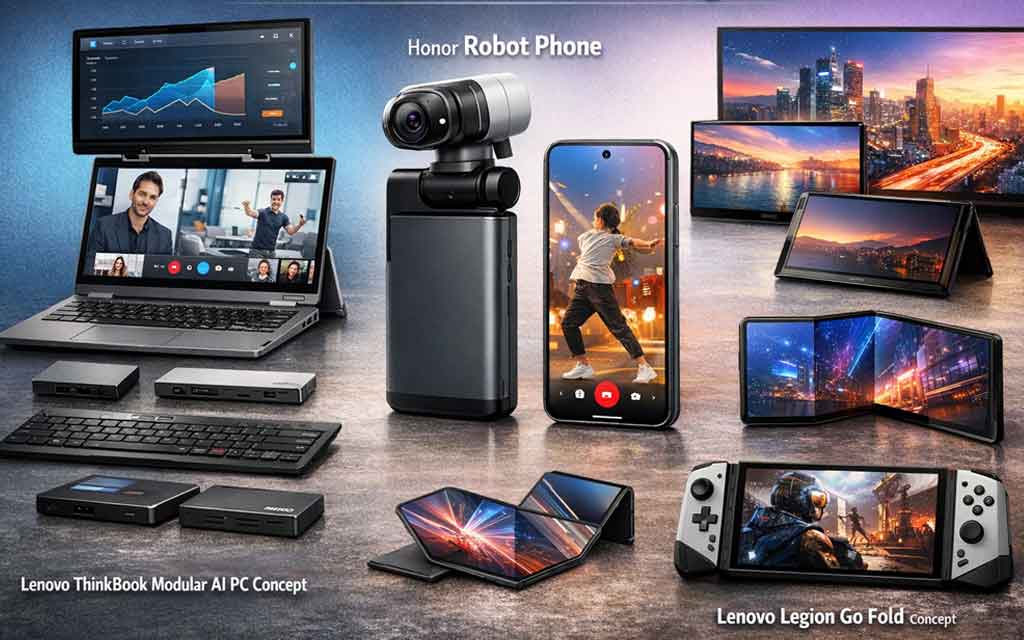
Mobile World Congress (MWC) 2026 in Barcelona delivered a feast of boundary-pushing concepts and prototypes that blur the lines between phones, laptops, robots, and AI companions. While practical launches like new foldables and chips dominated headlines, the show’s “wild” side shone through with experimental designs aimed at redefining productivity, gaming, and interaction. Drawing from roundups by Android Headlines, CNET, PCMag, The Verge, ZDNET, and others, here’s a curated list of the most audacious gadgets and concepts that stole the spotlight—focusing on Lenovo’s modular marvels, Honor’s robotic innovations, and emerging tri-fold displays.
These aren’t all destined for store shelves soon (many remain concepts or China-exclusive teases), but they signal where mobile and AI tech could head next: more adaptable, embodied, and immersive experiences.
1. Lenovo ThinkBook Modular AI PC Concept – The Ultimate Shapeshifter Laptop
Lenovo pushed modularity to new heights with the ThinkBook Modular AI PC Concept, a 14-inch productivity laptop that’s essentially a customizable workstation. Key features include:
- Swappable “MagicBay” modules for ports, I/O, and expansions (plug-and-play in seconds).
- Detachable secondary 14-inch display that magnetically attaches to the lid for dual-screen workflows.
- Interchangeable keyboard and components for “carry small, use big” flexibility—transform from ultra-portable clamshell to expanded collaboration setup.
- Built around AI acceleration for adaptive productivity scenarios.
Hands-on reports from The Verge and ZDNET praised its Framework-like repairability and versatility for professionals juggling modes (e.g., solo work to team presentations). Android Headlines called it “rich in utility,” highlighting seamless upgrades without buying new hardware. It’s conceptual for now—no release date—but it could inspire more sustainable, upgradable laptops in a throwaway tech era.
(Conceptual renders of the modular ThinkBook in action, showing detachable screens and ports.)
2. Honor Robot Phone – Smartphone Meets Robotic Gimbal
Honor doubled down on “embodied AI” with the Robot Phone, a functional prototype blending smartphone smarts with robot-grade motion. Highlights:
- 200MP main camera on the industry’s smallest 4DoF (degrees of freedom) gimbal—tucks away when idle, pops out for stabilized tracking shots, gesture responses (nodding, bobbing to music), and cinematic follow modes.
- Designed as a “new species” of phone for spatial awareness and interactive AI (e.g., embodied companionship scenarios).
- Planned launch in late 2026 (China-first), with potential global teases.
Mashable, Android Authority, and Forbes described it as “wild and weird” yet impressively executed—far beyond gimmick status thanks to smooth robotics and practical video perks. CNET noted its potential beyond party tricks, like dynamic content creation. It’s the standout “crazy” phone concept, proving Honor’s AI vision extends to physical movement.
(Hands-on shots of the Robot Phone’s gimbal camera in motion and tucked away.)
3. Tri-Fold Displays and Foldables – Pushing Beyond Two Folds
Tri-fold tech matured at MWC 2026, with prototypes emphasizing practicality over novelty:
- TCL CSOT’s 28-inch tri-fold desktop monitor folds to 16-inch for portability, delivering cinema-grade DCI-P3 coverage—ideal for creators needing big screens on the go.
- Samsung and Huawei demos of Galaxy Z TriFold-style multi-fold phones (e.g., Huawei’s refined hinge tech post-Mate XT successor).
- Honor’s ultra-thin Magic V6 (8.75mm folded, 4mm open) as a benchmark for slimmer book-style foldables, though not tri-fold itself.
Android Headlines and Yanko Design highlighted tri-folds’ stronger desktop/monitor use case vs. pocketable phones—better crease management and durability. These concepts tease a future where screens adapt fluidly, though consumer tri-fold phones remain rare due to complexity.
(TCL’s tri-fold monitor folded and expanded; conceptual tri-fold phone renders.)
Bonus Wild Mentions from MWC 2026
- Lenovo Legion Go Fold Concept — A Windows gaming handheld with 7.7-inch foldable POLED expanding to 11.6-inch, detachable controllers, and keyboard for laptop mode—PCMag and Mashable called it “endlessly versatile” yet quirky.
- AI-infused robots and companions (e.g., Honor’s humanoid shopping assistant) tying into phone ecosystems.
- Other concepts like Xiaomi’s physical hypercar demo and various AI toys.
Conceptual vs. Practical: What’s Realistic?
Many of these—especially Honor’s Robot Phone and Lenovo’s modular ThinkBook—are bold proofs-of-concept showcasing AI embodiment and customization. Practical hurdles include cost, durability, and battery demands, but they influence real products (e.g., better gimbals in future cameras or modular accessories). Tri-folds shine more in larger formats for now.
MWC 2026 proved the industry isn’t settling—it’s experimenting wildly to find the next big paradigm shift. Which concept excites you most?
I’m Ethan, and I write about the tech that’s actually going to change how we live — not the stuff that just sounds impressive in a press release. I cover AI, EVs, robotics, and future tech for VFuture Media. I was on the ground at CES 2026 in Las Vegas, walking the show floor so I could give you a real read on what matters and what’s just noise. Follow me on X for daily takes.
If you found this useful, the best thing you can do is share it with someone who’d actually appreciate it. And if you want more like it, we’re here every week.


Leave a Comment