
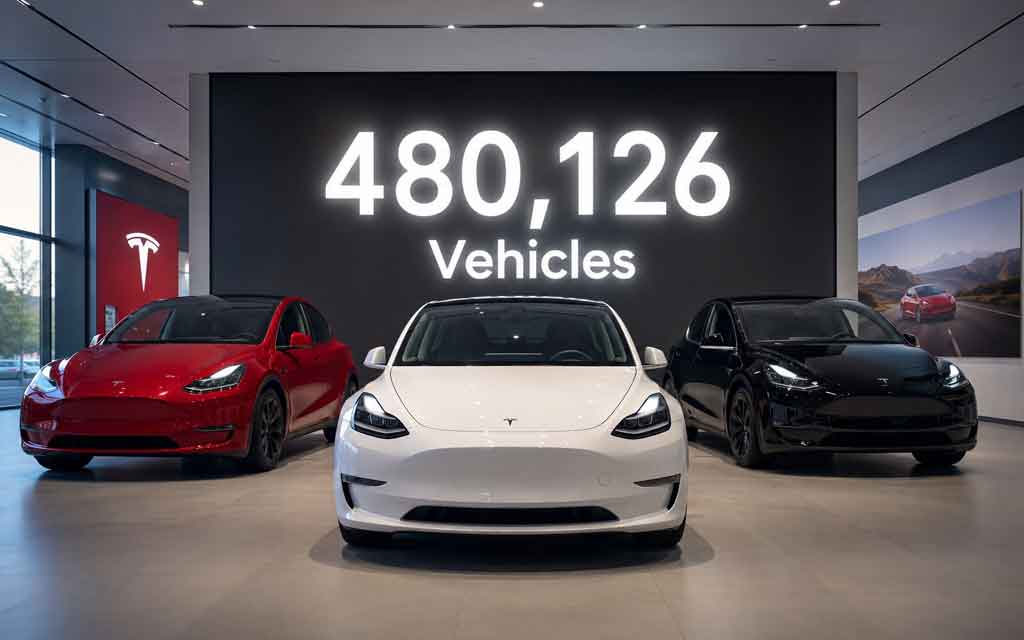
Tesla produced 451,758 vehicles and delivered a record 480,126 units in Q2 2026 — a 25% year-over-year jump that crushed Wall Street expectations. What the strong performance means for Tesla, the EV market, and American innovation.
Tesla posted one of its strongest quarterly delivery performances in years, delivering 480,126 vehicles globally in the second quarter of 2026. The number not only set a new record for any Q2 in the company’s history but also significantly exceeded analyst expectations of roughly 402,000–406,000 vehicles.
According to Tesla’s official production and delivery report released on July 2, 2026, the company produced 451,758 vehicles during the quarter. Deliveries outpaced production by more than 28,000 units, allowing Tesla to draw down inventory built up earlier in the year.
The result comes at a time when parts of the broader EV industry are seeing softer demand and legacy automakers are shifting resources toward hybrids. Tesla’s ability to deliver strong growth highlights the continued strength of its core product lineup and software ecosystem.
The Record by the Numbers
Here’s how Tesla’s Q2 2026 performance breaks down:
Tesla Q2 2026 Production & Delivery Highlights
Total Deliveries
- Q2 2026: 480,126 vehicles
- Year-over-Year Change: +25%
- Notes: Achieved a new Q2 delivery record.
Total Production
- Q2 2026: 451,758 vehicles
- Year-over-Year Change: —
- Notes: Production remained strong to support global demand.
Model 3 / Model Y
- Q2 2026: 467,762 vehicles
- Year-over-Year Change: +25.2%
- Notes: Continued to account for the vast majority of Tesla’s production and deliveries.
Other Models
- Q2 2026: 12,364 vehicles
- Year-over-Year Change: +19%
- Notes: Includes the Cybertruck and refreshed Model S and Model X.
The Model 3 and Model Y continued to dominate, accounting for nearly 97% of all deliveries. The remaining volume came from the Cybertruck (available in North America and select markets) and the refreshed Model S and Model X.
Why Tesla Beat Expectations
Several factors contributed to the strong Q2 result:
- Improved European Demand: Reports highlighted a notable rebound in Europe, helping offset softer periods in other regions.
- Inventory Normalization: Tesla produced fewer vehicles than it delivered, actively reducing inventory levels. This suggests healthier underlying demand rather than heavy discounting to clear stock.
- Product Strength: The Model Y remains one of the best-selling vehicles globally in its class. Continuous software updates, improved range, and the expanding Supercharger network continue to support ownership experience and resale values.
- Cybertruck Contribution: While still relatively small in absolute numbers, Cybertruck deliveries are growing and adding to the “Other Models” category. The vehicle continues to generate significant interest and media attention.
These elements combined to produce a result that stood out positively during a week when several other EV makers reported more mixed outcomes.
Competitive Context in Mid-2026
Tesla’s Q2 performance arrived alongside Rivian’s own positive update. Rivian beat its Q2 delivery guidance and raised its full-year 2026 outlook, showing that well-executed electric trucks and adventure vehicles continue to find strong demand.
At the same time, several legacy automakers are reporting softer pure-EV sales and accelerating their hybrid and extended-range EV programs. This divergence highlights two different realities in the current market:
- Companies with strong brand loyalty, software advantages, and charging infrastructure (like Tesla) are maintaining or growing volume.
- Many traditional manufacturers are finding it more profitable in the near term to offer hybrids that require less new infrastructure and appeal to buyers concerned about range and charging access.
Tesla’s results reinforce its position as the volume leader in the global EV space, even as the overall market becomes more segmented between pure EVs, hybrids, and extended-range vehicles.
Implications for American Innovation and Green Tech
Tesla remains one of the most important American companies driving the transition to electric mobility. Its Gigafactory in Texas and other U.S. operations support thousands of high-tech manufacturing and engineering jobs. The company’s continued focus on software-defined vehicles, over-the-air updates, and energy storage (Megapack deployments were also mentioned in the quarterly update) positions it at the intersection of automotive and energy innovation.
For American drivers, Tesla’s scale helps accelerate the build-out of fast-charging infrastructure and keeps downward pressure on battery costs across the industry. The company’s push into autonomy (Full Self-Driving) and future robotaxi ambitions, while still in development, represent long-term bets on transforming personal transportation.
The strong Q2 delivery number also sends a signal that demand for compelling electric vehicles remains healthy among buyers who prioritize technology, performance, and ecosystem integration.
Challenges and Market Realities
Despite the impressive volume, Tesla continues to operate in a challenging environment:
- Margin Pressure: High competition and pricing discipline in key markets continue to affect profitability.
- Evolving Policy Landscape: The expiration of the federal EV tax credit in late 2025 has changed the economics for some buyers, though Tesla’s brand strength and total cost of ownership advantages have helped mitigate the impact.
- Competition Intensifying: Rivian, legacy OEMs, and new entrants are all fighting for share in specific segments (trucks, SUVs, luxury).
- Execution Risk on Future Bets: Robotaxi, new vehicle platforms, and energy storage growth are still in earlier stages and carry execution and regulatory risk.
The upcoming earnings call (expected later in July) will provide more color on margins, cash flow, and management’s outlook for the second half of 2026.
The Road Ahead
Tesla’s record Q2 2026 deliveries demonstrate that the company can still deliver strong growth even as the broader EV market becomes more complex. By outpacing production and clearing inventory, Tesla showed operational discipline alongside healthy demand.
As the industry navigates the post-incentive environment and a growing split between pure EVs and hybrids, Tesla’s combination of software leadership, charging network, and brand remains a powerful competitive advantage.
For investors and observers of green technology, the result is a reminder that companies executing well on product, software, and infrastructure can continue to grow even when some competitors are retrenching.
The next major update will come with Tesla’s full Q2 financial results and earnings commentary later this month. Those numbers will reveal whether the strong delivery performance translated into improved financial metrics and what management sees for the remainder of 2026.
FAQs
How many vehicles did Tesla deliver in Q2 2026? Tesla delivered a record 480,126 vehicles globally in Q2 2026.
Did Tesla beat analyst expectations? Yes. Deliveries significantly exceeded Wall Street consensus estimates of approximately 402,000–406,000 vehicles.
Which models drove most of Tesla’s volume? The Model 3 and Model Y accounted for 467,762 of the 480,126 total deliveries.
How does Tesla’s result compare to Rivian’s? Both companies reported strong Q2 2026 results. Rivian beat its own guidance and raised its full-year outlook, while Tesla posted record Q2 deliveries and outperformed analyst estimates.
When will Tesla release full Q2 financial results? Tesla typically holds its earnings call approximately three weeks after the end of the quarter. More detailed financial commentary is expected later in July 2026.



Leave a Comment