
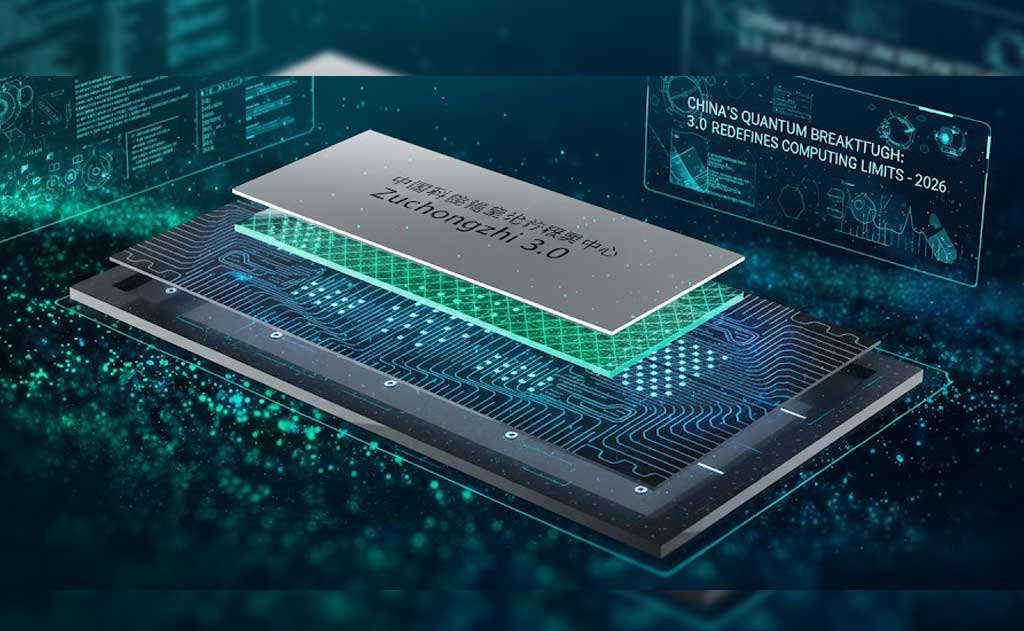
In the high-stakes global race for quantum supremacy, China has once again surged ahead. Researchers at the University of Science and Technology of China (USTC) unveiled their latest superconducting quantum processor, Zuchongzhi 3.0, demonstrating unprecedented computational power. This machine completed a highly complex benchmark task in mere minutes—a feat that would take the world’s most powerful classical supercomputers billions of years to achieve.
This isn’t hype; it’s a verifiable milestone in quantum advantage, pushing the boundaries of what’s possible in computing. As we stand on the cusp of 2026, this breakthrough signals that quantum technology is accelerating from laboratory experiments toward transformative real-world impact.
What Is Quantum Advantage and Why Does This Matter?
Quantum advantage (sometimes called quantum supremacy) occurs when a quantum computer solves a problem infeasible for classical supercomputers in any reasonable timeframe. The task chosen for these demonstrations is random circuit sampling (RCS)—a mathematical problem designed to exploit quantum superposition and entanglement, where qubits process exponentially many possibilities simultaneously.
Unlike practical applications (e.g., drug discovery, optimization, or cryptography), RCS isn’t “useful” yet. But it proves quantum hardware has crossed a critical threshold: classical machines simply can’t keep up.
China’s Zuchongzhi 3.0, with its 105 readable qubits and 182 couplers, executed RCS in roughly 100-200 seconds. Estimates suggest the Frontier supercomputer (the world’s fastest classical system) would need billions of years for the same computation using current algorithms. This performance is quadrillions (10^15) times faster than classical benchmarks and millions of times ahead of Google’s prior published results.
This builds on earlier Chinese successes like Jiuzhang (photonic) and previous Zuchongzhi versions, solidifying China’s lead in superconducting quantum systems.
How Quantum Computers Work: Qubits vs. Bits
Classical computers use bits (0 or 1). Quantum computers use qubits, which can be 0, 1, or both simultaneously thanks to superposition. Entanglement links qubits, enabling parallel processing of vast datasets.
Zuchongzhi 3.0 leverages superconducting qubits cooled to near absolute zero, allowing precise control. Key improvements include better coherence times, reduced errors, and scalable architecture—paving the way for fault-tolerant systems.
Later iterations (e.g., Zuchongzhi 3.2 in late 2025) achieved the fault-tolerant threshold, where error correction enhances stability rather than introducing more noise. This milestone—second only to Google’s Willow—brings practical, error-corrected quantum computing closer.
The Bigger Picture: Progress Accelerating Faster Than Ever
This isn’t an isolated win. China has invested heavily (over $15 billion estimated in quantum tech), fostering ecosystems in Hefei and beyond. Commercial deployments of Zuchongzhi-based systems emerged in 2025, making quantum resources available via cloud platforms.
Globally, the race intensifies:
- Google’s Willow demonstrated error-corrected logical qubits.
- IBM targets fault-tolerant systems by 2029.
- Other players (IonQ, Quantinuum) push neutral-atom and trapped-ion approaches.
Yet China’s speed in scaling qubits and benchmarks keeps it at the forefront. Experts note progress is “accelerating faster than ever,” with practical quantum utility potentially arriving sooner than skeptics predict.
Challenges Remaining: From Benchmark to Real-World Revolution
Quantum tech faces hurdles:
- Error rates — Qubits are fragile; decoherence destroys computations.
- Scalability — Thousands/millions of logical qubits needed for fault-tolerance.
- Energy/cooling — Extreme requirements limit accessibility.
Current advantages are benchmark-specific. True revolution awaits in fields like:
- Simulating molecules for new drugs/materials.
- Optimizing logistics/finance.
- Breaking classical encryption (post-quantum cryptography urgency).
Still, each milestone like Zuchongzhi 3.0 erodes classical limits, inching toward that tipping point.
What This Means for the Future of Computing
China’s breakthrough redefines computing limits, proving quantum processors operate in realms classical machines can’t touch. It accelerates the timeline for quantum’s integration into AI, cybersecurity, and science.
For businesses and innovators, now is the time to monitor quantum developments. Hybrid quantum-classical systems could soon solve intractable problems, creating competitive edges.
At VFutureMedia, we track emerging tech shaping tomorrow. This Chinese quantum leap isn’t just news—it’s a signal that the quantum era is dawning.
I’m Ethan, and I write about the tech that’s actually going to change how we live — not the stuff that just sounds impressive in a press release. I cover AI, EVs, robotics, and future tech for VFuture Media. I was on the ground at CES 2026 in Las Vegas, walking the show floor so I could give you a real read on what matters and what’s just noise. Follow me on X for daily takes.
Stay ahead: Subscribe for updates on quantum computing, AI, and future tech. What do you think—will China lead the quantum revolution? Share in the comments!


Leave a Comment