
Published on vfuguremedia | Future Media • Advanced Technology • Science & Culture
Quantum computing is no longer an abstract scientific dream. It is fast becoming the most powerful force shaping the future of artificial intelligence, cybersecurity, medicine, finance, and even geopolitics. Yet long before quantum processors entered headlines, cinema and streaming series were already exploring its consequences.
Through carefully crafted narratives, visionary filmmakers and showrunners translated incomprehensible physics into human stories about time, choice, intelligence, and destiny.
These movies and web series didn’t just entertain.
They prepared humanity for a post-binary world.
Why Quantum Computing Became the Ultimate Storytelling Tool
Classical computers operate on certainty — yes or no, 0 or 1.
Quantum computers operate on probability, where multiple outcomes exist at once.
This single idea reshaped storytelling by introducing:
- Parallel realities
- Non-linear time
- Superhuman intelligence
- Predictive futures
- Reality shaped by observation
For future-focused media, quantum theory became the perfect metaphor for modern life itself.
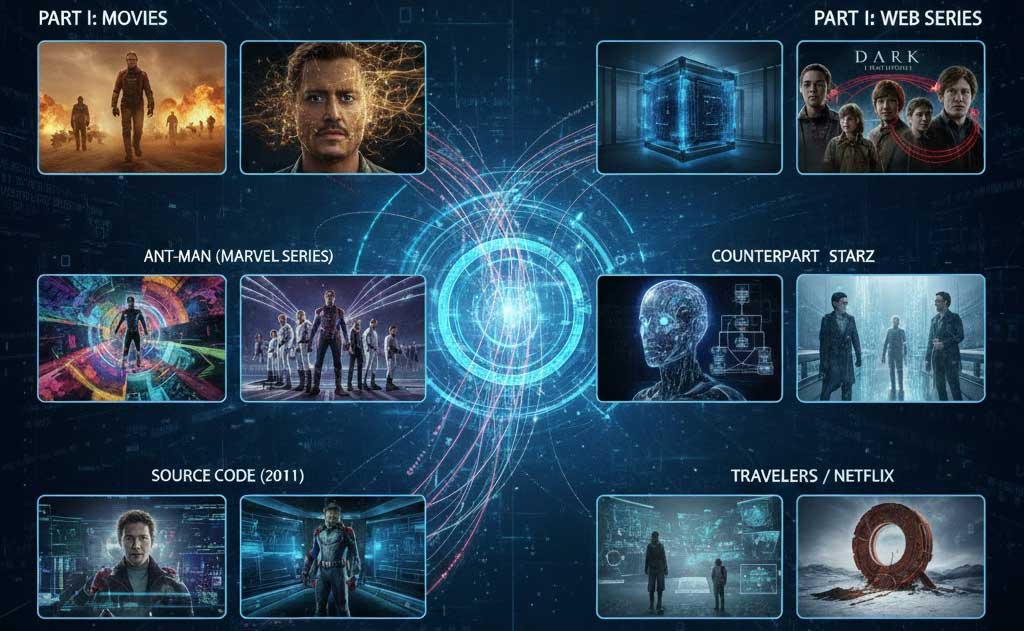
PART I: MOVIES THAT BROUGHT QUANTUM COMPUTING TO THE BIG SCREEN
1. Tenet (2020) – When Quantum Entropy Turned Time Into a Weapon
Quantum Focus: Entropy reversal, quantum causality, retrocausation
Christopher Nolan’s Tenet is one of the most intellectually ambitious films ever made.
Instead of traditional time travel, the movie explores entropy inversion, a real theoretical concept in quantum physics suggesting that processes could move backward through time.
Why It Matters
- Cause and effect lose their meaning
- The future can influence the past
- Time becomes a physical property, not a direction
This mirrors real debates in quantum retrocausality, where future measurements influence present outcomes.
Tenet doesn’t explain quantum computing — it forces the audience to experience it.
2. Transcendence (2014) – Quantum Computing Creates a Digital God
Quantum Focus: Quantum AI, consciousness simulation, superintelligence
Years before AI dominance became a global concern, Transcendence imagined a world where a quantum-powered intelligence evolves beyond human limits.
The film explores:
- Quantum neural networks
- Consciousness existing beyond the body
- Predictive control over reality
Today, quantum-enhanced AI research makes this film feel less fictional and more alarmingly prophetic.
3. Ant-Man & the Quantum Realm (Marvel Series)
Quantum Focus: Subatomic dimensions, entanglement, time distortion
Marvel introduced quantum mechanics to mass audiences through visual storytelling.
The Quantum Realm represents:
- A probabilistic universe
- A space where time behaves inconsistently
- Reality altered by observation
This reflects real quantum behavior, where particles exist as possibilities until observed.
4. Avengers: Endgame (2019) – Quantum Time Travel Explained Correctly
Quantum Focus: Timeline branching, multiverse theory
Unlike most time-travel films, Endgame uses quantum branching, not past alteration.
Key idea:
- Changing the past doesn’t rewrite history
- It creates a new timeline
This aligns with the Many-Worlds Interpretation of quantum mechanics.
5. Source Code (2011) – Quantum Simulation of Consciousness
Quantum Focus: Quantum memory reconstruction, observer effect
Rather than time travel, Source Code uses quantum reconstruction, where consciousness enters a probability-based simulation of the past.
It subtly explains:
- How reality can be recreated from data
- Why observation changes outcomes
- Why multiple realities can coexist
PART II: WEB SERIES THAT EXPLAINED QUANTUM REALITY IN DEPTH
6. Dark (Netflix) – The Most Accurate Quantum Story Ever Told
Quantum Focus: Entanglement, deterministic loops, parallel universes
Dark is widely regarded as the most scientifically complex series in television history.
It presents:
- Timelines behaving like entangled particles
- Events mathematically locked across realities
- A universe governed by inevitability
Its structure mirrors quantum determinism, where outcomes are fixed across dimensions.
7. Devs (FX / Hulu) – Real Quantum Computing on Screen
Quantum Focus: Quantum computers, wave-function collapse, determinism
Devs is praised by physicists for its accuracy.
The quantum system in the show:
- Is slow and unstable
- Requires extreme isolation
- Predicts reality probabilistically
This is how real quantum machines behave today.
The series asks a terrifying question:
If everything is predictable, does free will exist?
8. Westworld (HBO) – Quantum Logic Inside Artificial Minds
Quantum Focus: Probabilistic decision-making, consciousness emergence
The hosts in Westworld behave like quantum systems:
- Existing in multiple decision states
- Evolving through observation
- Collapsing possibilities into action
It explores whether human consciousness itself is quantum-based.
9. Counterpart (Starz) – Two Worlds Entangled by Science
Quantum Focus: Parallel universes, quantum divergence
A single scientific accident creates two entangled Earths.
The series shows:
- How tiny probability changes reshape societies
- Political and emotional consequences of parallel realities
- Identity shaped by chance
It is one of the most realistic portrayals of multiverse theory.
10. Travelers (Netflix) – Probability Over Time Travel
Quantum Focus: Future modeling, probabilistic outcomes
Rather than altering the past, Travelers uses advanced prediction models.
Key idea:
- The future exists as probability sets
- Human action collapses outcomes into reality
This reflects real quantum probability mathematics.
11. Tales from the Loop (Amazon Prime Video) – Quantum Science as Emotion
Quantum Focus: Time loops, gravity distortion, memory instability
This series treats quantum technology as emotional architecture.
It focuses not on spectacle, but on:
- Loneliness caused by scientific progress
- Memory altered by time anomalies
- The quiet cost of innovation
Why These Stories Feel Urgently Relevant Today
Quantum computing is rapidly becoming:
- A national security priority
- A threat to global encryption
- A catalyst for next-generation AI
These movies and series feel prophetic because they explored consequences before technology arrived.
Final Thought: Fiction Didn’t Predict the Quantum Age — It Prepared Us for It
The quantum future isn’t coming.
It’s unfolding now.
Cinema and streaming didn’t just imagine this world — they trained us to think beyond certainty, beyond binaries, and beyond linear time.
In a quantum universe, everything exists as possibility.
And these stories taught us how to live with that uncertainty.
I’m Ethan, and I write about the tech that’s actually going to change how we live — not the stuff that just sounds impressive in a press release. I cover AI, EVs, robotics, and future tech for VFuture Media. I was on the ground at CES 2026 in Las Vegas, walking the show floor so I could give you a real read on what matters and what’s just noise. Follow me on X for daily takes.
Honestly, we’re still debating this one in the comments. Where do you land? Drop your take below — the best discussions on this site have always come from readers who actually know their stuff.



Leave a Comment