What Is Site Reliability Engineering?
Site reliability engineering applies software engineering to operations. How SLIs, SLOs, error budgets, burn-rate alerts, toil limits and postmortems work.
Site reliability engineering (SRE) is a discipline that runs production systems using software engineering methods instead of manual operations. Its founder at Google, Benjamin Treynor Sloss, summarized it as "what happens when you ask a software engineer to design an operations team" [1]. Its core tools are measurable reliability targets (SLOs), an explicit budget for failure (the error budget), a cap on repetitive manual work and blameless learning from incidents.
This article goes deeper on the SRE practice. For how SLOs connect to monitoring and telemetry, see our explainer on observability vs monitoring.
Where SRE came from
Google's SRE book recounts that Treynor Sloss built the first SRE team of seven engineers in 2003 [1]. The problem it addressed is old: development teams want to ship features fast; operations teams want stability, and the two incentives collide. SRE's answer was to staff operations with engineers, give them the authority to automate, and replace arguments about risk with a shared number.
Today SRE is both a job title and a set of practices used well beyond Google. Google's Site Reliability Engineering book and its companion, The Site Reliability Workbook, both published free online at sre.google, remain the primary references.
The core idea: 100% is the wrong target
The SRE book states it bluntly: "100% is the wrong reliability target for basically everything" [1]. Users can't tell the difference between very high availability and perfect availability, because their own devices and networks fail more often than that. Meanwhile, every extra "nine" costs more and slows change.
So SRE picks a target below 100% and treats the gap as a resource. That gap is the error budget.
SLIs, SLOs and SLAs
Three terms carry the whole system. The SRE book defines them [3]:
- Service level indicator (SLI): "a carefully defined quantitative measure of some aspect of the level of service that is provided." Request latency and error rate are typical.
- Service level objective (SLO): "a target value or range of values for a service level that is measured by an SLI." For example, 99% of requests complete in under 100 ms.
- Service level agreement (SLA): an "explicit or implicit contract with your users that includes consequences of meeting (or missing) the SLOs." If missing the target has no consequence, it is an SLO, not an SLA.
How to express an SLI
The Workbook recommends expressing SLIs as a ratio: "the number of good events divided by the total number of events" [6]. That gives a number between 0% and 100% that everyone can read the same way.
It also suggests SLI types by kind of system [6]:
System type | Recommended SLIs |
|---|---|
Request-driven (APIs, web) | Availability, latency, quality |
Pipelines (batch, streaming) | Freshness, correctness, coverage |
Storage | Durability |
How to set an SLO
The SRE book's advice cuts against instinct [3]:
- Don't pick a target based on current performance. You may lock in heroic effort.
- Keep it simple and avoid absolutes such as "always available."
- Have as few SLOs as possible.
- Perfection can wait. Start loose and tighten; relaxing a target later is harder.
Error budgets: turning reliability into a resource
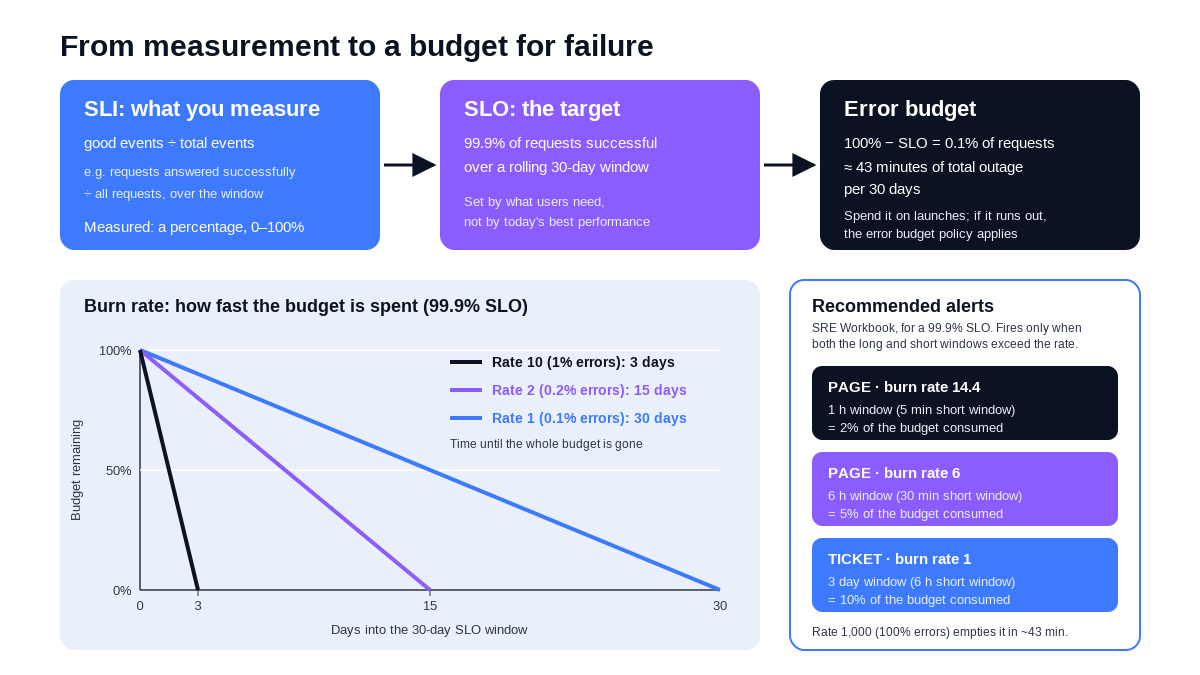
The Workbook's formula is simple: "the error budget is 100% minus the SLO" [6]. Its worked example: a service with a 99.9% success SLO that received 3 million requests over the period "had a budget of 3,000 (0.1%) errors" [6].
The SRE book describes the process [2]:
- Product management defines an SLO.
- Monitoring measures actual performance.
- The difference is the remaining budget.
- As long as budget remains, new releases can ship.
The benefit, in the book's words, is "a common incentive that allows both product development and SRE to focus on finding the right balance between innovation and reliability" [2]. Developers can spend budget on risky launches; if they burn it, they slow down. Nobody needs to argue from instinct.
Error budget policies
A budget only works if exhaustion has consequences agreed in advance. The Workbook recommends a written policy that specifies what happens when the budget is spent and who acts. Common actions include prioritizing reliability bugs, pausing feature work until the service is back within SLO, and freezing production changes. The policy should list authors, approvers, review dates and an escalation path for disagreements [6].
Burn rate: alerting on what users feel
If your SLO is the definition of "working," your alerts should fire when you are at risk of missing it. The Workbook defines burn rate as "how fast, relative to the SLO, the service consumes the error budget" [7].
A burn rate of 1 means you'd use exactly the whole budget over the SLO window. For a 99.9% SLO over 30 days, the Workbook gives these figures [7]:
Burn rate | Error rate | Budget exhausted in |
|---|---|---|
1 | 0.1% | 30 days |
2 | 0.2% | 15 days |
10 | 1% | 3 days |
1,000 | 100% | 43 minutes |
The last row is a useful gut check: a 99.9% monthly SLO tolerates roughly 43 minutes of complete outage.
The Workbook's recommended starting point for a 99.9% SLO is a multiwindow, multi-burn-rate alert [7]:
Severity | Long window | Short window | Burn rate | Budget consumed |
|---|---|---|---|---|
Page | 1 hour | 5 minutes | 14.4 | 2% |
Page | 6 hours | 30 minutes | 6 | 5% |
Ticket | 3 days | 6 hours | 1 | 10% |
An alert fires only when both the long and short windows exceed the threshold. The long window prevents paging on brief blips; the short window lets the alert clear soon after the problem stops [7]. Fast burns wake someone up; slow burns become tickets.
Toil and the 50% cap
SRE's second pillar is protecting engineering time. The SRE book defines toil as work tied to running a production service that tends to be manual, repetitive, automatable, tactical, without enduring value, and that grows linearly ("O(n)") as the service grows [4].
Google caps operational work, meaning tickets, on-call and manual tasks, at 50% of SRE time in aggregate. The rest goes to engineering that reduces future toil or improves the service [1][4]. When operational load exceeds the cap, the SRE book says the excess is redirected to the product development teams [1]. That redirection is the enforcement mechanism: if a service is painful to run, its developers feel the pain.
Blameless postmortems
When things break, SRE writes it down. The SRE book defines a postmortem as "a written record of an incident, its impact, the actions taken to mitigate or resolve it," plus root causes and follow-up actions [5]. Blameless means focusing on contributing causes "without indicting any individual or team for bad or inappropriate behavior" [5].
Teams should agree on triggers ahead of time. The book's examples include user-visible downtime beyond a threshold, any data loss, on-call intervention such as a rollback, resolution time above a limit, and monitoring failures where a human discovered the problem [5].
What SREs are responsible for
The SRE book lists the scope: availability, latency, performance, efficiency, change management, monitoring, emergency response and capacity planning [1]. Day to day, that means on-call rotations, building automation and tooling, reviewing designs for reliability, running capacity forecasts and owning the SLO and alerting configuration.
SRE vs DevOps
The Workbook's own shorthand is a programming joke: "class SRE implements interface DevOps" [8]. DevOps is a broad philosophy about breaking down silos between development and operations. SRE is a concrete role with specific practices, such as SLOs and error budgets, that implement many DevOps ideas [8]. The two share principles: small, frequent changes, shared tooling, data-driven decisions and blameless postmortems [8]. Our explainer on DevOps vs platform engineering covers a related distinction.
DevOps | SRE | |
|---|---|---|
What it is | Culture and set of principles | Job role plus concrete practices |
Scope | Whole organization | Production services |
Reliability target | Not prescribed | Explicit SLOs and error budgets |
Operational work | Shared between dev and ops | Capped at 50%, rest is engineering |
Incidents | Learning culture | Blameless postmortems with defined triggers |
Benefits
- A shared language for risk. SLOs replace "is it stable enough?" debates with a number both sides agreed to [2].
- Faster safe change. Error budgets explicitly permit risk when there's room for it.
- Fewer, better alerts. Burn-rate alerting pages on user impact, not on every CPU spike [7].
- Sustainable operations. The toil cap keeps teams from drowning in manual work [4].
Limitations and risks
- Bad SLIs, bad decisions. An SLI that doesn't reflect user experience optimizes the wrong thing.
- Policies without teeth. An error budget with no agreed consequence is just a dashboard [6].
- Cargo-cult SRE. Renaming an operations team "SRE" without the 50% engineering time or the authority to push back on releases changes nothing.
- Staffing. SRE requires engineers who can code and operate systems. Smaller organizations often adopt the practices (SLOs, postmortems) before creating the role.
- Cost trade-offs. Higher targets cost more. Tie reliability goals to cloud cost optimization decisions rather than treating them separately.
How to start
- Pick one user-facing service and one or two journeys that matter most.
- Define SLIs as good/total ratios from data you already collect [6].
- Set a modest SLO based on what users need, not today's best performance [3].
- Write an error budget policy and get product and engineering leadership to sign it [6].
- Page on SLO burn, not on causes: add multiwindow burn-rate alerts [7].
- Start postmortems with clear triggers, and track their action items to completion [5].
- Measure toil and schedule time to automate the worst of it [4].
Outlook
SLOs and error budgets have become common vocabulary in reliability work. We expect more of the work to shift toward platform teams that offer SLO tooling as a service to product teams, though that is our expectation rather than a forecast from Google's books.
Frequently asked questions
What does a site reliability engineer do?
An SRE keeps production services reliable using engineering rather than manual effort. Responsibilities span availability, latency, performance, efficiency, change management, monitoring, emergency response and capacity planning [1]. In practice that means on-call, automation, SLO and alerting design, and postmortems.
What is the difference between an SLO and an SLA?
An SLO is an internal target measured by an SLI. An SLA is a contract with users that includes consequences, such as credits, for missing the target [3].
How is an error budget calculated?
Subtract the SLO from 100%. A 99.9% SLO leaves a 0.1% error budget. The Workbook's example: 3 million requests at 99.9% allows about 3,000 failed requests in the period [6].
What is a burn rate?
Burn rate is how fast a service is consuming its error budget relative to the SLO [7]. A burn rate of 1 uses the budget exactly over the SLO window; 10 uses it ten times faster. For a 99.9% SLO over 30 days, a burn rate of 10 exhausts the budget in 3 days [7].
What is toil in SRE?
Toil is manual, repetitive, automatable operational work that has no lasting value and grows as the service grows [4]. Google keeps operational work below 50% of SRE time so engineers can automate it away [4].
Is SRE the same as DevOps?
No, but they're closely related. Google's Workbook describes SRE as a concrete implementation of DevOps principles: "class SRE implements interface DevOps" [8]. DevOps is the broader cultural philosophy; SRE is a role with specific practices.
Sources
- Benjamin Treynor Sloss (ed. Betsy Beyer), "Introduction," Site Reliability Engineering, Google. https://sre.google/sre-book/introduction/
- "Embracing Risk," Site Reliability Engineering, Google. https://sre.google/sre-book/embracing-risk/
- Chris Jones, John Wilkes and Niall Murphy with Cody Smith (ed. Betsy Beyer), "Service Level Objectives," Site Reliability Engineering, Google. https://sre.google/sre-book/service-level-objectives/
- "Eliminating Toil," Site Reliability Engineering, Google. https://sre.google/sre-book/eliminating-toil/
- "Postmortem Culture: Learning from Failure," Site Reliability Engineering, Google. https://sre.google/sre-book/postmortem-culture/
- Steven Thurgood and David Ferguson with Alex Hidalgo and Betsy Beyer, "Implementing SLOs," The Site Reliability Workbook, Google. https://sre.google/workbook/implementing-slos/
- Steven Thurgood et al., "Alerting on SLOs," The Site Reliability Workbook, Google. https://sre.google/workbook/alerting-on-slos/
- Niall Richard Murphy et al., "How SRE Relates to DevOps," The Site Reliability Workbook, Google. https://sre.google/workbook/how-sre-relates/