Types of Artificial Intelligence Explained
Narrow vs general, reactive vs limited memory, rules vs machine learning, predictive vs generative: the main ways AI is classified and what each means.
There is no single official list of "types of AI." The phrase gets used for at least five different classifications: by capability (narrow AI, general AI, superintelligence), by functionality (reactive machines through self-aware AI), by technique (rule-based systems versus machine learning and deep learning), by what the system does (predictive, generative, agentic) and by the kind of data it handles (language, vision, speech, multimodal). Every AI product you can use today is narrow in the capability sense. Most are built with deep learning, and they differ mainly in what they output and which data they take in.
This guide sets out each classification, shows where real systems fit, and explains which labels actually help you judge a product. If you're starting from zero, read our complete guide to artificial intelligence first.
Why "types of AI" is confusing
The US National Institute of Standards and Technology (NIST) defines an AI system broadly, as "an engineered or machine-based system that can, for a given set of objectives, generate outputs such as predictions, recommendations, or decisions influencing real or virtual environments" [1]. That definition doesn't sort AI into types. It covers a chess engine, a spam filter and a chatbot equally.
So writers, researchers and vendors have built their own taxonomies. They answer different questions:
- How capable is it compared with a person? (capability)
- What kind of memory and world model does it have? (functionality)
- How was it built? (technique)
- What does it produce? (function or output)
- What data does it work on? (modality)
Mixing these up causes most of the confusion. "Generative AI" and "narrow AI" are not competing categories. A chatbot is both.
1. By capability: narrow, general and superintelligent
This is the most common classification, and the one with the most hype attached.
- Narrow AI (also called weak AI or artificial narrow intelligence) performs a defined task or set of tasks: translating text, recommending videos, detecting fraud.
- Artificial general intelligence (AGI) would match skilled humans across most cognitive tasks. OpenAI's charter, for example, defines AGI as "highly autonomous systems that outperform humans at most economically valuable work" [6].
- Superintelligence would go far beyond people. Philosopher Nick Bostrom's widely cited definition is "an intellect that is much smarter than the best human brains in practically every field, including scientific creativity, general wisdom and social skills" [5].
A useful refinement comes from Google DeepMind researchers, who argue that generality and performance should be measured separately [3]. Their "Levels of AGI" paper rates systems from Level 1 (Emerging) to Level 5 (Superhuman) along both a narrow and a general track. On that scheme, AlphaFold is a "Superhuman Narrow AI" because it predicts protein structures better than any human, while the authors rated frontier chatbots of September 2023 as only "Emerging AGI": general in scope, but at or somewhat above unskilled-human level on most tasks [3]. They list Competent AGI and everything above it as "not yet achieved" [3].
We compare the three capability tiers, and the competing predictions about them, in our explainer on narrow AI vs general AI vs superintelligence. For one view of the AGI timeline debate, see What Is AGI?
2. By functionality: the "four types" framework
Many articles list "the four types of AI": reactive machines, limited memory, theory of mind and self-aware AI. This scheme comes from a 2016 essay by Arend Hintze, then an assistant professor at Michigan State University [2]. It's one researcher's framework, not a technical standard, but it is widely repeated, so it's worth knowing what it actually says.
Type | What it means in Hintze's essay | His example | Exists today? |
|---|---|---|---|
Type I: Reactive machines | No memory; responds only to the current situation | IBM's Deep Blue chess computer, which "ignores everything before the present moment" | Yes |
Type II: Limited memory | Uses recent observations, but doesn't store them as lasting experience | Self-driving cars tracking the speed and direction of nearby vehicles | Yes |
Type III: Theory of mind | Models other agents' thoughts, emotions and intentions | None | Not in the sense he describes |
Type IV: Self-awareness | Forms representations of itself; has consciousness | None | No; he wrote that we are "probably far from" it |
Source: Hintze [2].
Two cautions. First, the framework predates large language models. A modern chatbot holds the current conversation in its context window and can, through added tools, store notes across sessions. That's richer than Hintze's Type II example, but it is still not the persistent, self-built experience he had in mind. Second, Types III and IV describe psychological properties (understanding minds, consciousness) that nobody yet knows how to measure in a machine. Treat any product marketed as "theory of mind AI" with caution.
3. By technique: rules, machine learning and deep learning
This classification describes how a system is built, and it's the most useful one for engineers.
Symbolic or rule-based AI. Developers write explicit rules and logic. This was the dominant approach for decades, sometimes called "good old-fashioned AI" (GOFAI). The Levels of AGI paper places GOFAI and simple rule-based systems such as the early-1970s program SHRDLU at its lowest AI level, "Emerging Narrow AI" [3]. Rule-based systems are transparent and predictable, but brittle when they meet cases their authors didn't anticipate.
Machine learning (ML). Instead of writing rules, developers train a model on examples. Stanford researchers summarize the shift this way: "rather than specifying how to solve a task, a learning algorithm would induce it based on data" [4].
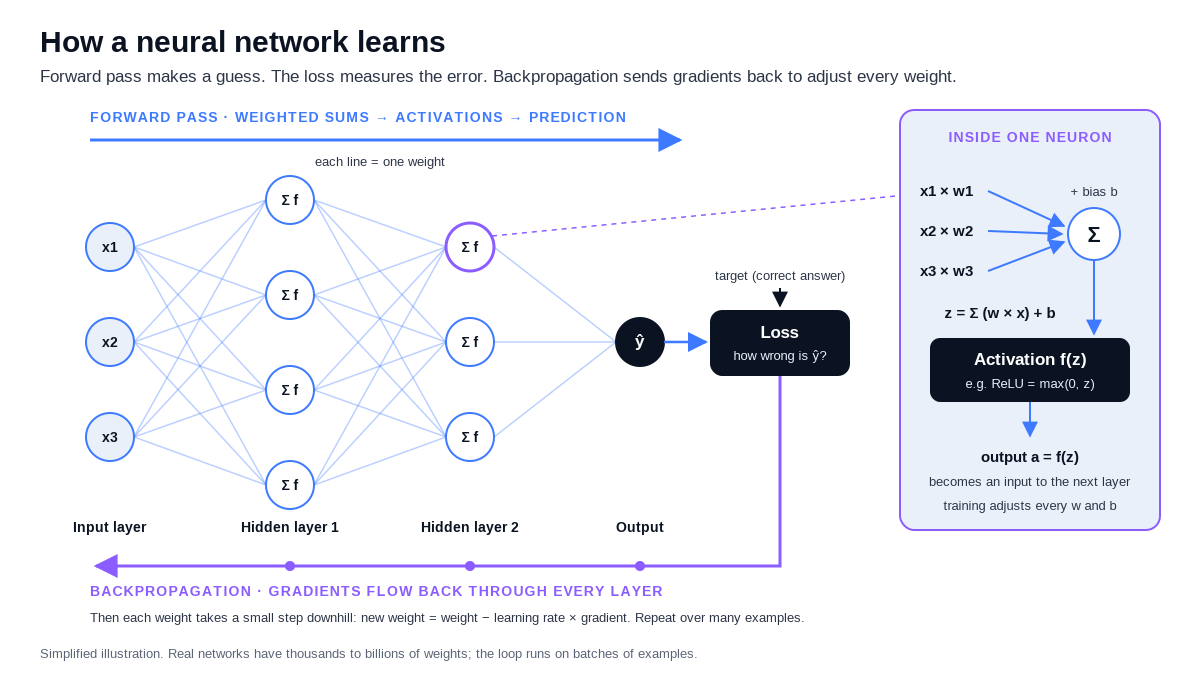
Deep learning. A subset of ML that uses neural networks with many layers. A key enabler was back-propagation, described in a 1986 Nature paper by David Rumelhart, Geoffrey Hinton and Ronald Williams as a procedure that "repeatedly adjusts the weights of the connections in the network" to shrink the gap between actual and desired output [8]. Our guide to neural networks explains how this works.
Foundation models. The newest layer: very large models trained on broad data and then adapted to many tasks. The Stanford team that coined the term frames AI's history as successive steps of "emergence and homogenization": ML made the method for a task emerge from data, deep learning made the features emerge, and foundation models let even capabilities such as in-context learning emerge, while one model is reused across many applications [4]. See What Are Foundation Models?
For how ML and deep learning nest inside AI, see Machine Learning vs Deep Learning vs AI.
4. By what the system does: predictive, generative, agentic
This is the most practical lens for buyers, because it maps to use cases.
- Predictive (or discriminative) AI scores, ranks or classifies: is this login suspicious, will this machine fail, which product will this customer click? Much of the AI in security tools is of this kind. Our report on AI in cybersecurity covers examples.
- Generative AI produces new content: text, code, images, audio or video. See Generative AI Explained for Beginners.
- Agentic AI takes actions toward a goal, choosing which tools or software to call and in what order. See What Is Agentic AI?
These categories overlap. An agent usually runs on a generative model, and a generative model can be asked to classify.
5. By data type: language, vision, speech and multimodal
AI research is also organized by the kind of input a system handles:
- Natural language processing (NLP): text and language. See What Is Natural Language Processing?
- Computer vision: images and video. See Computer Vision Explained
- Speech and audio: recognition, synthesis and translation.
- Multimodal AI: systems that combine two or more of these. See What Is Multimodal AI?
The boundaries are blurring. Foundation models increasingly handle text, images and audio in one network.
The five lenses side by side
Lens | Question it answers | Main categories | Most useful for |
|---|---|---|---|
Capability | How does it compare with human ability? | Narrow, general (AGI), superintelligence | Policy, long-term risk, reading claims about AGI |
Functionality | What memory and world model does it have? | Reactive, limited memory, theory of mind, self-aware | Teaching concepts; little use in procurement |
Technique | How was it built? | Rule-based, machine learning, deep learning, foundation models | Engineering, explainability, maintenance |
Function or output | What does it produce or do? | Predictive, generative, agentic | Matching tools to business problems |
Data type | What input does it handle? | Language, vision, speech, multimodal | Choosing models and data pipelines |
Where real systems fit
Running three familiar systems through every lens shows how the labels stack:
System | Capability | Functionality (Hintze) | Technique | Function | Data type |
|---|---|---|---|---|---|
Deep Blue (late-1990s chess computer) | Narrow; rated "Exceptional Narrow AI" in the Levels of AGI paper [3] | Reactive [2] | Search over possible moves [2] | Decision-making | Board positions |
Email spam filter | Narrow | Reactive (each message is judged on its own) | Often machine learning | Predictive | Text |
General-purpose chatbot | Narrow by most definitions; "Emerging AGI" in the Levels of AGI scheme as of 2023 [3] | Limited memory (context window), our classification | Deep learning foundation model | Generative, sometimes agentic | Text, often images and audio |
The chatbot row shows why one label is never enough. Calling it "narrow AI" is accurate under the classic definition, but misses how broad its abilities are. Calling it "AGI" stretches the term past what even the researchers who proposed the levels claim.
How to use these labels when judging a product
- Ignore the functionality hype. No shipping product has theory of mind or self-awareness in Hintze's sense [2]. A vendor claiming otherwise is selling a metaphor.
- Ask about technique. Rule-based, classic ML or a foundation model? The answer tells you about cost, explainability and how the system will fail. A rule engine fails predictably; a generative model can produce fluent errors (see What Are AI Hallucinations?).
- Ask about function. Do you need a score (predictive), content (generative) or actions (agentic)? Many problems need only the first, which is cheaper and easier to audit.
- Check the data type. A text model won't read your scanned invoices unless it's multimodal or paired with a vision model.
- Treat "general" claims as claims. Capabilities are uneven. Stanford's 2026 AI Index reports frontier models meeting or beating humans on PhD-level science questions and competition math, while robots succeed at only 12% of real household tasks and AI still struggles with multi-step planning and telling time [7].
The same questions apply when AI arrives bundled inside enterprise software, such as the AI features now built into virtual desktops.
Outlook
Expect the technique and data-type categories to keep merging: the trend is toward single large models that handle many kinds of input and are adapted to many tasks [4]. The capability labels will stay contested, because there is no agreed test for AGI. The Levels of AGI authors themselves describe benchmark design for general intelligence as an open challenge [3]. For practical decisions, the function lens (predictive, generative, agentic) will remain the most useful one.
Frequently asked questions
What are the four types of AI?
The "four types" usually means Arend Hintze's 2016 framework: reactive machines, limited memory, theory of mind and self-aware AI [2]. Only the first two exist. It's a teaching framework, not an industry standard, and it predates today's language models.
What are the three types of AI?
This usually refers to the capability tiers: narrow AI, artificial general intelligence (AGI) and superintelligence. All AI in use today is classed as narrow by the traditional definition. AGI and superintelligence are hypothetical, and experts disagree on whether and when they will arrive.
Is ChatGPT narrow AI or general AI?
By the classic definition it is narrow, because it doesn't match skilled humans across most cognitive tasks. Google DeepMind researchers proposed calling such chatbots "Emerging AGI" to reflect their breadth, while rating their performance as only at or somewhat above unskilled-human level on most tasks [3].
Is generative AI a type of AI?
Yes, in the "what does it do" sense. Generative AI produces new content, as opposed to predictive AI, which classifies or scores. Generative AI is still narrow in the capability sense.
Does self-aware AI exist?
No. Hintze, who popularized the category, wrote that researchers are "probably far from creating machines that are self-aware" [2]. Chatbots can talk about themselves fluently, but that is learned language behavior, not evidence of consciousness.
Sources
- National Institute of Standards and Technology. "Artificial Intelligence Risk Management Framework (AI RMF 1.0), NIST AI 100-1." https://nvlpubs.nist.gov/nistpubs/ai/NIST.AI.100-1.pdf
- Hintze, A. "Understanding the four types of AI, from reactive robots to self-aware beings." The Conversation, November 13, 2016. https://theconversation.com/understanding-the-four-types-of-ai-from-reactive-robots-to-self-aware-beings-67616
- Morris, M. R., et al. "Levels of AGI for Operationalizing Progress on the Path to AGI." arXiv 2311.02462. https://arxiv.org/abs/2311.02462
- Bommasani, R., et al. "On the Opportunities and Risks of Foundation Models." arXiv 2108.07258. https://arxiv.org/abs/2108.07258
- Bostrom, N. "How Long Before Superintelligence?" https://nickbostrom.com/superintelligence
- OpenAI. "OpenAI Charter." https://openai.com/charter/
- Stanford HAI. "Inside the AI Index: 12 Takeaways from the 2026 Report." April 13, 2026. https://hai.stanford.edu/news/inside-the-ai-index-12-takeaways-from-the-2026-report
- Rumelhart, D. E., Hinton, G. E., and Williams, R. J. "Learning representations by back-propagating errors." Nature 323, 533 (1986). https://www.nature.com/articles/323533a0