
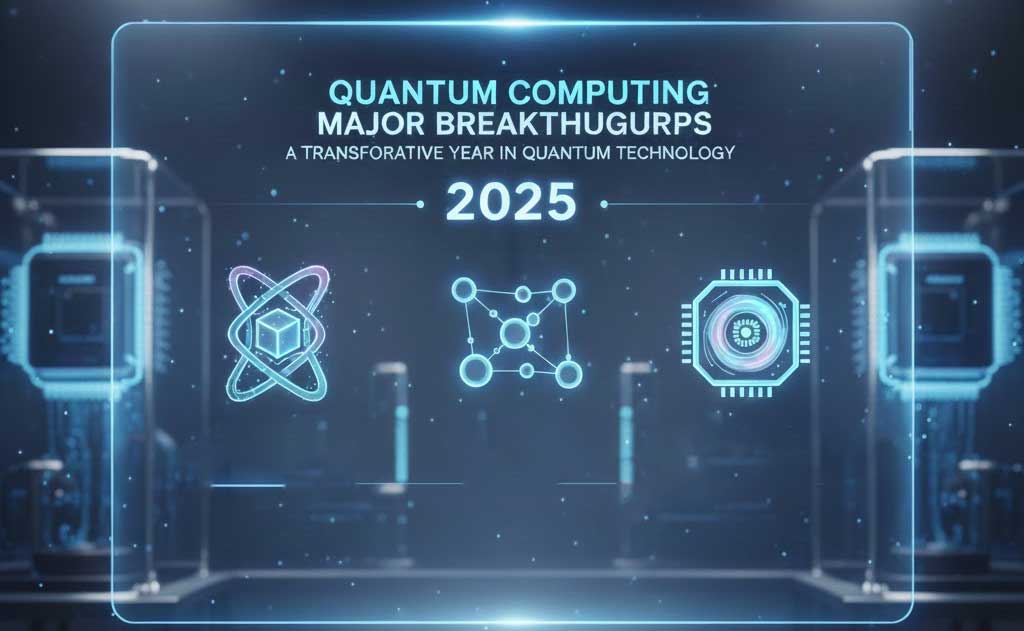
Introduction to Quantum Computing Breakthroughs in 2025
2025 has been hailed as a pivotal year for quantum computing, coinciding with the United Nations’ declaration of the International Year of Quantum Science and Technology. This designation marks the 100th anniversary of foundational quantum mechanics discoveries and has spotlighted remarkable advancements in the field. Quantum computing, which harnesses principles like superposition and entanglement to perform calculations exponentially faster than classical computers for certain problems, saw unprecedented progress in hardware, error correction, and practical applications.
Major players including Google, IBM, IonQ, Quantinuum, and Microsoft pushed boundaries, shifting quantum technology from theoretical promise to tangible utility. Investments surged, with billions poured into the sector, and demonstrations of quantum advantage—where quantum systems outperform classical supercomputers on meaningful tasks—became more frequent. This article explores the major quantum computing breakthroughs of 2025, their implications, and future potential, optimized for readers searching for the latest in quantum advancements.
Key highlights include Google’s verifiable quantum advantage, IBM’s path to fault-tolerant systems, record qubit fidelities, and emerging real-world applications in drug discovery, materials science, and cryptography.
Google’s Willow Chip and Quantum Echoes Algorithm: Achieving Verifiable Quantum Advantage
One of the standout quantum computing breakthroughs in 2025 came from Google Quantum AI with the Willow chip and the groundbreaking Quantum Echoes algorithm.
The Willow processor, featuring 105 superconducting qubits, demonstrated exponential error reduction as qubit counts increased—a critical “below threshold” milestone for scalable quantum error correction. This addressed a decades-old challenge, where adding qubits typically amplified errors.
Building on this, Google’s Quantum Echoes algorithm achieved a 13,000x speedup over the world’s fastest classical supercomputers in simulating physics problems, such as out-of-order time correlators. Published in Nature, this marked the first verifiable quantum advantage on a scientifically meaningful task, producing data relevant to molecular geometry and nuclear magnetic resonance (NMR) spectroscopy.
This breakthrough paves the way for applications in drug design and fusion energy, bringing quantum computing closer to solving real-world problems in chemistry and materials science. Google’s progress reinforces superconducting qubits as a leading approach, with implications for accelerating discoveries previously impossible on classical systems.
IBM’s Nighthawk, Loon, and Roadmap to Fault-Tolerant Quantum Computing
IBM made significant strides in 2025, unveiling processors and software advancements aimed at quantum advantage by 2026 and fault-tolerant computing by 2029.
The IBM Quantum Nighthawk processor, set for delivery by year-end, is designed for high-performance quantum software to demonstrate quantum advantage—solving problems better than classical methods alone.
Meanwhile, the experimental IBM Quantum Loon processor showcased all key components for fault-tolerant quantum computing, including advanced routing layers for long-distance qubit connections and qubit reset technologies.
IBM also achieved a 10x speedup in quantum error correction decoding, completed ahead of schedule, and shifted to 300mm wafer fabrication for faster development. These innovations position IBM to build large-scale, error-corrected systems, with partnerships like RIKEN demonstrating utility-scale molecular simulations.
IBM’s detailed roadmap, including hybrid quantum-classical integration, underscores its leadership in making quantum computing practical for industries like finance and pharmaceuticals.
IonQ and Quantinuum: High-Fidelity Qubits and Logical Entanglement
Trapped-ion quantum computing saw major gains in 2025 from IonQ and Quantinuum.
IonQ achieved a world-record 99.99% two-qubit gate fidelity and demonstrated practical quantum advantage in a medical device simulation with Ansys, outperforming classical high-performance computing by 12%. IonQ’s acquisitions, including Oxford Ionics, bolstered its path to fault-tolerant systems with millions of qubits.
Quantinuum, leveraging Honeywell’s heritage, entangled high-fidelity logical qubits and introduced certified quantum random number generation—a paid commercial application surpassing classical unpredictability.
Collaborations, such as Microsoft with Quantinuum creating 12-24 logical qubits, highlighted trapped ions’ superior fidelity and connectivity. These advancements make trapped-ion systems ideal for near-term applications in optimization and security.
Error Correction Milestones: The Key to Scalable Quantum Computing
Quantum error correction dominated 2025 breakthroughs, transforming noisy intermediate-scale quantum (NISQ) devices into reliable systems.
Google’s Willow went “below threshold,” exponentially suppressing errors with more qubits. IBM’s Loon validated fault-tolerant architectures, while Microsoft advanced topological qubits and logical entanglement with partners.
Other notables include QuEra’s algorithmic fault tolerance reducing overhead by 100x, and global efforts like China’s microwave-controlled error correction. Record coherence times and low error rates (e.g., 0.000015% per operation) brought fault-tolerant quantum computing timelines forward.
These developments mean scalable quantum computers are no longer just a physics problem but an engineering one, accelerating progress toward utility.
Other Notable Quantum Advancements in 2025
- MIT’s Fluxonium Qubit: Achieved 99.998% single-qubit fidelity, a world record boosting superconducting reliability.
- Room-Temperature Quantum Communication: Stanford’s device entangled photons and electrons without supercooling, advancing quantum networks.
- Quantum Randomness Commercialization: Quantinuum’s certified random numbers marked the first revenue-generating quantum superiority.
- Global Efforts: India’s QpiAI-Indus 25-qubit system; Fujitsu/RIKEN’s 256-qubit machine; and D-Wave’s practical annealing supremacy.
- Nobel Recognition: 2025 Physics Nobel for macroscopic quantum effects in superconducting circuits, validating foundational tech.
Investments tripled, with the market reaching $3.5 billion, driven by government and corporate confidence.
Applications and Impact of 2025 Quantum Breakthroughs
2025’s advancements translated into real-world impact:
- Drug Discovery and Chemistry: Quantum simulations of molecular interactions promise faster drug design.
- Materials Science: Better modeling of superconductors and batteries.
- Finance and Optimization: Improved portfolio management and logistics.
- Cryptography: Push for post-quantum standards amid Q-Day concerns.
- AI Integration: Quantum-enhanced machine learning, including fine-tuning billion-parameter models.
Hybrid quantum-classical systems emerged, with cloud access democratizing the technology.
Challenges Remaining in Quantum Computing
Despite progress, challenges persist: scaling to millions of qubits, reducing costs, and developing more algorithms. Noise, decoherence, and energy demands require ongoing innovation.
However, 2025’s momentum suggests these hurdles are surmountable within the decade.
The Future of Quantum Computing Post-2025
Experts predict room-temperature qubits, widespread quantum networks, and commercial fault-tolerant systems by 2030. Trends include hybrid architectures, quantum-AI convergence, and global collaboration.
2025 has proven quantum computing is transitioning from hype to reality, with breakthroughs setting the stage for transformative technologies.
Conclusion: Why 2025 Was the Year Quantum Computing Matured
The major quantum computing breakthroughs of 2025—from Google’s verifiable advantage to IBM’s fault-tolerant roadmap and record fidelities—mark an inflection point. Quantum technology is poised to revolutionize industries, solving intractable problems in science and society.
I’m Ethan, and I write about the tech that’s actually going to change how we live — not the stuff that just sounds impressive in a press release. I cover AI, EVs, robotics, and future tech for VFuture Media. I was on the ground at CES 2026 in Las Vegas, walking the show floor so I could give you a real read on what matters and what’s just noise. Follow me on X for daily takes.
For vfuturemedia readers, staying informed on these developments is crucial as quantum edges toward everyday impact. The quantum era is here—embrace it.

Leave a Comment