
By Ethan Brooks Tech & AI Analyst at VFutureMedia.com Published: February 5, 2026
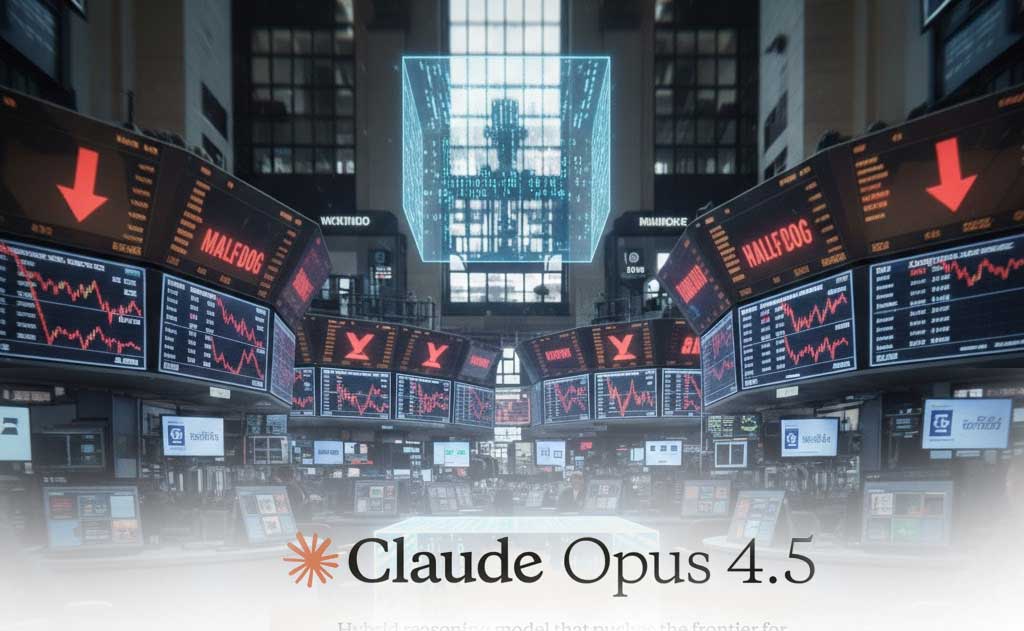
In late 2025, Anthropic unveiled Claude Opus 4.5, its most advanced AI model to date. Touted as the world’s leading performer in coding, AI agents, and computer-use tasks, this release has sent shockwaves far beyond developer communities. By early 2026, the model’s capabilities—paired with tools like Claude Code and Cowork—are fueling a dramatic stock plunge in data analytics, professional services, and SaaS sectors. Investors are bracing for widespread disruption as AI agents automate complex workflows once handled by human experts and specialized software.
What Makes Claude Opus 4.5 a Coding Powerhouse?
Released on November 24, 2025, Claude Opus 4.5 builds on Anthropic’s Opus family with frontier-level intelligence at a dramatically lower cost. Priced at $5 per million input tokens and $25 per million output tokens (a sharp reduction from prior Opus models), it democratizes access to top-tier performance.
Key highlights include:
- State-of-the-art coding benchmarks: It achieved record scores on real-world software engineering tests, including 80.9% on SWE-Bench Verified—surpassing competitors like Google’s Gemini 3 and OpenAI’s offerings. In Anthropic’s internal engineering challenges, it outperformed human candidates in speed and accuracy.
- Agentic excellence: The model excels at autonomous, long-running tasks. It supports extended thinking modes (with an “effort” parameter for controlling reasoning depth), tool use, and multi-step planning—enabling AI agents to handle hours-long workflows with fewer errors.
- Practical enterprise boosts: Significant gains in spreadsheet automation, financial modeling (20% accuracy improvement in internal evals), slide creation, deep research, and vision tasks make it ideal for office and analytical work.
- Alignment and safety: Anthropic emphasizes its robust safeguards, low hallucination rates, and Responsible Scaling Policy compliance (deployed at AI Safety Level 3).
These features power products like Claude Code (a terminal-based coding environment where Opus 4.5 drives much of its own development) and Cowork (a desktop agent interface for non-technical users). Developers report building full applications from natural language prompts, while enterprises automate data pipelines and legal/marketing tasks.
The 2026 Stock Plunge: AI Agents Disrupt Data Analytics and Professional Services
By February 2026, the market fallout is clear. Global software, data analytics, and professional services stocks have shed hundreds of billions in value, with selloffs intensifying after Anthropic’s updates to Claude Cowork (including plug-ins for legal, sales, marketing, and data analysis automation).
Analysts and traders point to Claude Opus 4.5 as a catalyst:
- Automation threat: AI agents now handle multi-hour autonomous work—analyzing datasets, generating reports, and executing code—tasks traditionally outsourced to firms in data analytics (e.g., RELX, Wolters Kluwer) and professional services.
- SaaS vulnerability: Subscription-based tools face pricing pressure as free or low-cost AI alternatives emerge. Companies once seen as AI beneficiaries are now at risk of disintermediation.
- Market reaction: European and U.S. stocks in these sectors plunged, with some names dropping sharply in early February sessions. Investors fear AI’s shift into the “application layer” erodes moats in enterprise software.
This isn’t hype—it’s a preview of structural change. As agents like those powered by Opus 4.5 mature, routine analytical and service work could vanish, forcing firms to pivot or consolidate.
Why This Matters for Businesses and Developers
For developers, Claude Opus 4.5 redefines productivity. It integrates seamlessly via API (model ID: claude-opus-4.5-20251101), available on major clouds like AWS Bedrock, Google Vertex AI, and Anthropic’s platform. Teams report 50-80% faster coding cycles, with agents handling complex, multi-file projects.
For enterprises, the implications are double-edged:
- Opportunity: Adopt these tools to cut costs and accelerate innovation in coding, data analysis, and automation.
- Risk: Ignore the shift, and competitors using agentic AI could outpace you.
Anthropic’s focus on safety and alignment positions Claude as a reliable choice for high-stakes deployments, from fintech to healthcare.
Looking Ahead: The Agentic Future
Claude Opus 4.5 isn’t just an incremental upgrade—it’s evidence that AI is moving from assistant to autonomous coworker. As 2026 unfolds, expect more releases (rumors of Claude 5 loom) and deeper integration into workflows.
Wall Street’s reaction underscores a harsh reality: the AI revolution is no longer theoretical. It’s here, reshaping industries and valuations overnight.
Stay ahead of the curve—explore Claude Opus 4.5 today at claude.ai or via the Anthropic API. The future of work is agentic, and it’s arriving faster than many expected.
Ethan Brooks covers the tech that’s reshaping how we move, work, and think — for VFuture Media. He was at CES 2026 in Las Vegas when the world got its first real look at humanoid robots, AI-powered vehicles, and Samsung’s tri-fold phone. He writes about AI, EVs, gadgets, and green tech every week. No hype. No filler. X · Facebook
We started VFuture Media because we wanted tech news written by people who actually follow this industry — not content farms chasing keywords. If that resonates, we’d love to have you as a regular reader. Pull up a chair.




Leave a Comment