
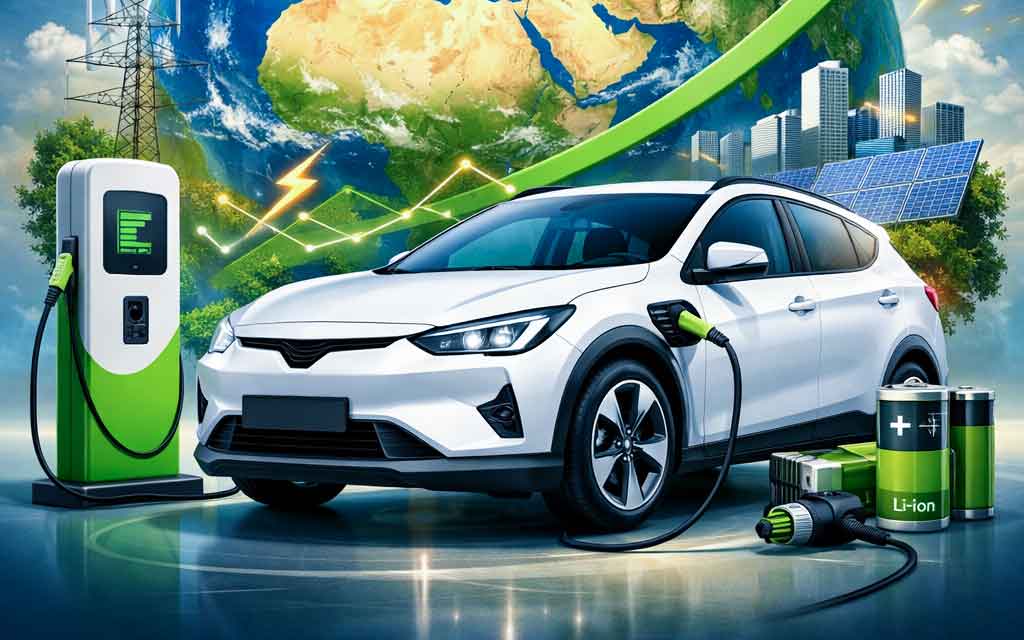
February 2026 Global EV Sales: Country-Wise Breakdown, Trends & Market Outlook
February 2026 Global EV Sales: Country-Wise Breakdown, Trends & Market OutlookAs February 2026 concludes, the global electric vehicle (EV) market—covering battery electric vehicles (BEVs) and plug-in hybrid electric vehicles (PHEVs)—continues to navigate a transitional phase. Early 2026 data, primarily from January reports by Benchmark Mineral Intelligence (BMI), Rho Motion, and other trackers, shows a global slowdown persisting into the first quarter. Full February monthly breakdowns are emerging gradually, but trends indicate stabilization or slight recovery from January’s dip, with no major reversal of the year-to-date pattern.
Globally, January 2026 saw approximately 1.2 million EV units sold, down 3% year-over-year (YoY) from January 2025 and sharply down 44% month-over-month from December 2025’s peak. This reflects a high base effect from 2025’s strong finish, combined with policy adjustments in key markets. February likely followed a similar trajectory, with seasonal factors (post-Lunar New Year in Asia, Presidents’ Day promotions in the US) providing some lift, but overall YoY growth remaining flat or modestly negative in mature regions. Emerging markets continue to offset declines, driving diversification in global demand.
This in-depth analysis breaks down performance by major countries and regions, drawing from reliable industry sources like BMI, Rho Motion, J.D. Power/GlobalData forecasts, and national data. It examines sales volumes, YoY changes, market shares, policy drivers, consumer behaviors, infrastructure developments, and implications for 2026. The focus is on providing balanced, evidence-based insights for stakeholders worldwide.
Global Overview
Estimated global EV sales for February 2026 hover around 1.25–1.3 million units (based on sequential improvement from January and seasonal patterns), maintaining a global market share of 22–25% of new light-vehicle sales. Key dynamics include:
- Mature markets (China, US, Europe) facing headwinds from subsidy reductions, high bases, and economic pressures.
- Emerging markets (Rest of World or RoW) surging, often doubling or tripling volumes due to incentives, Chinese exports, and affordability.
- BEVs vs. PHEVs: BEVs comprise ~70% of sales, but PHEVs gain traction in regions with charging limitations.
- 2026 Full-Year Projections: 23–28 million units (10–20% growth from 2025’s ~20–23 million), with shares rising to 25–28%.
China: Dominant but Cooling
China, accounting for ~50% of global EV sales, saw January volumes at ~600,000 units (down 20% YoY and 55% MoM). February trends likely showed partial recovery post-Lunar New Year, but remained subdued due to a high 2025 base and policy tweaks.
- Key Figures: ~600,000–650,000 units estimated for February; market share ~40%.
- Drivers: Introduction of purchase taxes and reduced subsidies for 2026 eroded momentum. Domestic leaders like BYD (strong in PHEVs) and Tesla maintained volume, but overall demand softened in urban centers.
- Consumer Insights: High satisfaction in cities with robust charging; rural adoption slower due to infrastructure gaps.
- Outlook: Growth may rebound to 10–21% for the year, supported by exports (China shipped heavily to Europe and RoW) and innovations like advanced batteries. Challenges include oversupply and price competition.
United States: Ongoing Incentive-Driven Slump
The US market remained weak, with January sales ~85,000–90,000 units (down 33% YoY). February projections (J.D. Power/GlobalData) align with retail EV share at 6.6% (down from prior years), amid total new-vehicle sales ~1.18 million.
- Key Figures: ~80,000–100,000 units; share 6–7%.
- Drivers: Federal $7,500 tax credit expiration in Q3 2025 inflated prices; high interest rates and affordability issues hit demand.
- Regional Variations: California sustains higher penetration (~25%); Midwest and South lag.
- Outlook: Potential flat or declining 2026 volumes (~20–30% drop possible without renewed support). Used EV influx from expiring leases offers deals; hybrids bridge the gap.
Europe: Bright Spot with Resilient Growth
Europe (EU + UK + EFTA) bucked the trend, with January sales >320,000 units (up 24% YoY). February likely continued this momentum, supported by CO2 targets and Chinese imports.
- Key Figures: ~330,000–380,000 units; share 18–20%.
- Country Highlights:
- Germany: ~90,000–110,000 units; strong subsidies and VW Group dominance.
- France: PHEV surge; ~50,000–70,000 units.
- UK: ZEV Mandate drives ~35,000–45,000 units.
- Norway: Sharp drop (VAT changes); still high share but lower absolute volume.
- Drivers: Stricter emissions rules and BYD’s rapid rise (+150%+ in some months).
- Outlook: Steady 14–15% growth projected; potential tariffs on Chinese EVs pose risks.
India: Strong Momentum in Emerging Asia
India’s passenger EV sales grew robustly, with January at 18,042 units (up 51% YoY). February likely sustained this, aided by tax reductions from late 2025.
- Key Figures: ~20,000–25,000 passenger EVs; overall share 2–3% (two-wheelers dominate).
- Drivers: FAME-III subsidies, state incentives (e.g., Telangana road tax waivers), and affordable models from Tata.
- Challenges: Charging infrastructure needs expansion; urban focus in cities like Hyderabad.
- Outlook: Potential 1–1.5 million units in 2026; exports and local manufacturing rising.
Brazil: Latin America’s Rising Star
Brazil saw strong gains, contributing to RoW surge (January up significantly).
- Key Figures: ~25,000–35,000 units; share ~10%.
- Drivers: Import tax cuts, Chinese brands (BYD, Great Wall) dominating; urban demand in São Paulo.
- Outlook: Continued acceleration with localization efforts.
Thailand: Record-Breaking Surge in ASEAN
Thailand achieved a record in January with >44,000 units (more than tripled YoY). February likely maintained high levels.
- Key Figures: ~40,000–50,000 units; share 15–20%.
- Drivers: EV 3.0 incentives (subsidies, duty exemptions); Chinese factory investments.
- Outlook: Strong but potential moderation as subsidies phase out by late 2026.
Other Notable Markets
- South Korea: Significant RoW contributor; strong growth with Hyundai/Kia.
- Vietnam: High share (~40% in 2025 trends continuing); ASEAN leader.
- Indonesia: 15%+ share; overtaking some mature markets.
- Japan: Lagging (~5% share); hybrid preference slows BEV shift.
- Australia: Policy-driven uptick (~10% share).
Broader Trends and 2026 Implications
The February 2026 landscape highlights divergence: mature markets adjust to post-incentive realities, while emerging regions leapfrog via affordability and exports. Chinese dominance persists, but global diversification reduces risks. Challenges include battery supply volatility and grid readiness; opportunities lie in hybrids, infrastructure investment, and policy alignment.
For consumers in places like Hyderabad, local incentives and improving charging make 2026 a promising entry point despite global headwinds.
The future doesn’t wait — and neither should your feed. If this got you thinking, there’s plenty more where that came from. Browse our latest at VFutureMedia and stick around.
About the Author: Ethan Brooks is a seasoned automotive and sustainability journalist with over 15 years covering global EV markets. His analyses, informed by data from BMI, Rho Motion, IEA, and others, provide trustworthy insights for international audiences. Based on extensive tracking of policy and consumer trends, Ethan delivers balanced perspectives on electrification’s worldwide evolution.


Leave a Comment