
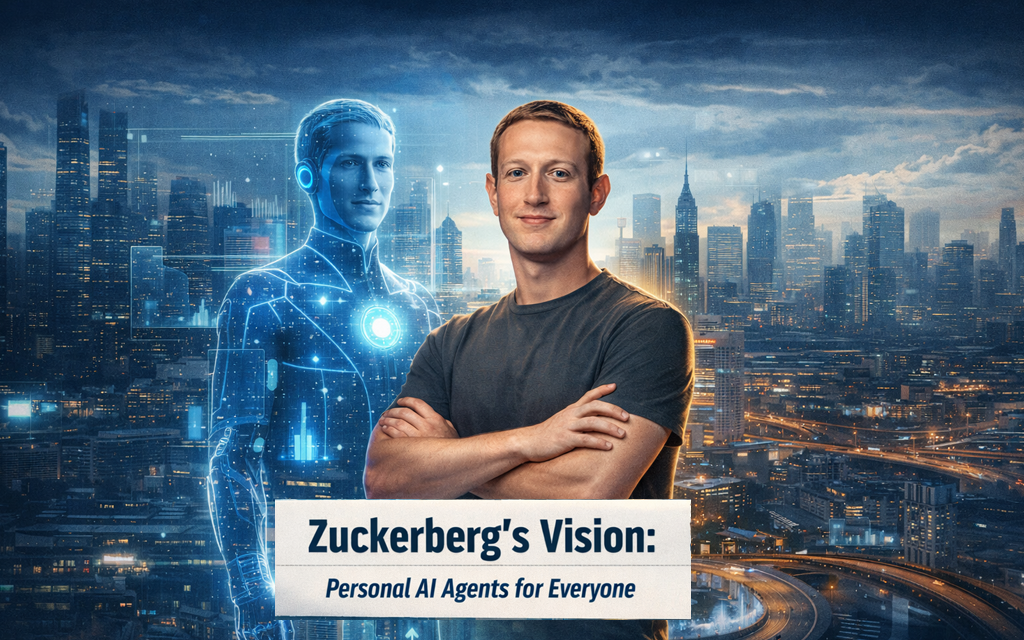
In a significant development that highlights the accelerating adoption of AI at the executive level, Mark Zuckerberg is building a CEO AI agent designed to help him perform his job better. According to a Wall Street Journal report published on March 23, 2026, the Meta founder and CEO is personally testing an advanced AI assistant that provides instant access to information across the company.
This isn’t a simple chatbot. It’s a sophisticated personal AI agent built specifically for high-level strategic leadership — giving Zuckerberg the ability to bypass traditional organizational layers and get real-time insights on demand.
As VFuture Media continues to track breakthroughs in AI and future technologies, this move by one of the world’s most influential tech leaders marks a clear turning point in how top executives will operate in the AI era.
What Is Mark Zuckerberg’s CEO AI Agent?
The Zuckerberg CEO AI agent (currently in early internal testing) functions as an executive-level intelligence system. Instead of waiting days or weeks for reports from multiple departments, Zuckerberg can simply ask the agent for answers drawn directly from Meta’s internal systems, documents, and data.
Reported capabilities include:
- Instant retrieval of complex information that normally requires multiple levels of management
- Rapid summarization of large data sets for faster decision-making
- Enhanced strategic oversight in a company employing nearly 78,000 people
This project aligns directly with Meta’s aggressive push into agentic AI — systems that don’t just respond to queries but actively assist in executing tasks and workflows.
Zuckerberg has repeatedly stated his belief that every individual — both inside Meta and among its billions of users — should eventually have their own personal AI agent, moving society toward what he calls “personal superintelligence.”
Meta’s Growing AI Agent Ecosystem
Zuckerberg’s personal CEO AI agent is part of a larger internal transformation at Meta:
- My Claw: An internal agent capable of accessing chats, files, and collaborating with other employees’ agents
- Second Brain: Powered by Claude, this tool indexes company-wide documents and serves as an AI-powered knowledge repository
- Strategic acquisitions such as Manus (general-purpose AI agents) and Moltbook (AI agent social network) to accelerate development
In recent earnings calls, Zuckerberg declared 2026 as the year AI will fundamentally change how work gets done at Meta. The company is actively flattening hierarchies, empowering individual contributors, and integrating AI deeply into performance evaluations and daily operations.
Why This Matters: The Dawn of AI-Powered Executive Leadership
The implications of a Mark Zuckerberg CEO AI agent extend far beyond Meta:
1. Flattening Corporate Hierarchies AI agents can surface critical insights instantly, dramatically reducing the need for层层 meetings and middle-management bottlenecks.
2. Massive Productivity Gains Early internal testing at Meta shows employees are already working faster and more effectively with agentic tools — a model expected to spread rapidly across global enterprises.
3. The Future of the “AI CEO” While Zuckerberg’s agent currently assists him, the conversation around AI eventually running companies is heating up. Will human CEOs be augmented, replaced, or transformed into visionaries supported by superintelligent systems?
Key Benefits for Leaders Using AI Agents:
- 24/7 access to company-wide knowledge without delays
- More accurate, data-driven strategic decisions
- Ability to scale leadership effectively in massive organizations
- More time for high-level vision and innovation while AI handles operational oversight
The Explosive Growth of the AI Agents Market
The global market for AI agents is projected to grow at a compound annual growth rate (CAGR) of 40–50% through 2030. Meta’s heavy investments in infrastructure, custom silicon, and agent technology position it as a frontrunner in turning AI hype into real business impact.
This development also reflects Meta’s post-layoff efficiency strategy: using AI to eliminate repetitive work while amplifying the impact of remaining talent.
Challenges Ahead
Deploying AI at the CEO level naturally raises important questions:
- How do companies ensure data security and privacy with powerful internal agents?
- Who bears responsibility when an AI agent influences major business decisions?
- How will this technology reshape executive roles and broader employment landscapes?
Meta is approaching these challenges through controlled internal testing and a strong emphasis on AI systems that augment — rather than replace — human judgment.
Zuckerberg’s Vision: Personal AI Agents for Everyone
Zuckerberg doesn’t want this technology limited to the C-suite. His long-term goal is to give every Meta employee and every user their own personal AI agent — essentially putting the same powerful capabilities he’s building for himself into the hands of billions.
This vision points toward a future where:
- Personal agents negotiate on your behalf
- AI collaborators work across organizations in real time
- “Superintelligence” companions deeply understand and advance your goals
What This Means for the Future of Work and Innovation
At VFuture Media, we focus on technologies that are actively shaping tomorrow — and Mark Zuckerberg’s CEO AI agent is a prime example of leadership embracing AI to drive unprecedented efficiency and innovation.
This development is likely to spark a wave of similar initiatives across industries, with tech giants, startups, and traditional corporations racing to build specialized AI agents for executive roles.
The clear message: AI is not here to take jobs — it’s here to dramatically enhance human capability at every level.
Final Thoughts
Mark Zuckerberg building a CEO AI agent is more than just interesting tech news — it’s a glimpse into the future of leadership itself. As Meta continues to flatten teams and empower individuals with personal AI tools, the broader business world is paying close attention.
Will other CEOs quickly follow? How soon will AI agents evolve from helpful assistants to true strategic co-pilots?
One thing is certain: 2026 is set to be the breakout year when AI transitions from a productivity tool to a core part of executive decision-making.
Ready to stay ahead of the AI revolution?
Subscribe to VFuture Media for the latest insights on AI, future tech, robotics, and emerging innovations. Share your thoughts in the comments: Would you trust an AI agent to help run a multi-trillion-dollar company?
Sources: Wall Street Journal (March 23, 2026), Meta earnings calls, and industry analysis.
Tags: Mark Zuckerberg AI Agent, Meta AI, CEO AI Agent, AI Agents 2026, Future of Work, Personal AI Agents, Artificial Intelligence, Tech Leadership, Agentic AI


Leave a Comment