
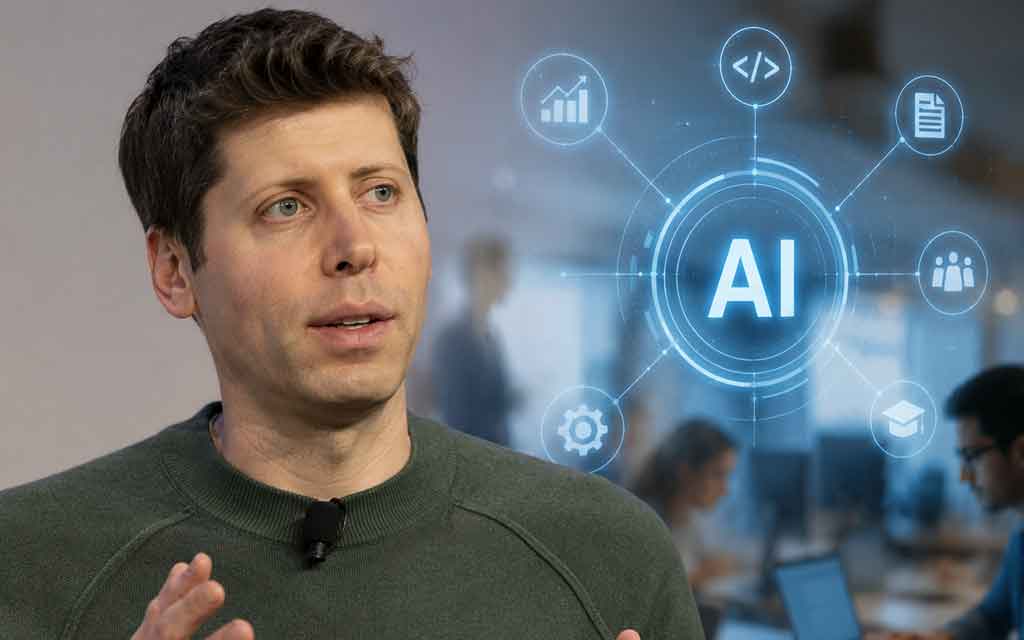
In a surprising reversal, OpenAI CEO Sam Altman has walked back his earlier warnings about AI causing mass unemployment. Speaking at the Commonwealth Bank of Australia’s Accelerate AI Conference on May 26, 2026, Altman stated that AI is unlikely to lead to the “jobs apocalypse” many feared — including himself.
“I don’t think we’re going to have the kind of jobs apocalypse that some of the companies in our space advocate or talk about,” Altman said. He admitted being “delighted to be wrong” about the rapid elimination of entry-level white-collar jobs.
From Alarm to Optimism: Altman’s Shifting Views on AI and Jobs
Sam Altman has long been one of the most vocal figures warning about AI’s disruptive potential. In previous statements, he suggested AI could replace most jobs people do today and wipe out entire job categories.
Yet, in his latest remarks from Sydney, Altman acknowledged that the impact on white-collar roles has been far slower than expected. He noted that human interaction in many professions limits how far AI can fully replace workers.
This shift comes as AI tools like ChatGPT, GPT models, and AI agents become mainstream, yet widespread job losses in sectors like tech, finance, marketing, and administration haven’t materialized at the predicted scale.
Why the “Jobs Apocalypse” Hasn’t Happened (Yet)
Several factors explain Altman’s revised outlook:
- Human Touch Remains Irreplaceable: Roles requiring empathy, creativity, complex decision-making, and personal relationships — such as healthcare, education, sales, leadership, and customer service — resist full automation.
- AI as Augmentation Tool: Instead of pure replacement, AI is enhancing productivity. Workers use it for routine tasks, allowing focus on higher-value work.
- Slower Adoption and Integration: Technical, regulatory, and organizational hurdles slow AI deployment in many industries.
- New Job Creation: Historical tech revolutions show that while old jobs evolve or disappear, new opportunities emerge in AI development, prompt engineering, AI ethics, data curation, and AI-human collaboration roles.
Altman’s comments align with a broader industry trend. Other AI leaders are also softening earlier doomsday predictions as real-world data emerges.
What This Means for Professionals and Businesses in 2026 and Beyond
For Employees:
- Focus on AI literacy and hybrid skills. Learn to work alongside AI rather than compete against it.
- Develop irreplaceable human skills: emotional intelligence, strategic thinking, creativity, and leadership.
- Entry-level roles may evolve rather than vanish — using AI to accelerate learning and output.
For Businesses:
- Invest in responsible AI adoption that augments your workforce.
- Prioritize upskilling programs to future-proof teams.
- Explore AI for efficiency gains without aggressive headcount reduction.
For the Economy:
- AI could drive significant productivity growth, leading to economic expansion and new industries — similar to the internet boom.
The Future of Work: Transformation, Not Annihilation
While Altman’s updated view is reassuring, AI will continue reshaping the job market. Some roles in customer support, data entry, basic coding, content generation, and analysis will transform or shrink. However, the overall picture points to adaptation and opportunity rather than catastrophe.
At VFuture Media, we believe the key to thriving in the AI era is proactive adaptation. Companies and individuals who embrace AI as a collaborator will gain the biggest advantages.
Stay Ahead of AI Trends with VFuture Media
The AI landscape evolves rapidly. Whether you need help with AI-powered content strategies, digital transformation consulting, or forward-looking media solutions, our team at www.vfuturemedia.com is here to guide you.
Ready to future-proof your career or business? Contact us today for a consultation on integrating AI effectively into your workflow.
What are your thoughts on Sam Altman’s comments? Will AI create more jobs than it displaces? Share in the comments below.

Leave a Comment