
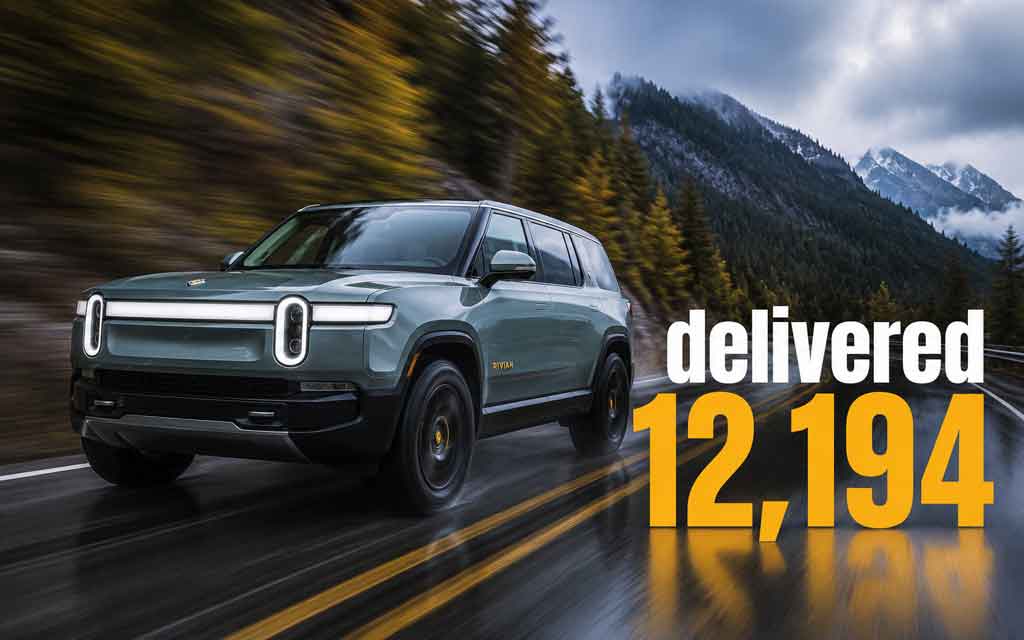
Rivian delivered 12,194 vehicles in Q2 2026 — beating its own guidance — and raised its full-year outlook to 65,000–70,000 vehicles. What the strong performance means for America’s EV truck leader, investors, and the future of green mobility.
In a clear sign of operational momentum, Rivian Automotive delivered more vehicles than expected in the second quarter of 2026 and raised its full-year delivery guidance. The electric adventure vehicle maker produced 12,613 vehicles and handed over 12,194 units between April and June — comfortably ahead of its prior target range of 9,000 to 11,000.
The beat was driven by continued strength in the R1 platform, growth in its Electric Delivery Van (EDV) business, and the first contributions from the more affordable R2 lineup. As a direct result, Rivian lifted its 2026 full-year delivery guidance from 62,000–67,000 vehicles to a new range of 65,000–70,000.
The news triggered a positive market reaction, with Rivian shares rising roughly 6% in early trading. While full financial results are still due on July 30, the operational update provides one of the clearest positive signals yet from the U.S. EV sector this summer.
The Numbers Behind the Beat
Rivian’s Q2 performance stood out against a mixed backdrop for electric vehicle makers. Here’s the breakdown:
Rivian Q2 2026 Performance Highlights
Production
- Q2 2026 Actual: 12,613 vehicles
- Prior Guidance: —
- Result: Production remained on track with company expectations.
Deliveries
- Q2 2026 Actual: 12,194 vehicles
- Prior Guidance: 9,000–11,000 vehicles
- Result: Exceeded guidance, outperforming the upper end of the forecast.
Full-Year 2026 Guidance
- Updated Guidance: 65,000–70,000 vehicles
- Previous Guidance: 62,000–67,000 vehicles
- Result: Raised full-year outlook, reflecting stronger-than-expected performance and confidence in production momentum.
The company attributed the outperformance to “robust growth quarter-over-quarter in EDV and R1 coupled with the introduction of R2 deliveries.”
This marks meaningful progress for a company that only began regular customer deliveries in 2022. The Normal, Illinois manufacturing plant continues to ramp, and the addition of R2 volume is helping diversify the mix beyond the higher-priced R1 trucks and SUVs.
What Drove the Strong Quarter?
Three main factors powered Rivian’s Q2 results:
- R1 Platform Strength — The R1T pickup and R1S SUV remain highly regarded for their combination of performance, capability, and software experience. Real-world owners continue to praise the vehicles for serious off-road and towing use cases that many competitors still struggle to match.
- EDV Commercial Momentum — Rivian’s purpose-built electric delivery vans (originally developed for Amazon) provide a steadier, high-volume revenue stream. Fleet operators value the lower operating costs and driver-friendly design, giving Rivian a foothold in the commercial segment that pure consumer-focused startups often lack.
- R2 Production Begins — The start of R2 deliveries in Q2 is strategically significant. Positioned as a more affordable, higher-volume electric SUV, the R2 is designed to dramatically expand Rivian’s addressable market. Early production ramp indicators appear encouraging.
Together, these elements show Rivian successfully executing on a multi-pronged growth strategy rather than relying on a single model.
Raising the Bar for 2026
The decision to raise full-year guidance is particularly notable because it reflects confidence in the second half of the year. Rivian specifically cited “the progress Rivian has made, and the production and delivery outlook for the second half of the year.”
This comes at a time when several legacy automakers are scaling back aggressive pure-EV targets and pivoting toward hybrids. Rivian’s ability to increase its outlook while others retrench underscores the strength of demand for purpose-built electric trucks and adventure vehicles in the United States.
The raised range of 65,000–70,000 vehicles for 2026 still represents significant year-over-year growth and positions Rivian as one of the few pure-play EV companies currently expanding its production outlook rather than contracting it.
Broader Market Context
Rivian’s results arrived alongside Tesla’s strong Q2 delivery numbers (480,126 vehicles globally). While the two companies target somewhat different buyer profiles — Tesla more mainstream, Rivian more adventure and utility-focused — both demonstrated that demand for well-executed electric vehicles remains robust in key segments.
At the same time, several legacy manufacturers reported softer EV sales and are accelerating hybrid and extended-range electric vehicle (EREV) programs to meet American buyers’ real-world needs around range, towing, and long-distance travel. Rivian’s focus on capable, high-utility EVs gives it a differentiated position in this evolving landscape.
What This Means for American Buyers and Green Tech
For U.S. consumers, Rivian’s progress is meaningful. The company builds its vehicles in Illinois, supports American manufacturing jobs, and offers trucks and SUVs designed specifically for the way many Americans actually use vehicles — towing trailers, heading off-road, and taking long road trips.
The R2’s arrival later this year and into 2027 is expected to bring electric adventure capability to a broader price segment, potentially accelerating adoption among buyers who want capability without the current R1’s premium positioning.
From a green tech perspective, every additional Rivian on the road contributes to lowering transportation sector emissions — one of the largest sources of greenhouse gases in the United States. Commercial EDVs also help fleet operators cut fuel and maintenance costs while reducing local air pollution in delivery-heavy urban areas.
Challenges Remain on the Path Forward
Despite the encouraging operational beat, Rivian still faces well-known hurdles:
- Path to sustained profitability — High fixed costs and ongoing investments in new platforms mean margins remain under pressure.
- Intense competition — Tesla’s Cybertruck, upcoming offerings from Ford, GM, and others, and a broader industry shift toward hybrids create a dynamic competitive environment.
- Scaling R2 production — Successfully ramping the more affordable model without quality or cost issues will be critical to hitting the higher end of the new guidance range.
- Full financial picture — Investors will look to the July 30 earnings report for clarity on gross margins, cash burn, and capital expenditure plans.
The Road Ahead
Rivian’s Q2 2026 update delivers a rare piece of unambiguously positive news from the U.S. EV sector this summer. By beating delivery targets and raising its full-year outlook, the company has demonstrated real operational progress at a time when many competitors are pulling back.
The combination of continued R1 strength, EDV volume, and the early ramp of the R2 platform gives Rivian multiple levers for growth. While challenges around profitability and competition persist, the raised guidance and positive stock reaction suggest investors see a clearer path forward than they did just a few months ago.
For American drivers who want capable electric trucks and SUVs built for real-world use — and for the broader green tech transition — Rivian’s momentum is a welcome development.
Full Q2 financial results are scheduled for July 30, 2026. Those numbers will provide the next major data point on whether this operational strength translates into improving financial performance.
FAQs
How many vehicles did Rivian deliver in Q2 2026? Rivian delivered 12,194 vehicles in Q2 2026, beating its guidance range of 9,000–11,000.
Did Rivian raise its 2026 delivery guidance? Yes. Rivian raised its full-year 2026 delivery outlook from 62,000–67,000 vehicles to 65,000–70,000 vehicles.
What drove Rivian’s Q2 beat? Strong growth in R1 trucks and SUVs, continued EDV (Electric Delivery Van) volume, and the start of R2 deliveries.
When will Rivian report full Q2 financial results? Rivian is scheduled to release its complete Q2 2026 financial results on July 30, 2026.
Is Rivian stock up after the announcement? Rivian shares rose approximately 6% in early trading following the Q2 delivery beat and raised guidance.




Leave a Comment