
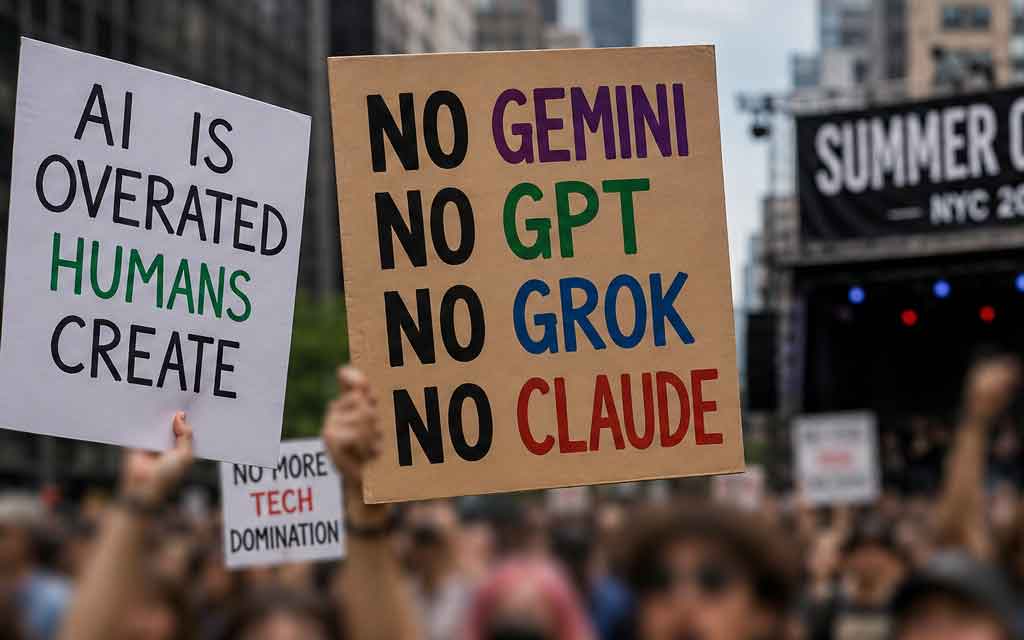
In the heart of New York City this summer, a growing contingent of Generation Z is pushing back hard against the AI revolution. At the inaugural Summer of Ludd festival (June 28–July 5, 2026), young anti-tech activists made their position crystal clear with a memorable chant:
“No Gemini, no GPT, no Grok, no Claude.”
The slogan — targeting Google’s Gemini, OpenAI’s GPT models, xAI’s Grok, and Anthropic’s Claude — captured the spirit of a week-long series of events dedicated to offline living, community, and resistance to Big Tech’s dominance. Organized by neo-Luddite groups, the festival has become a cultural flashpoint for a generation that grew up with smartphones and is now increasingly rejecting the digital world that raised them.
What Was the Summer of Ludd?
The Summer of Ludd was a week of talks, workshops, and activities held across New York City. Named after the 19th-century Luddites who famously smashed textile machinery in protest of industrialization, the modern version focuses on reclaiming life from screens, algorithms, and AI.
Events included:
- Workshops on flirting and dating offline
- Clothing mending and repair sessions
- Discussions on resisting data centers
- Phone-free social gatherings
- Talks on digital minimalism and community building
Organizers deliberately avoided heavy online promotion, instead directing people to a phone hotline for daily schedules. The approach stayed true to the festival’s principles: less screen time, more real-world connection.
Crowds were relatively small but passionate, consisting mostly of people in their 20s. Coverage from outlets including The Economist and WIRED noted that while attendance wasn’t massive, the event reflected a broader and growing ambivalence among Gen Z toward technology.
The Rise of Gen Z Luddites
Generation Z is the first cohort to grow up entirely immersed in digital technology. Yet many of them are now leading a backlash. A 2025 Pew Research study found that 48% of teens believed social media had negative effects on people their age — a sharp rise from previous years.
This skepticism has expanded beyond social media into generative AI. Young people are increasingly critical of:
- Constant surveillance and data extraction
- Algorithmic control over attention and culture
- AI-generated “slop” flooding the internet
- The mental health toll of always-on devices
- Corporate power concentrated in a handful of tech giants
The chant against specific frontier AI models — Gemini, GPT, Grok, and Claude — shows that the critique has moved beyond vague anti-tech sentiment into direct opposition to the most powerful AI systems currently shaping the world.
Other chants at the festival included “We will free the iPad babies,” highlighting concerns about the impact of early and heavy screen exposure on younger children.
Why Now? The Cultural Context of 2026
Several factors have fueled this neo-Luddite energy among young people:
1. AI Content Fatigue The explosion of AI-generated images, videos, writing, and music has led many to dismiss large volumes of it as low-quality “slop.” This echoes comments from figures like Christopher Nolan, who recently noted that younger generations are “utterly rejecting” AI-generated content.
2. Mental Health and Attention Crisis Gen Z reports high rates of anxiety, depression, and attention difficulties, which many link to smartphone and social media overuse. Digital detoxes and intentional offline living are becoming status symbols in some circles.
3. Economic and Power Concerns Young people see AI as accelerating job displacement in creative and knowledge work while concentrating wealth and power in Big Tech companies. Data center expansion and energy use have also become local flashpoints.
4. Desire for Authenticity and Community In reaction to algorithm-driven feeds and synthetic media, many are seeking real-world connection, handmade objects, and unmediated experiences.
The Summer of Ludd is not an isolated event. Similar sentiments appear in online communities, college campuses, and cultural spaces where “going analog” or limiting AI use is increasingly discussed.
Is This a Real Movement or a Niche Protest?
Critics argue that the festival’s small crowds and deliberate offline approach limit its reach. In a world dominated by digital platforms, completely rejecting technology can make it harder to organize and scale influence.
Supporters counter that the goal is not to smash every computer (as historical Luddites did with machines) but to create space for alternative ways of living and to push back against the idea that AI adoption is inevitable and unquestionably positive. They see themselves as building “new social infrastructure” away from surveillance capitalism.
The movement also intersects with other progressive and left-leaning causes, including environmental concerns about data centers and critiques of corporate power.
Implications for Tech Companies and AI Developers
The Summer of Ludd and the viral chant targeting major AI models should serve as a cultural signal:
- Brand perception matters among younger users. Aggressive AI integration without clear user benefit or transparency risks backlash.
- Authenticity is becoming a premium. Content and experiences that feel human-made may gain cultural capital.
- User agency and offline options could become competitive advantages.
- Tech companies may face increasing pressure around youth mental health, data practices, and the environmental footprint of AI.
While most Gen Z users still rely heavily on technology, a vocal and culturally influential minority is actively rejecting aspects of it. That minority can shape trends, memes, and eventually broader public opinion.
Looking Ahead
The Summer of Ludd may prove to be an early cultural marker of a larger shift. Just as previous generations pushed back against industrialization or television, parts of Gen Z are questioning the totalizing role of smartphones and AI in daily life.
Whether this remains a niche subculture or grows into a more mainstream movement will depend on how tech companies respond — and on whether offline living can offer compelling alternatives that stick.
For now, the image of young people in New York chanting “No Gemini, no GPT, no Grok, no Claude” stands as a vivid reminder: not everyone is ready to fully embrace the AI-powered future that Silicon Valley is building.
Frequently Asked Questions
What is the Summer of Ludd festival? A week-long series of events in New York City (June 28–July 5, 2026) focused on offline living, digital resistance, and community activities inspired by historical Luddites.
What does the chant “No Gemini, no GPT, no Grok, no Claude” mean? It is a direct rejection of major frontier AI models from Google, OpenAI, xAI, and Anthropic, symbolizing broader opposition to generative AI and Big Tech.
Is this just a small group of people? Attendance was not huge, but the event reflects a wider cultural ambivalence among Gen Z toward technology that has been documented in surveys and other youth spaces.
Are Gen Z completely anti-technology? No. Many use technology daily. The criticism tends to focus on over-reliance, surveillance, AI-generated content quality, mental health impacts, and corporate power rather than a total rejection of all tech.
How does this connect to historical Luddites? The original Luddites (early 1800s England) protested machinery they believed threatened jobs and craftsmanship. Modern neo-Luddites draw inspiration from that resistance while focusing on digital technology, AI, and data capitalism.
Bottom Line At New York’s Summer of Ludd festival, Gen Z anti-tech activists made a clear statement with the chant “No Gemini, no GPT, no Grok, no Claude.” The event highlights a growing neo-Luddite undercurrent among young people who are questioning the AI-driven, always-connected future being sold to them.
As AI continues its rapid expansion, this cultural pushback may become an important counterforce — one that tech companies ignore at their peril.
For more on AI culture, generational tech attitudes, and the future of digital society, stay tuned to vfuturemedia.com.




Leave a Comment