
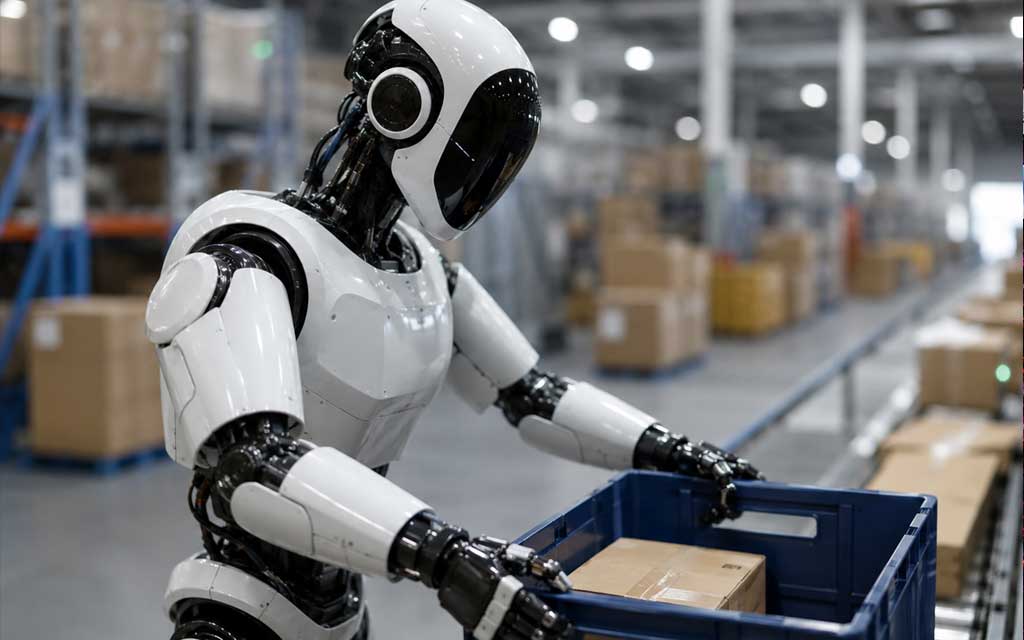
In a development that accelerates the fusion of AI, robotics, and real-world learning, China is deploying thousands of humanoid robots across factories, warehouses, logistics hubs, battery plants, and even homes. The goal, as reported by Bloomberg on July 15, 2026, is to immerse these machines in human environments so they can gather massive amounts of data and “learn how to be human.” This marks a significant escalation in China’s robotics push, mirroring its successful strategy in electric vehicles (EVs) that led to the record export of over 1 million vehicles in June 2026.
As an American tech reporter covering AI, autonomy, EVs, and global competition for www.vfuturemedia.com, this Bloomberg revelation is both impressive and urgent. While the U.S. excels in frontier AI software, software-defined vehicles, and autonomous systems (think Tesla Optimus ambitions and Waymo), China’s hardware-scale approach — backed by state support, vertical integration, and relentless data collection — threatens to reshape manufacturing, labor markets, and the broader AI-robotics ecosystem. For American policymakers, automakers, and innovators, this is another wake-up call to leverage tools like the Inflation Reduction Act (IRA) and CHIPS Act for domestic resilience.
The Bloomberg Details: Scale, Strategy, and “Embodied Intelligence”
According to Bloomberg, Chinese startups and established players are shipping advanced humanoids at a faster pace than the U.S., placing them in real operational settings to collect “torrents of data.” Key highlights:
- Industrial Deployments: Robots are working in battery factories, auto plants (e.g., BYD, Geely, FAW-Volkswagen), logistics centers, and warehouses. Tasks include sorting components, lifting boxes, testing instruments, and handling dangerous operations like refrigerant leak detection.
- Home and Service Scenarios: Early pilots in households for chores like folding clothes, cooking, and cleaning, plus public spaces. Training centers use human demonstrations recorded on video for AI model improvement.
- Data-Driven Learning: The strategy emphasizes “embodied AI” — robots learning through physical interaction rather than pure simulation. This generates diverse, real-world datasets for improving dexterity, adaptability, and generalization.
Companies leading the charge include UBTech (Walker series deployed at Foxconn for iPhone assembly and auto plants), Unitree (G1 and H1 models, viral performers and high-volume shipper), AgiBot (strong in automotive pilots and data collection), and others like EngineAI. China had over 140 humanoid manufacturers and 330+ models by 2025, producing more than half of global units.
Projections are aggressive: Targets include 10,000+ units by end-2026 in commercial scenarios, scaling toward hundreds of thousands. Government initiatives, subsidies, and national programs support deployment in over 100 “high-value application scenarios.”
Why This Strategy Works for China – And Worries America
China is applying the EV playbook to robotics: massive state-backed investment, supply chain control (batteries, actuators, sensors), cost reduction, and rapid iteration. Just as EV exports shattered records, humanoids could power the next export wave in manufacturing and services.
Advantages:
- Data Moat: Thousands of robots in diverse environments create unparalleled training data for AI models — critical for generalist robots.
- Cost Leadership: Lower production costs enable volume deployment and experimentation.
- Labor Demographics: Aging population and workforce shortages make automation a national priority under “New Productive Forces.”
- Integration with Existing Strengths: Links to battery tech (IRA-competitive area), AI models, and 5G/edge computing.
From an American viewpoint, this raises strategic concerns. Elon Musk and others have warned about China leading in humanoids. U.S. companies like Tesla, Figure, and Agility Robotics are advancing, but at smaller scales focused on high-reliability pilots (e.g., BMW factories for Figure). America’s edge lies in software, safety, and integration with autonomous driving tech, but hardware volume favors China.
Implications for U.S. Auto, EV, and Manufacturing
Humanoid robots could transform the very sectors where the U.S. is fighting to maintain leadership:
- EV and Battery Production: Robots in Chinese battery gigafactories accelerate output and reduce costs, intensifying pressure on U.S. facilities incentivized by the IRA. American plants could benefit from similar automation but must navigate higher labor standards and union considerations.
- Auto Assembly: Dexterous humanoids could handle complex tasks currently requiring human finesse, potentially shifting competitive dynamics in software-defined vehicles.
- Warehousing and Logistics: Faster fulfillment for e-commerce and parts supply chains.
- Autonomy Synergies: Data from humanoid manipulation improves robotic arms, perception, and planning — directly relevant to self-driving tech and last-mile delivery.
The IRA and EU Green Deal/Battery Regulation provide frameworks for onshoring and sustainable manufacturing, but robotics adds a new layer. U.S. policy should expand incentives for domestic robot production, AI training infrastructure, and workforce transition programs.
Broader AI and Geopolitical Context
This deployment ties into themes we’ve covered at VFutureMedia:
- AI Competition: Parallels Anthropic’s India expansion (localized access) and Apple’s China AI partnerships with Alibaba/Baidu. China leverages domestic data and control for rapid progress.
- Creative Industries: Enhances George Lucas’s vision of AI in filmmaking — robots for set building, effects, or even performance.
- Music and Generative Tech: Real-world learning data could improve AI music generators like Suno, though ethical scraping issues persist.
- Global Supply Chains: China’s robotics lead could extend export dominance, similar to EVs, pressuring Western tariffs and friend-shoring.
Ethical and safety questions loom: Job displacement, human-robot interaction norms, data privacy, and control in homes. China’s approach prioritizes speed; America can emphasize responsible innovation, alignment, and human-centric design.
Challenges for China’s Humanoid Push
Despite momentum, hurdles remain:
- Performance Gap: Many robots achieve 60-80% of human productivity in structured tasks; unstructured home environments are harder.
- Reliability and Safety: Dexterity, battery life, and error handling in dynamic settings.
- Economics: High upfront costs; rental models (e.g., AgiBot’s SHAREBOT) are emerging to lower barriers.
- Talent and IP: Dependence on global components and competition for AI researchers.
U.S. strengths in foundational models, simulation (e.g., synthetic data), and rigorous testing could close gaps if scaled aggressively.
Opportunities for American Innovation and Response
America should not panic but act decisively:
- Accelerate Domestic Production: Expand IRA-style credits to robotics manufacturing, components, and AI hardware.
- Public-Private Partnerships: Collaborate on standards for safety, ethics, and interoperability.
- Talent Pipeline: Invest in STEM education and immigration policies to attract robotics/AI experts.
- Hybrid Leadership: Combine U.S. software superiority with allied manufacturing (e.g., USMCA partners).
- R&D Focus: Prioritize generalist robots for auto/EV applications, healthcare, and defense.
Companies like Tesla (Optimus), Boston Dynamics (Hyundai), and startups can leverage America’s AI ecosystem for differentiated, high-value robots.
Future Outlook: The Robotics Decade Ahead
By 2030, humanoids could become commonplace in factories and logistics, with homes following. China aims for mass adoption; the U.S. can aim for smarter, safer, more integrated systems that augment human capabilities.
In the AI-auto-EV convergence, humanoid robots represent the physical embodiment of intelligence. They will assemble vehicles, manage battery plants, maintain autonomous fleets, and eventually assist in daily life — reshaping economies and societies.
For American families, workers, and innovators, this means adapting: New jobs in robot oversight, programming, and maintenance; opportunities in creative and high-skill sectors; and policy ensuring benefits are shared broadly.
Conclusion: America’s Strategic Imperative in the Humanoid Age
China’s deployment of thousands of humanoid robots to learn in the real world is a bold bet on embodied AI and industrial supremacy. It builds on EV success and amplifies the global tech race we’ve tracked — from battery incentives under the IRA to EU regulations and AI localization strategies.
As George Lucas urges Hollywood to embrace AI, America must embrace robotics leadership with the same pioneering spirit. Through innovation, smart policy, and ethical focus, the U.S. can ensure the future of work, mobility, and intelligence remains anchored in American values and ingenuity.
The robots are learning to be human. The question is: Will America lead the teachers?




Leave a Comment