
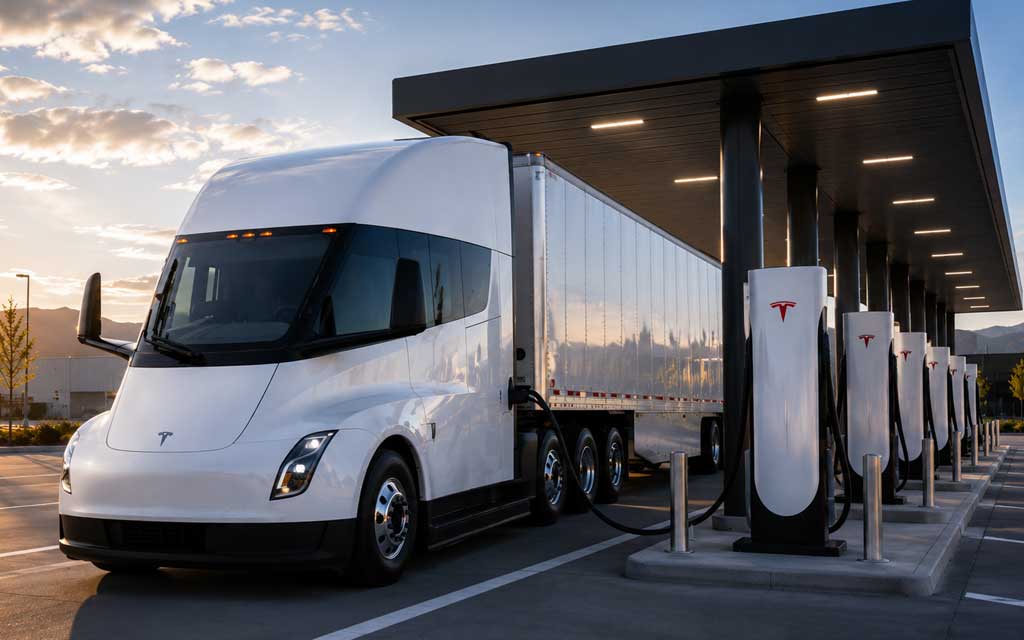
The midday sun beats down on Valley Boulevard in Bloomington, California, an unremarkable stretch of industrial landscape an hour east of Los Angeles. On a recent July afternoon, a gleaming white Tesla Semi eases into one of six oversized bays. The driver steps out, plugs in a thick MCS cable, and watches the numbers climb. Within minutes the truck is pulling more than a megawatt. What used to require a lengthy diesel fill-up and a rest stop is now a 30-minute recharge that can restore hundreds of miles of range.
This is Tesla’s first full-scale public Megacharger station, opened in mid-July 2026 at 18434 Valley Boulevard. Six stalls, each capable of delivering up to 1.2 megawatts. The site is open to all Tesla Semi customers. For the first time, high-power commercial charging is no longer confined to private fleet depots or limited pilot locations.
The moment feels quieter than the hype that preceded it. There was no elaborate ribbon-cutting. Tesla simply posted “New Tesla Megacharger: Bloomington, CA (6 stalls)” and updated its map. Yet the implications are loud. This is the clearest signal yet that electric Class 8 trucking is moving from demonstration projects into the messy reality of public freight corridors.
The Hardware That Changes the Math
Each stall is engineered for the realities of heavy-duty operations. Peak power reaches 1.2 MW through the MCS 3.2 (Megawatt Charging System) standard—specifically Tesla’s MC2 connector—which aligns with the open industry protocol rather than a proprietary lock-in. Continuous current capability sits at 1,500 A across a wide voltage range. The physical layout features drive-through bays sized for full-size semis, with ample room for trailers.
Tesla’s own figures state that a Semi can recover up to 60 percent of its range in 30 minutes at a Megacharger. With energy consumption quoted at roughly 1.7 kWh per mile and long-range versions offering up to 500 miles, that equates to several hundred miles restored during a mandatory driver break. Earlier video demonstrations showed the truck hitting peaks near 1.2 MW, adding energy at a rate that makes the old “range anxiety” argument look increasingly dated for regional and corridor work.
An earlier, lower-power site near Ontario International Airport (around 750 kW, fewer stalls, first-generation connector) has already faded from Tesla’s public map. Bloomington represents the scaled version: more power, more stalls, and public access.
Why Bloomington?
The location is strategic. Southern California is one of the densest freight regions in the United States, serving the Ports of Los Angeles and Long Beach, massive distribution hubs, and the I-10 and I-15 corridors. Bloomington sits in the path of daily truck movements between the ports, the Inland Empire warehouses, and routes heading east or north. Placing the first true public Megacharger here tests real operational density rather than an idealized showpiece site.
Tesla has signaled far broader ambitions. Company maps and statements point to at least 64 Megacharger locations planned across the United States, heavily concentrated along major freight corridors in California, Texas, Florida, and the Southeast. A partnership with Pilot Travel Centers aims to install megawatt-scale chargers at select travel centers along routes including I-5 and I-10, with initial sites expected in the same 2026 window. Pre-assembled units are intended to accelerate deployment.
Voices from the Cab and the Dispatch Desk
Early fleet operators who have already put Tesla Semis into service describe a different kind of day. PepsiCo, DHL Supply Chain, and smaller carriers have logged millions of combined miles. Real-world efficiency has often landed between 1.5 and 1.9 kWh per mile depending on load, terrain, and speed—close to Tesla’s claims. One Texas carrier reported 1.64 kWh/mile over thousands of miles of cross-border hauling. Uptime figures from Tesla’s pilot fleet hover around 95 percent, better than typical diesel averages, with many service issues resolved in under a day.
Drivers notice the silence first. No diesel rumble, no exhaust. Acceleration is immediate. Regenerative braking reduces wear on conventional brakes. The operational economics shift dramatically once electricity rates are favorable: energy costs can fall to roughly one-third of diesel on a per-mile basis under current pricing assumptions, though the exact number depends heavily on depot versus public charging rates and local electricity costs.
The remaining friction is infrastructure. Public high-power sites have been scarce. A driver running a regional route from the ports to the Central Valley or into Nevada previously had to plan carefully around depot returns or limited pilot chargers. Bloomington changes that calculation for Southern California fleets. “You can now treat a rest break as a real opportunity to put meaningful energy back into the truck,” one early operator noted in industry discussions. “That’s the difference between electric working on paper and electric working in the schedule.”
Diesel’s Long Shadow and the Cost Equation
A new diesel Class 8 tractor still costs less upfront—often $150,000–$190,000 versus a Tesla Semi that can exceed $200,000–$250,000 depending on configuration. Diesel refueling remains fast and ubiquitous. The total cost of ownership story flips, however, when fuel, maintenance, and downtime are counted over several years. Diesel trucks carry turbochargers, DEF systems, complex transmissions, and emissions equipment that electric drivetrains simply do not have. Tesla and early fleets report fewer unscheduled repairs in those categories.
The challenge is not purely technical. Grid capacity at highway locations, utility interconnection timelines, and the sheer capital required to build dozens of multi-megawatt sites remain significant. A single 1.2 MW stall draws roughly the power of a small commercial building. Scaling to hundreds of stalls across the country will require coordinated planning with utilities and careful load management.
Policy Winds and Competitive Landscape
California’s regulatory environment has long pushed zero-emission medium- and heavy-duty vehicles. The Advanced Clean Trucks regulation requires manufacturers to sell increasing percentages of zero-emission trucks. Broader fleet rules have faced political and legal headwinds, including federal waiver issues and recent adjustments, creating uncertainty for some private fleets even as sales mandates persist.
Tesla’s decision to use the open MCS standard rather than a closed connector is consequential. Daimler, Volvo, Scania, and others are preparing MCS-compatible electric trucks. Competitors such as Kempower have already deployed megawatt-class sites nearby, including in San Bernardino. The charging network will not belong to any single truck maker. That interoperability could accelerate adoption—or intensify competition for the best real-estate and the fastest deployment.
Environmental and Economic Ripples
Every mile shifted from diesel to electricity in the California freight basin reduces local NOx and particulate pollution that disproportionately affects communities near ports and warehouses. Greenhouse gas reductions scale with the grid’s cleanliness; California’s relatively clean electricity mix amplifies the benefit today. Quieter trucks also change the lived experience along freight corridors.
Economically, the transformation is uneven. Fleets that can secure favorable electricity rates and reliable charging access stand to lower operating costs and potentially gain an edge on contracts that value sustainability metrics. Drivers may face less physical fatigue from noise and vibration, but they will also need new skills and familiarity with charging protocols. Truck stops and travel centers that adapt early could see new revenue streams; those that do not risk becoming less relevant on electrified corridors.
The Road Ahead
Stand in Bloomington today and the future is still provisional. Six stalls cannot serve an entire region’s freight volume. The network of 64-plus planned sites is ambitious but not yet built. Battery costs, residual values, and secondary markets for electric semis are still maturing. Grid upgrades will take years.
Yet the direction of travel is clear. When a truck can add several hundred miles of range during a federally mandated break, the operational case for long regional and even some long-haul electric routes strengthens dramatically. Tesla’s vertical integration—vehicle, battery, and now public high-power charging—gives it a first-mover advantage, but the open MCS standard ensures it will not be alone.
Imagine the same stretch of Valley Boulevard five years from now: multiple operators’ trucks sharing the bays, software optimizing arrival times, renewable energy contracts powering the site, and drivers treating the stop as routine rather than a logistical gamble. The diesel pumps a few miles away would still be busy, but their monopoly on convenience would be broken.
Tesla’s first public Megacharger is not the finish line. It is the moment the industry can no longer claim that the infrastructure does not exist. The stalls are live. The trucks are rolling. The freight system that moves nearly everything we buy is beginning, slowly and unevenly, to plug in.




Leave a Comment