Small Language Models vs Large Language Models
What separates a small language model from a large one, how SLMs got so capable, where they beat LLMs on cost and privacy, and when you need a big model.
A small language model (SLM) is a language model with far fewer parameters than the largest models, typically in the range of a few hundred million to around 10 billion, designed to be cheap and fast enough to run on a laptop, phone or modest server. A large language model (LLM) has tens or hundreds of billions of parameters or more and usually runs in a data center. SLMs trade some breadth and reasoning depth for lower cost, lower latency and the option to keep data on the device.
The gap between them has narrowed quickly. Stanford HAI's 2025 AI Index notes that in 2022 the smallest model scoring above 60% on the MMLU knowledge benchmark was PaLM, with 540 billion parameters, and that by 2024 Microsoft's Phi-3-mini "with just 3.8 billion parameters, achieved the same threshold," a "142-fold reduction in over two years" [4].
What counts as "small"?
There is no official cutoff. Definitions come from vendors and shift over time.
- Microsoft's cloud blog says SLMs are "typically" sized at "just under 10 billion parameters," roughly five to ten times smaller than LLMs [2].
- Microsoft's Azure glossary describes the gap more dramatically: "Where LLMs like GPT-4 can contain more than a trillion parameters, an SLM might only contain a few hundred million" [1].
Some families span the boundary. Google's Gemma 3 comes in five sizes, from 270 million to 27 billion parameters, and Google says their small size allows deployment in "environments with limited resources such as laptops, desktops" [6]. Whether the 27B version is "small" depends on whom you ask.
The top end is fuzzy too. Stanford HAI's 2026 AI Index reports that the most capable models are among the least transparent, with developers keeping "training code, dataset sizes, and parameter counts to themselves" [14]. For many frontier LLMs, nobody outside the company knows the exact size.
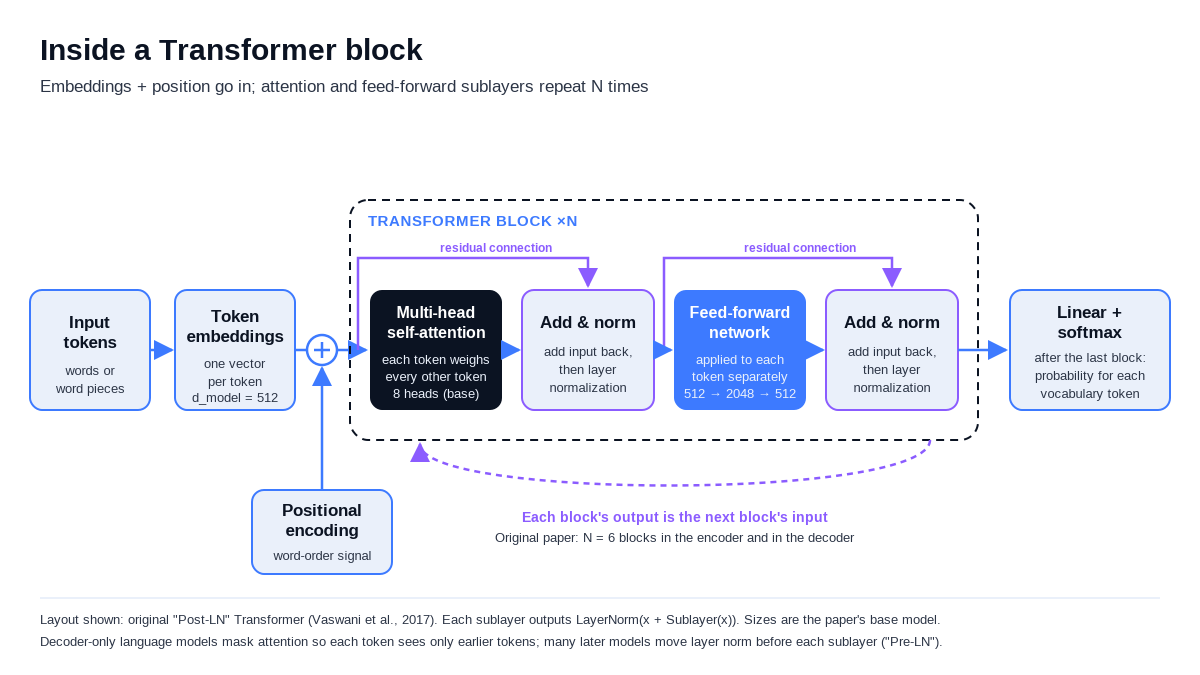
A parameter is one learned number inside the model. Our explainer on how large language models work covers what parameters do; both SLMs and LLMs use the same basic Transformer architecture.
Why size matters in practice
Parameter count drives memory, speed and cost.
Here is a rough rule of thumb (our own arithmetic, weights only, ignoring the extra memory needed while running): a model needs about 2 bytes per parameter at 16-bit precision, 1 byte at 8-bit and half a byte at 4-bit.
Model size | 16-bit weights | 8-bit weights | 4-bit weights |
|---|---|---|---|
3.8 billion parameters | about 7.6 GB | about 3.8 GB | about 1.9 GB |
27 billion parameters | about 54 GB | about 27 GB | about 13.5 GB |
175 billion parameters | about 350 GB | about 175 GB | about 88 GB |
The first row is Phi-3-mini's size [3], the middle row is one of Gemma 3's sizes [6], and the last is the size of GPT-3 [13]. Figures use decimal gigabytes (1 GB = 1 billion bytes). For comparison, Microsoft's Copilot+ PC specification calls for 16 GB of memory [15]. A 3.8B model at 4-bit fits easily. A 175B model doesn't come close to fitting on a consumer device.
Every token a model generates also requires computation across its parameters, so smaller models are generally faster and cheaper per token. That is a big reason serving costs have fallen. Stanford HAI's 2025 AI Index reports that the inference cost of a system performing at GPT-3.5's level "dropped over 280-fold" between late 2022 and late 2024, a decline it links partly to increasingly capable small models [5]. Our guide to AI training vs inference explains why serving costs matter so much.
How small models got so capable
Better training data
Phi-3's developers credit data rather than size. Phi-3-mini, at 3.8 billion parameters, was trained on 3.3 trillion tokens of "heavily filtered" public web data and synthetic data [3]. Microsoft reports it scores 69% on MMLU (as of the April 2024 report), which it says rivals much larger models of the time, "despite being small enough to be deployed on a phone" [3]. These are the developer's own benchmark results.
Training longer than "compute-optimal"
Research on scaling explains part of the trend. In 2022, Hoffmann and colleagues found that many large models were undertrained, and that for a fixed training budget, model size and data should grow together [11]. Their smaller Chinchilla model beat larger rivals and needed "substantially less compute for fine-tuning and inference" [11]. Developers of small models push this further, spending extra training compute on more data to get a model that's cheap to run. Gemma 3's 270M model, for example, was trained on 6 trillion tokens [6].
Distillation
Knowledge distillation trains a small "student" model to imitate a large "teacher." In a 2015 paper, Hinton, Vinyals and Dean developed a technique for compressing the knowledge in a large model, or an ensemble of models, into a single model that is easier to deploy [9]. Azure lists distilled models as one of the main types of SLM [1].
Quantization
Quantization stores weights at lower precision. The LLM.int8() paper reported that 8-bit matrix multiplication "cut the memory needed for inference by half" without performance loss on the models it tested [10]. Apple's 2025 on-device model, about 3 billion parameters, uses 2-bit quantization-aware training to run efficiently on Apple silicon [7]. Our upcoming explainer on model quantization covers the trade-offs.
SLM vs LLM at a glance
Small language models | Large language models | |
|---|---|---|
Typical size | Hundreds of millions to about 10B parameters [1][2] | Tens of billions to undisclosed, possibly trillions [1][14] |
Where it runs | Phone, laptop, edge device, single server | Data center accelerator clusters |
Cost per request | Low | Higher |
Latency | Low, no network round trip if local | Higher, depends on network and load |
Privacy | Data can stay on the device [2] | Data usually goes to a provider's servers |
Offline use | Possible [2] | Usually not |
Breadth of knowledge | Narrower | Broader |
Complex reasoning | Weaker on multifaceted reasoning tasks [1] | Stronger |
Customization | Cheaper and faster to fine-tune [2] | More expensive to fine-tune |
Where small models shine
- On-device features. Apple's on-device model powers Apple Intelligence features and is available to app developers through its Foundation Models framework [7].
- Narrow, repeated tasks. Classification, extraction, routing, formatting and summarizing within a known domain. Microsoft notes that smaller models can be fine-tuned more cheaply and quickly for focused fields [2].
- Privacy-sensitive data. Local processing can keep data under the organization's control [2].
- Low or no connectivity. Offline translation, voice features and field devices [1][2].
- AI agents. Belcak and colleagues argue in a 2025 position paper that SLMs are "sufficiently powerful, inherently more suitable, and necessarily more economical" for many calls inside agentic systems, because agents often perform "a small number of specialized tasks repetitively and with little variation" [8]. That is an argued position, not a measured result. See our guide to agentic AI.
Where large models still win
Azure is candid about the limits of small models: "limited capacity for complex language comprehension," potential for reduced accuracy on complex tasks, and higher error rates on tasks that involve multifaceted reasoning, which may make them unsuitable for applications such as scientific research or medical diagnostics [1].
Large models generally lead on:
- Open-ended questions across many domains. More parameters can store more knowledge. Scaling research found that larger models are "significantly more sample-efficient," learning more from the same data [12].
- Long, multistep reasoning and complex instructions.
- Rare facts. A small model has less room for long-tail knowledge, so it may be more likely to guess. Grounding it with retrieval-augmented generation can help, since the facts then come from documents rather than the model's memory.
You don't have to choose just one
Many production systems combine sizes. The same position paper suggests that where general conversation is needed, systems that call several different models are "the natural choice" [8]. A common pattern:
- A small model handles routine requests, classification and tool calls.
- Hard or unusual requests are routed to a large model.
- Retrieval supplies facts to whichever model answers.
Microsoft also says many organizations use a mix of SLMs and LLMs [2].
How to choose
Ask these questions in order:
- Can the data leave the device or your network? If not, an SLM running locally or on your own servers may be the only option.
- How narrow is the task? The narrower and more repetitive, the better a small, fine-tuned model fits. Compare RAG vs fine-tuning for adapting it.
- What latency and cost per request can you accept? High-volume, real-time features favor small models.
- How hard is the reasoning? If tasks need long chains of reasoning or broad world knowledge, start with a large model and see if a smaller one can match it.
- Test on your own data. Published benchmark scores, often self-reported by developers, don't predict performance on your specific task.
Hardware matters too: an NPU-equipped laptop or a single GPU server can run a quantized SLM. Our comparison of AI chips, CPUs, GPUs and TPUs explains the options, and our upcoming piece on open-source vs closed-source AI covers which models you can download and run yourself.
Outlook
The trend in the sources is clear: capability per parameter is rising fast [4], and the cost of a given level of performance is falling [5]. Expect more features to move on-device and more systems to mix small and large models. Large models are not going away, though; the frontier of capability is still set by the biggest systems, even if their sizes are no longer disclosed [14].
Frequently asked questions
What is the difference between an SLM and an LLM?
Mainly size. SLMs have far fewer parameters, typically under about 10 billion by Microsoft's description [2], so they need less memory and compute and can run on local devices. LLMs are larger, more broadly capable, and usually run in data centers.
Can a small language model run on my phone or laptop?
Yes, many can. Phi-3-mini was described by its developers as "small enough to be deployed on a phone" [3], Apple runs a roughly 3-billion-parameter model on its devices [7], and Google says Gemma 3 can run on laptops and desktops [6]. Larger SLMs may need quantization or a capable GPU.
Are small language models less accurate?
On broad, complex tasks, generally yes [1]. On narrow tasks they're fine-tuned for, they can match or beat larger general models, which is why Microsoft highlights task-specific tuning as a key benefit [2]. Always test on your own workload.
What is knowledge distillation?
It's a training method where a small "student" model learns to imitate a larger "teacher" model's outputs. Hinton and colleagues showed it can compress a large model's knowledge into a smaller, cheaper one [9]. It is one of the main ways SLMs are built [1].
Do small models hallucinate more?
They hold less knowledge, so they can be more prone to guessing on rare facts, though this varies by model and task. Grounding a small model in retrieved documents and allowing it to say "I don't know" both help; see our explainer on AI hallucinations.
Are SLMs good for AI agents?
The authors of a 2025 position paper argue they are a strong fit for the many repetitive, specialized steps inside agent workflows, with larger models called only when needed [8]. That's a position paper, so validate the approach on your own tasks.
Sources
- What are small language models (SLMs)?, Microsoft Azure.
- 3 key features and benefits of small language models, Microsoft Cloud Blog, September 25, 2024.
- Phi-3 Technical Report: A Highly Capable Language Model Locally on Your Phone, Abdin et al., arXiv, 2024.
- The 2025 AI Index Report: Technical Performance, Stanford HAI.
- The 2025 AI Index Report, Stanford HAI.
- Gemma 3, Google.
- Apple Intelligence Foundation Language Models: Tech Report 2025, Apple, arXiv, 2025.
- Small Language Models are the Future of Agentic AI, Belcak et al., arXiv, 2025.
- Distilling the Knowledge in a Neural Network, Hinton, Vinyals, Dean, arXiv, 2015.
- LLM.int8(): 8-bit Matrix Multiplication for Transformers at Scale, Dettmers et al., arXiv, 2022.
- Training Compute-Optimal Large Language Models, Hoffmann et al., arXiv, 2022.
- Scaling Laws for Neural Language Models, Kaplan et al., arXiv, 2020.
- Language Models are Few-Shot Learners, Brown et al., arXiv, 2020.
- Inside the AI Index: 12 Takeaways from the 2026 Report, Stanford HAI, April 13, 2026.
- Windows 11 Specs and System Requirements, Microsoft, as of November 2026.