What Is Model Context Protocol (MCP)?
Model Context Protocol (MCP) is an open standard that connects AI apps to tools and data. How hosts, clients and servers work, plus the security risks.
The Model Context Protocol (MCP) is an open standard that defines how AI applications connect to outside tools and data, such as files, databases, business apps and APIs. Instead of writing a custom integration for every pairing of AI app and data source, a developer builds one MCP server for a system, and any MCP-compatible application can use it. Anthropic introduced MCP in November 2024, and it has since been placed under the Linux Foundation's Agentic AI Foundation.
Why MCP exists
Language models are only as useful as the context they can reach. When Anthropic announced MCP on November 25, 2024, it described models as "trapped behind information silos and legacy systems," and noted that "every new data source requires its own custom implementation" [1].
That creates a multiplication problem. With M AI applications and N data sources, point-to-point integrations grow toward M × N. A shared protocol turns that into M + N: each application implements the client side once, each data source implements the server side once.
The specification itself draws a comparison with the Language Server Protocol, which standardized how code editors support programming languages. MCP aims to do the same for how AI applications get context and tools [2].
Anthropic's launch included the specification and SDKs, local MCP server support in the Claude Desktop apps, and an open-source repository of reference servers for systems including Google Drive, Slack, GitHub, Git, Postgres and Puppeteer [1]. It named Block and Apollo as early adopters, and Zed, Replit, Codeium and Sourcegraph as developer-tool companies working with the protocol [1].
How MCP works: hosts, clients and servers
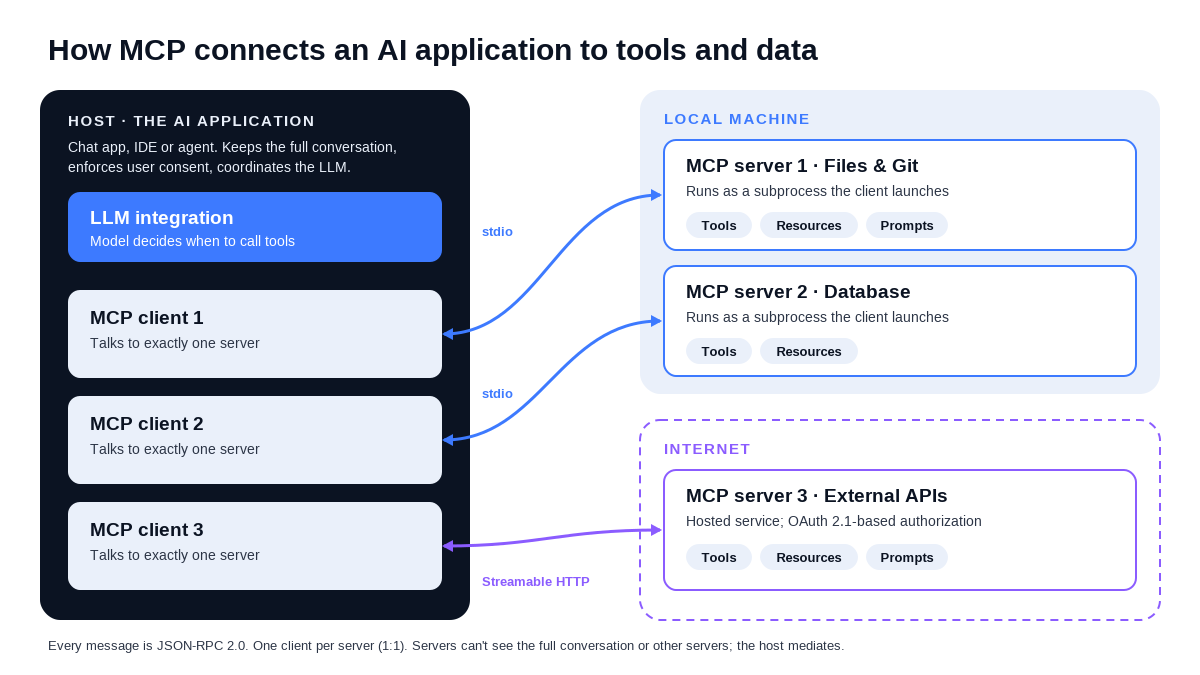
MCP uses JSON-RPC 2.0 messages between three roles [2][3]:
- Host: the AI application the user interacts with, such as a chat app, an IDE or an agent. The host creates and manages clients, controls their permissions, enforces security policies and consent, and coordinates the LLM integration [3].
- Client: a connector inside the host. Each client talks to exactly one server, a 1:1 relationship [3]. A host connected to five systems runs five clients.
- Server: a program that exposes a specific capability, such as access to a file system, a database or a SaaS API. Servers can be local processes or remote services [3].
One design principle explains much of the architecture: servers "should not be able to read the whole conversation, nor 'see into' other servers" [3]. The full conversation stays with the host. Each server gets only the context it needs, and any cross-server interaction goes through the host. That's a deliberate security boundary, not an implementation detail.
What servers offer: tools, resources and prompts
The spec defines three server primitives, distinguished by who controls them [4]:
Primitive | Controlled by | What it is | Example from the spec |
|---|---|---|---|
Tools | The model | Functions the LLM can call to take actions or fetch information | API POST requests, writing files |
Resources | The application | Data the client attaches as context | File contents, git history |
Prompts | The user | Templates the user invokes deliberately | Slash commands, menu options |
Tools are where most of the action is. A client discovers them with a tools/list request; each tool has a name and a JSON Schema describing its inputs, and can optionally carry a human-readable description and an output schema [5]. When the model decides to use one, the client sends tools/call with the arguments and passes the result back to the model [5].
The spec separates two kinds of failure. Protocol errors, such as an unknown tool name, come back as standard JSON-RPC errors. Tool execution errors, such as a date in the wrong format, come back as a normal result flagged isError: true, so the model can read the message and try again [5].
What clients offer: elicitation
Servers sometimes need something from the user mid-task, such as a username or a confirmation. In the current revision, a server can reply to a request with an "input required" result asking the client to collect that information through elicitation; the client asks the user and retries the original request with the answer [3][5].
Earlier revisions also let servers request sampling (asking the host's LLM to generate text) and roots (asking which directories they may access). Both are deprecated as of the 2026-07-28 revision and shouldn't be used in new implementations [3].
Transports: local and remote
MCP messages can travel two standard ways [6]:
- stdio: the client launches the server as a subprocess and exchanges newline-delimited JSON-RPC messages over standard input and output [7]. This is the usual setup for local servers, such as one that reads files on your laptop.
- Streamable HTTP: each message is an HTTP POST to a single MCP endpoint, with replies returned as JSON or as a server-sent event stream [6]. This is how remote, hosted MCP servers work.
Custom transports are allowed, as long as they keep the JSON-RPC format and the protocol's message patterns [6].
Authorization
For HTTP-based servers, the spec defines an optional authorization flow based on a subset of OAuth 2.1. The MCP server acts as an OAuth resource server, and the client obtains access tokens from an authorization server on the user's behalf [9]. Servers must validate that tokens were issued specifically for them, and must not pass tokens through to other services [9]. Local stdio servers are told not to use this flow and to take credentials from the environment instead [9].
What changed in 2026
MCP versions are dated by the last backward-incompatible change. As of November 2026, the current revision is 2026-07-28 [8]. It reworked the protocol's foundations:
- Stateless requests. Earlier revisions opened a connection-scoped session with an
initializehandshake. In 2026-07-28, "every request is self-contained and carries its own protocol version and capabilities" [3]. Clients can callserver/discoverto learn a server's supported versions and capabilities up front, but it's optional [8]. - No server-initiated requests. Servers now ask for input inside their replies rather than sending their own JSON-RPC requests [6].
- Extensions. Optional, opt-in extensions add features such as Tasks for long-running operations, "Skills over MCP," and MCP Apps for interactive UI elements rendered in conversations [2].
The spec includes backward-compatibility rules so newer clients can detect and fall back to servers built on 2025-11-25 and earlier revisions [6][7][8].
Governance: from Anthropic to a foundation
On December 9, 2025, MCP joined the Agentic AI Foundation (AAIF), a directed fund under the Linux Foundation co-founded by Anthropic, Block and OpenAI, with Google, Microsoft, AWS, Cloudflare and Bloomberg listed as supporters [10]. The MCP project said its governance model "continues as is": maintainers still make technical decisions through its Specification Enhancement Proposal process, and the foundation doesn't set the protocol's technical direction [10].
MCP compared with related approaches
Custom API integration | Model-specific function calling | MCP | A2A | |
|---|---|---|---|---|
Connects | One app to one system | One model API to your code | Any MCP host to any MCP server | Agent to agent |
Reusable across AI apps | No | Partly; schemas are vendor-specific | Yes | Yes |
Discovery | Read the docs | You pass tool definitions per request |
| Agent Cards |
Primary job | Data exchange | Let a model request a function call | Give an AI app tools and context | Delegate tasks between independent agents |
MCP and function calling aren't competitors. Function calling is how a model asks for a tool; MCP is a standard way for the host to find, describe and call that tool.
MCP and the Agent2Agent (A2A) protocol are complementary, according to A2A's own specification. MCP standardizes how an agent connects to tools, APIs and data; A2A standardizes how independent agents communicate and delegate work as peers. An A2A agent can use MCP internally to reach the tools it needs [11]. See our explainer on multi-agent systems for where A2A fits.
Where MCP is used
Documented uses fall into a few groups:
- Desktop assistants reaching local files and apps, as in the Claude Desktop launch support [1].
- Developer tools connecting coding assistants to repositories, issue trackers and databases. GitHub, Git and Postgres were among the first reference servers [1].
- Agentic systems that need many tools. Anthropic's engineering write-up on its multi-agent Research system describes MCP servers giving the model access to external tools whose descriptions vary widely in quality, and reports that using an agent to test and rewrite flawed tool descriptions led to a 40% decrease in task completion time for later agents using those tools [12]. See our multi-agent systems explainer.
- Retrieval. A search index or vector store exposed as an MCP server lets any compatible app use it for retrieval-augmented generation.
Benefits
- Build once, use everywhere. One server works with any compliant host.
- Clear security boundaries. Servers are isolated from each other and from the full conversation [3].
- Discoverability. Clients can list a server's tools, resources and prompts at runtime [4][5].
- Local and remote options. stdio for local processes, Streamable HTTP for hosted services [6].
- Neutral governance. Foundation stewardship reduces dependence on a single vendor [10].
Limitations and risks
MCP connects models to systems that can read data and take actions. The spec is direct about it: tools "represent arbitrary code execution and must be treated with appropriate caution" [2]. And the protocol can't enforce safety on its own; implementers are responsible for consent and authorization flows [2].
- Untrusted tool descriptions. Descriptions and annotations come from the server. The spec says clients must treat annotations as untrusted unless they come from a trusted server [5]. A malicious server can describe a tool misleadingly.
- Prompt injection through results. Tool results and resources can contain text that tries to steer the model. Anything a server returns is data, not instructions.
- Over-broad permissions. A server with write access to production systems can do real damage if the model is tricked or simply wrong. The spec recommends that a human be able to deny tool calls, that hosts show which tools are exposed, and that sensitive operations require confirmation [5].
- Tool-name collisions. Two servers can both expose a tool called
search. The spec advises hosts to disambiguate, for example by prefixing tool names with a server identifier [5]. - Spec churn. The 2026-07-28 revision was a significant redesign. Check which revisions your SDKs, hosts and servers support.
How to evaluate an MCP server
- Know who maintains it. Prefer official servers from the system's vendor or well-maintained open-source projects.
- Read the tool list. Does it expose write or delete operations you don't need? Can you disable them?
- Check authentication. Remote servers should use the OAuth-based flow with scoped tokens [9]; local servers should take credentials from the environment, not hard-coded files [9].
- Keep a human in the loop for anything destructive, as the spec recommends [5].
- Log tool calls. The spec recommends clients log tool usage for audit purposes [5].
Outlook
MCP went from an Anthropic release to a foundation-governed standard in about a year, and its 2026 revision rebuilt it around stateless, self-contained requests. The open questions now are less about whether AI apps will use a common tool protocol and more about security practice: how hosts present consent, how organizations vet servers, and how extensions such as Tasks and MCP Apps mature. For context on the broader shift toward agents, see our guide to agentic AI.
Frequently asked questions
Who created MCP, and who owns it now?
Anthropic created and open-sourced MCP in November 2024 [1]. In December 2025, it was contributed to the Agentic AI Foundation under the Linux Foundation, while its maintainers kept control of technical decisions [10].
Is MCP only for Claude?
No. It's an open protocol with public SDKs, and any application can implement a host or client. Anthropic's launch listed several companies outside Anthropic working with it [1], and the AAIF was co-founded by Anthropic, Block and OpenAI [10].
What's the difference between an MCP client and an MCP server?
The server exposes capabilities, such as tools for a database or an API. The client lives inside the AI application (the host) and connects to one server [3]. A host that uses several servers runs one client per server.
Is MCP secure?
The protocol includes security principles and an OAuth-based authorization flow for remote servers, but it can't enforce safe behavior on its own [2][9]. Safety depends on hosts asking for consent, organizations vetting servers, and keeping permissions narrow.
How is MCP different from an API?
An API is specific to one service. MCP is a common layer on top: a server can wrap any API and present it in a standard, discoverable form that any MCP host understands. The underlying API still does the work.
Does MCP replace function calling?
No. Function calling is how a model signals it wants a tool. MCP standardizes how the application finds and invokes those tools across many systems. They're typically used together.
Sources
- Anthropic. "Introducing the Model Context Protocol." November 25, 2024. https://www.anthropic.com/news/model-context-protocol
- Model Context Protocol. "Specification" (latest). https://modelcontextprotocol.io/specification/latest
- Model Context Protocol. "Architecture," revision 2026-07-28. https://modelcontextprotocol.io/specification/2026-07-28/architecture
- Model Context Protocol. "Server features overview," revision 2026-07-28. https://modelcontextprotocol.io/specification/2026-07-28/server
- Model Context Protocol. "Tools," revision 2026-07-28. https://modelcontextprotocol.io/specification/2026-07-28/server/tools
- Model Context Protocol. "Transports," revision 2026-07-28. https://modelcontextprotocol.io/specification/2026-07-28/basic/transports
- Model Context Protocol. "stdio," revision 2026-07-28. https://modelcontextprotocol.io/specification/2026-07-28/basic/transports/stdio
- Model Context Protocol. "Versioning." https://modelcontextprotocol.io/specification/versioning
- Model Context Protocol. "Authorization," revision 2026-07-28. https://modelcontextprotocol.io/specification/2026-07-28/basic/authorization
- Model Context Protocol blog. "MCP joins the Agentic AI Foundation." December 9, 2025. https://blog.modelcontextprotocol.io/posts/2025-12-09-mcp-joins-agentic-ai-foundation/
- A2A Project. "Agent2Agent (A2A) Protocol Specification," Appendix B. https://a2a-protocol.org/latest/specification/
- Anthropic. "How we built our multi-agent research system." June 2025. https://www.anthropic.com/engineering/multi-agent-research-system