

Autonomous Driving Levels Explained: SAE Levels 0 to 5
What SAE J3016 Levels 0 to 5 mean: who steers, who watches the road, who handles failures, what an ODD is, and why Level 2 still means you're driving.
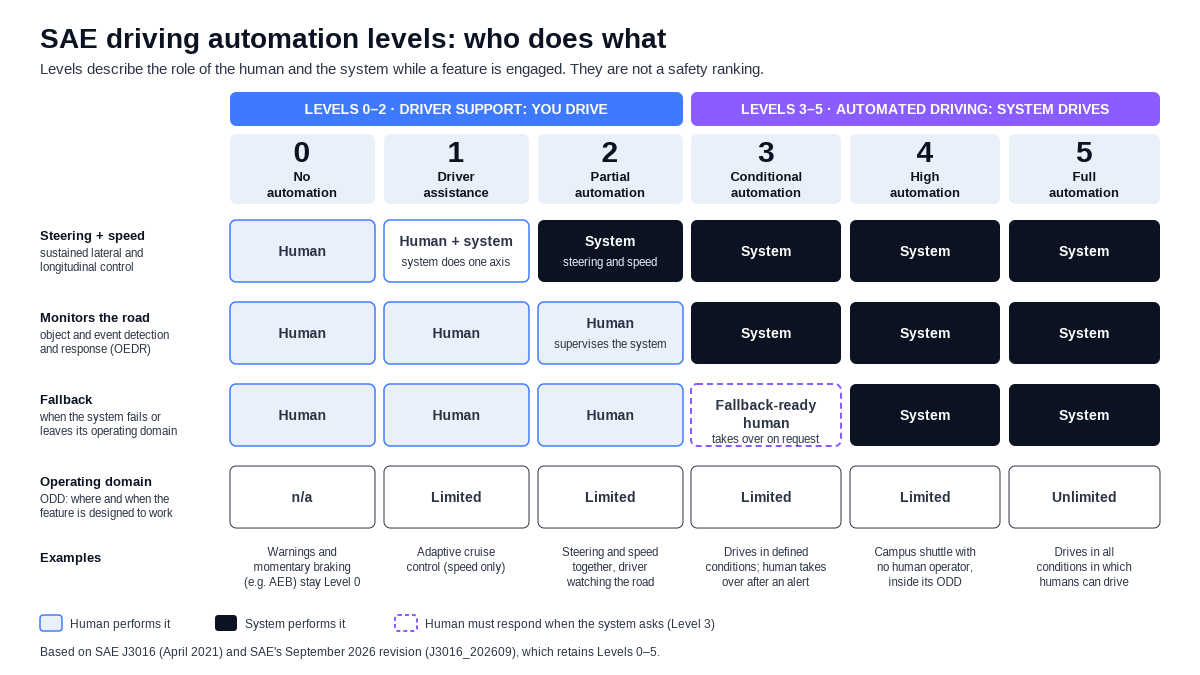
The SAE levels of driving automation run from Level 0 (no automation) to Level 5 (full automation). They are defined in the SAE J3016 standard [1]. At Levels 0 to 2, a human is driving, even when the car steers and brakes on its own, and must watch the road at all times. At Levels 3 to 5, an automated driving system performs the entire driving task while it is engaged [2][3]. The real dividing lines are who monitors the road, who takes over when something fails, and whether the system works only in limited conditions.
Where the levels come from
SAE International first issued J3016 in January 2014. Until September 2026, the current version was the April 2021 revision, J3016_202104 [1]. SAE published another revision on September 20, 2026, J3016_202609. It still defines Levels 0 through 5, and SAE says its simple level descriptors were changed to make the differences between levels easier to understand. SAE also notes that those short descriptors are not the formal definitions of the levels [2]. The explanations below draw on SAE's public summary of the 2026 revision [2] and on Carnegie Mellon researcher Philip Koopman's user guide to the 2021 text [3].
Three ground rules from the standard prevent most of the confusion:
- It is a vocabulary, not a safety rating. SAE says J3016 "provides a taxonomy and definitions and is not a safety standard" [2]. It describes what could be built; it does not certify that anything is safe [3].
- Higher is not "better." A higher level is not automatically safer, and progress is not simply a matter of moving "up the levels" [3].
- Levels describe features, not cars. A single vehicle can offer several features at different levels. The level at any moment depends on which feature is engaged [2][3]. Roles are assigned by the feature's design, not by how well it actually performs [2].
The standard also rules out fractional or "plus" levels such as "Level 2.5" or "Level 2+" [3].
The building blocks: DDT, OEDR, fallback and ODD
J3016 sorts features using a handful of defined terms [3]:
- Dynamic driving task (DDT): the real-time work of driving. That covers moving the vehicle (steering, accelerating and braking) plus monitoring and responding to the environment. It excludes strategic choices such as trip scheduling and picking destinations or waypoints [3].
- OEDR (object and event detection and response): the monitoring-and-responding part of the DDT. It means watching the driving environment, including what other road users do, recognizing when a response is needed and carrying it out [3].
- DDT fallback: what happens when a system fails or reaches the edge of its operating conditions. Either a human takes over or the vehicle reaches a minimal risk condition, which the 2021 edition describes as a stable, stopped condition [3].
- Operational design domain (ODD): the conditions a feature is designed to handle. Limits can include lighting, precipitation, the condition of road markings and geography [3].
The level depends on five questions: does the system handle steering or speed, both together, the monitoring (OEDR), the fallback, and is it limited to an ODD [3]?
The six levels, one by one
Level 0: No Driving Automation
The driver performs the entire driving task. Systems that only warn the driver, and features that intervene only momentarily, such as automatic emergency braking, electronic stability control and lane keeping assistance, do not change the driver's role, so they do not raise a car above Level 0 [2][3]. J3016 also avoids the umbrella term "ADAS" in its own definitions [3]. Our upcoming ADAS explainer covers those features.
Level 1: Driver Assistance
The system handles either steering or speed on a sustained basis, but not both at once. The driver does everything else, including watching the road, and continually supervises the feature [2][3]. Adaptive cruise control, which manages speed and following distance, is the classic Level 1 feature [3].
Level 2: Partial Driving Automation
The system handles steering and speed together, but the driver must continually supervise it [2]. A Level 2 feature's response to external events is limited, so the human must notice and react to at least some of them, and is still the driver [3]. Looking away does not hand the job to the car.
Level 3: Conditional Driving Automation
This is the first level where the system drives, including monitoring the road, under defined conditions [2]. A Level 3 feature can only be engaged inside its ODD [3]. The human becomes a "fallback-ready user." That person does not need to supervise, but must take over after an alert from the system or an evident vehicle malfunction [2], such as a broken body or suspension component [3]. J3016 expects a takeover request to give the user at least several seconds, though it sets no fixed minimum [3].
Level 4: High Driving Automation
The system drives and handles the fallback itself, within a defined ODD [2][3]. No one needs to be ready to take over: SAE's 2026 descriptor says human driving is not needed to mitigate risk [2]. If something goes wrong, the system brings the vehicle to a minimal risk condition on its own. That automatic fallback is the key difference from Level 3 [3]. An occupant of a car with an engaged Level 4 feature is a passenger. A campus shuttle with no human operator is a typical example [3].
Level 5: Full Driving Automation
Like Level 4, but the system can drive under all conditions in which humans can drive [2]. Its ODD is described as unlimited [3]. That still means on-road driving: J3016 covers only public roads and publicly accessible areas [2][3].
Comparison table
Level | Name | Steering and speed | Monitors the road (OEDR) | Fallback | ODD |
|---|---|---|---|---|---|
0 | No Driving Automation | Driver | Driver | Driver | n/a |
1 | Driver Assistance | Driver and system | Driver | Driver | Limited |
2 | Partial Driving Automation | System | Driver | Driver | Limited |
3 | Conditional Driving Automation | System | System | Fallback-ready user (becomes the driver during fallback) | Limited |
4 | High Driving Automation | System | System | System | Limited |
5 | Full Driving Automation | System | System | System | Unlimited |
Adapted from SAE J3016 (April 2021), Table 1, as restated in Koopman's user guide [3], and SAE's 2026 level descriptors [2].
The three most important lines
Between Level 2 and Level 3: who watches the road. At Level 2 you are driving and the car is helping. At Level 3, while the feature is engaged and inside its ODD, the system is driving and you are on standby. Marketing names often blur this line, so check the owner's manual for what the feature requires of you.
Between Level 3 and Level 4: who handles failure. A Level 3 system may hand control back to you. A Level 4 system must be able to reach a minimal risk condition on its own [3]. A feature that only expects the driver to take over as an option is, by the definitions, Level 4, even if it is marketed as Level 3 [3].
Between Level 4 and Level 5: where it works. Level 4 works only inside its ODD, for example a mapped city area or a specific freeway. Level 5 has no ODD limit [3].
One more subtlety: a test vehicle with a safety driver can still be Level 4. The presence of a safety driver does not change the level of a feature designed for Level 4 [3].
How US regulators use the levels
The National Highway Traffic Safety Administration (NHTSA) uses the J3016 vocabulary in its rules and notices. Its crash-reporting order, for example, covers "Automated Driving Systems" (ADS) and "Level 2 Advanced Driver Assistance Systems" (ADAS) [4]. In J3016 terms, an ADS is a Level 3, 4 or 5 system [3].
- Crash reporting. NHTSA's Standing General Order 2021-01 requires specified companies to report crashes involving ADS or certain Level 2 ADAS systems. A third amended version, issued April 24, 2025, took effect with the reporting period beginning June 16, 2025 [4]. From then through the end of 2025, NHTSA received reports of 517 alleged crashes involving ADS and 787 involving Level 2 ADAS. Through July 2026, its follow-up had contributed to seven formal investigations and prompted seven recalls [4]. These are counts of reported crashes, not crash rates, and they do not establish fault.
- The AV Framework. In April 2025, DOT and NHTSA announced an automated vehicle framework. Under it, NHTSA expanded its Automated Vehicle Exemption Program to US-built vehicles, began rulemakings to update federal safety standards for ADS vehicles without manual controls, and in July 2026 sought comment on interim guidance for commercial deployment exemptions [4].
- A commercial deployment exemption. On July 31, 2026, NHTSA published its grant of an exemption letting Zoox manufacture and commercially deploy an ADS-equipped passenger car that does not comply with parts of eight federal motor vehicle safety standards. The grant comes with enhanced oversight conditions [5].
For coverage of the commercial race, see our reporting on US robotaxis in 2026 and autonomous driving AI at CES 2026.
How to read a carmaker's claims
- Ask what you are responsible for. If the manual says you must keep watching the road, the feature is Level 2 or lower, whatever it is called.
- Ask about the takeover. Does the system ever ask you to take over? If yes, and you don't need to watch the road until then, that describes Level 3.
- Ask about the ODD. Which roads, speeds, weather and times of day does the feature support? Every feature from Level 1 to Level 4 has limits [3].
- Don't treat the level as a quality score. A well-designed Level 2 system can be more useful in daily life than a narrowly limited Level 3 one. The level defines roles by design, not how well the system performs [2][3].
- Watch for software names. Feature names and over-the-air updates change. Our coverage of Tesla FSD's 2026 updates shows why reading the official description matters more than the product name.
Outlook
Expect the vocabulary to keep evolving at the edges while the six-level structure stays stable. SAE's September 2026 revision kept Levels 0 to 5 but rewrote the plain-language descriptors [2]. US regulation is moving toward deployment of ADS vehicles without manual controls, through exemptions and proposed changes to federal safety standards [4][5]. For the sensors behind these systems, see our upcoming LiDAR vs radar vs camera explainer, and for the bigger picture, Self-Driving Cars: Technology and Challenges.
Frequently asked questions
Is Level 2 self-driving?
No. At Level 2 the system steers and controls speed, but you must continually supervise it and respond to events it can't handle. You remain the driver [2][3].
What is the difference between Level 3 and Level 4?
Fallback. A Level 3 system may ask you to take over and expects you to respond. A Level 4 system can handle failures itself and bring the vehicle to a minimal risk condition without you [2][3].
Does Level 5 exist today?
We could not find any primary source documenting a Level 5 feature in service. Level 5 requires driving under all conditions in which humans can drive, with no ODD limit [2][3]. That is a much higher bar than Level 4, which only has to work inside a defined ODD.
What is an operational design domain (ODD)?
It is the set of conditions a driving automation feature is designed to handle, such as certain roads, lighting or weather [3]. A Level 3 feature can only be engaged inside its ODD [3].
Is automatic emergency braking a level of automation?
No. Features that warn or intervene only momentarily, such as automatic emergency braking, do not perform part of the driving task on a sustained basis. A car with only those features is Level 0 [2][3].
Did SAE change the levels in 2026?
SAE published a revised J3016 on September 20, 2026. It still defines Levels 0 to 5, and SAE says it changed the simple level descriptors to clarify the differences between levels [2]. Check the current text for any wording updates.
Sources
- SAE International. "J3016_202104: Taxonomy and Definitions for Terms Related to Driving Automation Systems for On-Road Motor Vehicles" (SAE Mobilus listing). https://saemobilus.sae.org/content/j3016_202104 (accessed November 2026)
- SAE International. "J3016_202609: Taxonomy and Definitions for Terms Related to Driving Automation Systems for On-Road Motor Vehicles" (SAE Mobilus listing). https://saemobilus.sae.org/standards/j3016_202609-taxonomy-definitions-terms-related-driving-automation-systems-road-motor-vehicles (accessed November 2026)
- Philip Koopman, Carnegie Mellon University. "SAE J3016 User Guide" (updated September 4, 2021). https://users.ece.cmu.edu/~koopman/j3016/index.html (accessed November 2026)
- National Highway Traffic Safety Administration. "AV Framework Updates and Request for Comments on Interim Guidance," Federal Register, July 31, 2026 (Docket NHTSA-2026-1552). https://www.federalregister.gov/documents/2026/07/31/2026-15483/av-framework-updates-and-request-for-comments-on-interim-guidance (accessed November 2026)
- National Highway Traffic Safety Administration. "Zoox: Grant of Temporary Exemption From Portions of Various Requirements of the Federal Motor Vehicle Safety Standards for an Automated Driving System-Equipped Vehicle," Federal Register, July 31, 2026. https://www.federalregister.gov/documents/2026/07/31/2026-15485/zoox-grant-of-temporary-exemption-from-portions-of-various-requirements-of-the-federal-motor-vehicle (accessed November 2026)