Electric Vehicles: Complete Beginner's Guide
How electric cars work, BEV vs PHEV vs hybrid, charging, range, battery life, costs and US tax credit status, using DOE, AFDC and IEA data as of late 2026.
An electric vehicle (EV) uses one or more electric motors, powered by a rechargeable battery pack, to drive its wheels. Instead of filling a tank, you plug into a charger at home, at work or on the road. The big trade-offs are higher efficiency, lower maintenance and no tailpipe emissions, against longer refueling time and range that depends on charging access [1][3].
This guide covers how EVs work, the main types, charging and range, batteries, costs and the US tax credit situation as of November 2026, and a practical way to decide whether one fits your life.
How an electric car works
A battery electric car is mechanically simpler than a gasoline car. The US Department of Energy's Alternative Fuels Data Center (AFDC) lists the key components [1]:
- Charge port. Connects the car to an external power supply to charge the traction battery.
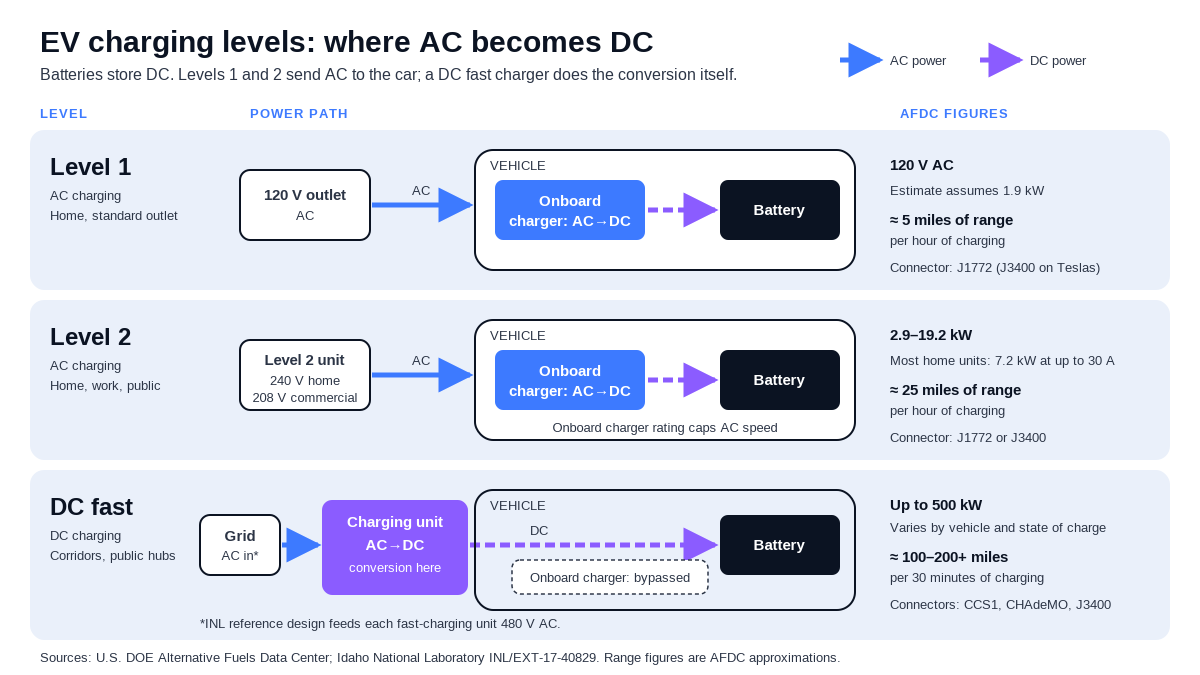
- Onboard charger. Takes the incoming AC electricity from the charge port and converts it to DC to charge the battery.
- Traction battery pack. Stores electricity for the motor.
- Power electronics controller. Manages the flow of energy from the battery, controlling the motor's speed and torque.
- Electric traction motor. Uses battery power to drive the wheels.
- DC/DC converter. Steps the high-voltage battery supply down to the lower voltage that runs accessories and recharges the auxiliary battery.
- Thermal system. Keeps the motor, power electronics and other components in their operating temperature range.
- Transmission. Transfers power from the motor to the wheels.
Think of it as a single energy pipeline: grid, charger, battery, inverter, motor, wheels. There's no engine, no fuel system and no exhaust.
That simplicity shows up in efficiency. Fueleconomy.gov says EVs convert over 77% of the electrical energy from the grid into power at the wheels, compared with about 12% to 30% of the fuel energy in conventional gasoline vehicles [3]. Most of the energy in gasoline leaves as heat.
The main types: BEV, PHEV and hybrid
"Electrified" covers three different designs. The AFDC defines them this way [2]:
- Battery electric vehicles (BEVs), also called all-electric vehicles, run only on a battery that you charge by plugging in. Typical range is 150 to 400 miles.
- Plug-in hybrids (PHEVs) combine a gasoline engine with an electric motor and a battery you can plug in. Most can travel between 20 and 40 miles on electricity alone before the engine takes over.
- Hybrids (HEVs) also pair an engine with a motor, but you can't plug them in. Gasoline fuels the engine, and regenerative braking recharges the small battery.
Battery electric (BEV) | Plug-in hybrid (PHEV) | Hybrid (HEV) | |
|---|---|---|---|
Plugs in? | Yes | Yes | No |
Gasoline engine? | No | Yes | Yes |
Electric-only driving | Always | Typically 20–40 miles, then gasoline [2] | Limited, short distances |
Typical range (AFDC) | 150–400 miles [2] | Electric range plus gasoline range | Gasoline range |
Tailpipe emissions | None [6] | None in electric-only mode [6] | Lower than conventional [6] |
Best fit | Drivers with reliable charging | Drivers who want electric commuting with a gasoline backup | Drivers who can't charge at home |
When the IEA counts "electric cars" in its statistics, it includes both BEVs and PHEVs, but not conventional hybrids [8].
Charging basics
There are three charging levels in the United States. AFDC gives these figures [4]:
- Level 1 uses a standard 120-volt outlet and adds about 5 miles of range per hour of charging (assuming 1.9 kW).
- Level 2 uses 240 V service (typical at homes) or 208 V (typical at commercial sites). It adds about 25 miles of range per hour. Most residential Level 2 chargers operate at up to 30 amps, delivering 7.2 kW, and a Level 2 unit can range from 2.9 to 19.2 kW.
- DC fast charging adds roughly 100 to 200+ miles of range in 30 minutes. A DC unit can provide up to 500 kW, but actual power varies by vehicle and battery state of charge.
AFDC says total charging time can range from less than 20 minutes on a DC fast charger to 20 hours or more on Level 1. It depends on how depleted the battery is, its capacity, its chemistry, the car's internal charger capacity and the charging equipment [4].
In practice, most owners with a driveway or garage do most of their charging at home overnight. DC fast charging matters most on road trips. Our explainer on charging levels goes deeper into connectors and charging speeds.
Connectors in the US
Two plug families matter for buyers in 2026:
- J1772 and CCS1. J1772 is the standard AC plug. CCS1 (also called "J1772 combo") adds DC pins below it for fast charging [4][9].
- SAE J3400 (NACS). SAE International standardized this connector based on Tesla's design [4]. Driveelectric.gov says most automakers committed to adopting it beginning in 2025, while non-Tesla EVs produced through 2024 keep a CCS1 port [9].
Adapters bridge the gap. Every Tesla comes with a J1772 adapter for non-Tesla Level 2 equipment [4]. If you're buying used, check which port the car has and which adapters come with it.
Range: what the number means
The range on a window sticker is an estimate under standard test conditions. Your real range depends on speed, temperature, terrain and use of heating or air conditioning. AFDC's typical BEV range of 150 to 400 miles is wide because battery sizes vary a lot between models [2].
A useful mental shift is to stop thinking about a full tank. If you charge at home most nights, you start most days with as much range as you need. Range matters mainly for long trips and for drivers without home charging.
The battery
The traction battery is the most expensive part of an EV, and the one people worry about most.
Chemistry. Most EVs use lithium-ion batteries, but there are two main cathode families. Lithium iron phosphate (LFP) accounted for over 55% of EV batteries deployed globally in 2025, while nickel-based chemistries such as NMC make up most of the rest [8]. Our LFP vs NMC explainer covers the trade-offs. The IEA says the all-solid-state batteries behind most headlines are still at the prototype stage [8].
Lifespan. Fueleconomy.gov cites a DOE study suggesting EV batteries may last 12 to 15 years in moderate climates and 8 to 12 years in severe climates [3]. AFDC notes that many manufacturers offer 8-year/100,000-mile battery warranties [5]. Check the exact terms for any car you're considering, including what capacity loss counts as a warranty claim.
Replacement. Fueleconomy.gov warns that batteries are expensive, so replacing one out of warranty can be costly [3]. This is the main reason a battery health report is worth getting on a used EV.
Costs, incentives and running expenses
We won't quote vehicle prices here because they change monthly. What you can compare reliably:
- Purchase incentives. The federal clean vehicle tax credit no longer applies. Fueleconomy.gov states that vehicles acquired after September 30, 2025, do not qualify for a credit [7]. The IEA notes that the July 2025 budget law (the One Big Beautiful Bill Act) ended the new and used EV credits after September 2025 [8]. Some states and utilities still run their own programs, so check locally.
- Energy costs. The IEA says electric cars generally have lower running costs than combustion cars, mainly because they're more efficient [8]. Your savings depend on your electricity rate, where you charge and local gasoline prices. Public DC fast charging usually costs more per mile than home charging.
- Maintenance. All-electric vehicles need less maintenance because they have fewer moving parts and fluids to change [5]. There are no oil changes. Brakes on vehicles with regenerative braking generally last longer [5].
Emissions
All-electric vehicles produce zero tailpipe emissions [6]. The full picture is the life cycle, which AFDC defines as all emissions from vehicle and fuel production through to decommissioning. AFDC notes that an EV's emissions advantage depends on how the local electricity is generated, and it's largest where power comes from low-polluting sources [6].
Battery manufacturing adds emissions at the start of an EV's life. Over years of driving, efficient operation can offset them, and the more your grid relies on clean generation, the faster that happens.
Market snapshot
Here's where things stood according to the IEA's Global EV Outlook 2026, published in May 2026 [8]:
- Electric car sales grew 20% globally in 2025, to more than 20 million. That's one in four new cars sold.
- In China, EVs accounted for nearly 55% of car sales. In Europe, the share reached 28%.
- In the United States, sales were around 1.5 million in 2025, just under 10% of car sales, slightly down from 2024. After the tax credits ended, fourth-quarter 2025 sales were 45% lower than a year earlier.
- At the end of 2025, the US had nearly 70,000 fast and ultra-fast public charging points and over 160,000 slow ones (the IEA counts chargers up to 22 kW as slow). The US has 33 electric light-duty vehicles per public charging point, but the IEA notes it also has greater access to home charging.
For a look at which models are selling, see our ranking of the best-selling EVs in the USA in 2026.
Limitations and trade-offs
EVs aren't the right answer for everyone yet. The main drawbacks:
- Charging access. Without home or workplace charging, you depend on public chargers, which adds time and usually cost.
- Refueling time. Even a fast charge to 80% can take about 30 minutes [3], far longer than a gasoline fill-up.
- Range in harsh conditions. Cold weather, high speeds and towing all reduce range.
- Battery replacement cost if the battery fails outside warranty [3].
- Policy uncertainty. US federal incentives and fuel economy rules changed sharply in 2025 [8].
How to decide: a five-question checklist
- Can you charge where you park overnight? If you have a 240 V circuit or can install one, a BEV becomes much easier to live with. If not, map the public chargers near home and work.
- What's your longest regular trip? If it's well within a car's real-world range, with a buffer for winter, daily range anxiety disappears. For occasional long trips, check the DC fast chargers on your usual routes.
- How often do you drive long distances? If it's frequent and chargers are sparse along your routes, a PHEV or hybrid may suit you better.
- Which connector does the car use? Note whether it has a J3400 (NACS) or CCS1 port and which adapters are included.
- What does the battery warranty actually cover? Check the years, miles and capacity threshold. On a used car, ask for a battery health report.
Outlook
The IEA expects global electric car sales to reach 23 million in 2026, about 28% of total car sales, with Europe growing fastest among major markets [8]. That's a projection, and the IEA notes that the economic effects of the Middle East conflict and the policy responses to it could shift the numbers either way.
In the US, the near term depends on prices and charging buildout more than on federal incentives. Watch J3400 adoption across new models, the pace of fast-charger installation, and whether lower-cost LFP-equipped models reach US showrooms.
Frequently asked questions
How long does it take to charge an electric car?
It depends on the charger and the car. AFDC says it can range from less than 20 minutes on a DC fast charger to 20 hours or more on a standard 120 V outlet [4]. Fueleconomy.gov puts a full recharge at 3 to 12 hours, and a fast charge to 80% at about 30 minutes [3].
Do I need a home charger?
Not strictly. A 120 V outlet adds about 5 miles of range per hour, which can cover short commutes [4]. Most owners who drive more find a Level 2 charger (240 V) far more practical. AFDC notes residential Level 2 units need a dedicated 40-amp circuit under the National Electrical Code [4].
How long do EV batteries last?
A DOE study cited by fueleconomy.gov suggests 12 to 15 years in moderate climates and 8 to 12 years in severe climates [3]. Many manufacturers back batteries with 8-year/100,000-mile warranties [5]. Real-world life depends on climate, charging habits and the battery chemistry.
Is there still a federal tax credit for EVs?
No. Vehicles acquired after September 30, 2025, don't qualify for the federal clean vehicle credit [7]. Some states and utilities still offer rebates or reduced charging rates, so check local programs before you buy.
Can a non-Tesla EV use a Tesla Supercharger?
Increasingly, yes. SAE standardized Tesla's connector as J3400, and most automakers committed to adopting it beginning in 2025 [9]. Older CCS1 cars may need an adapter, so check your automaker's guidance for compatibility.
Are EVs really cleaner than gasoline cars?
They have no tailpipe emissions [6]. Across the full life cycle, the advantage depends on how your local electricity is generated, and it's biggest where power comes from low-polluting sources [6].
Sources
- U.S. Department of Energy, Alternative Fuels Data Center. "How Do All-Electric Cars Work?" https://afdc.energy.gov/vehicles/how-do-all-electric-cars-work
- U.S. Department of Energy, Alternative Fuels Data Center. "Electric Vehicles." https://afdc.energy.gov/vehicles/electric
- fueleconomy.gov (DOE/EPA). "All-Electric Vehicles." https://www.fueleconomy.gov/feg/evtech.shtml
- U.S. Department of Energy, Alternative Fuels Data Center. "Developing Infrastructure to Charge Electric Vehicles." https://afdc.energy.gov/fuels/electricity-stations
- U.S. Department of Energy, Alternative Fuels Data Center. "Maintenance and Safety of Electric Vehicles." https://afdc.energy.gov/vehicles/electric-maintenance
- U.S. Department of Energy, Alternative Fuels Data Center. "Emissions from Electric Vehicles." https://afdc.energy.gov/vehicles/electric-emissions
- fueleconomy.gov (DOE/EPA). "Federal Tax Credits for Clean Vehicles." https://www.fueleconomy.gov/feg/tax2023.shtml
- International Energy Agency. "Global EV Outlook 2026." May 2026. https://www.cleanenergyministerial.org/content/uploads/2026/05/globalevoutlook2026.pdf
- Joint Office of Energy and Transportation. "Charging Connector." https://driveelectric.gov/charging-connector