EV Charging Levels Explained: Level 1, Level 2 and DC Fast
Level 1, Level 2 and DC fast charging compared: voltage, kW, miles of range per hour, where AC becomes DC, and J1772, CCS1 and J3400 (NACS) connectors.
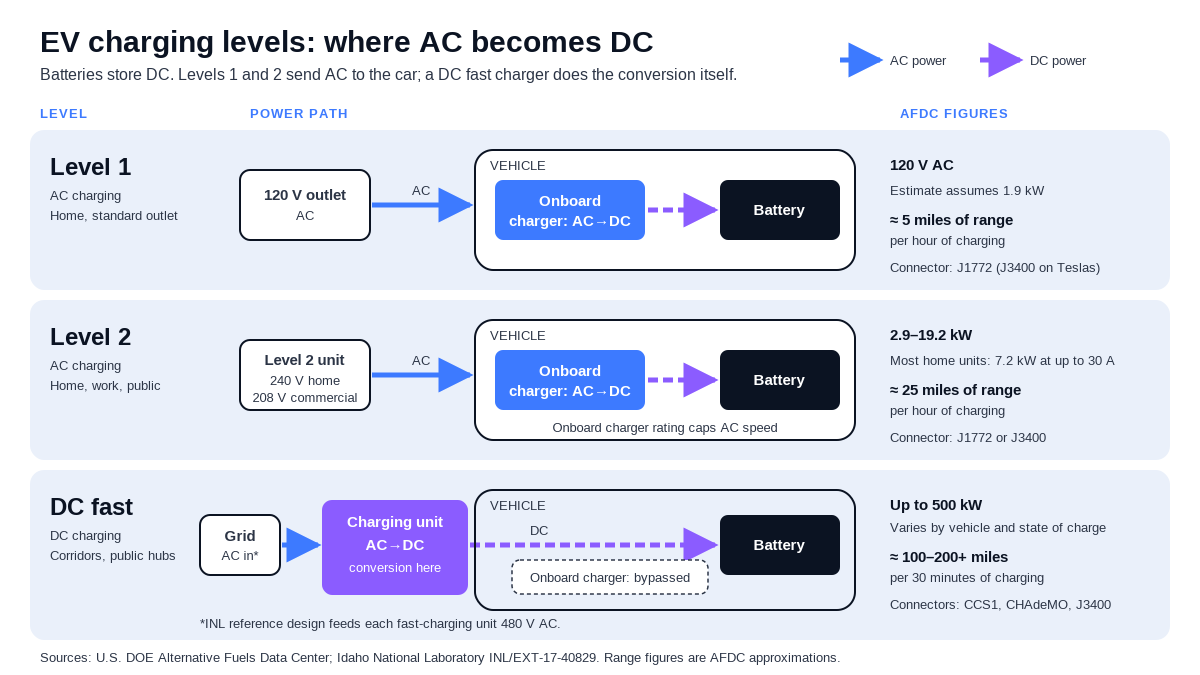
EV charging in the US comes in three levels. Level 1 uses a standard 120 V outlet and adds about 5 miles of range per hour. Level 2 uses 208 V or 240 V and adds about 25 miles per hour. DC fast charging adds roughly 100 to 200+ miles in 30 minutes [1]. The key difference is where AC grid power becomes the DC a battery stores: inside the car for Levels 1 and 2, and inside the charger for DC fast charging [2][3].
The one idea that explains charging speed
Batteries store direct current (DC). The grid delivers alternating current (AC). Something has to convert one to the other, and where that conversion happens sets the speed limit.
- Level 1 and Level 2 are AC charging. The station is basically a smart, safe switch that passes AC power to the car. The car's onboard charger takes the incoming AC from the charge port and converts it to DC to charge the battery [2]. The onboard charger's rating caps how fast AC charging can go, which is why AFDC lists "the vehicle's internal charger capacity" as a factor in charging time [1].
- DC fast charging moves the converter into the station. Idaho National Laboratory's DC fast charging design study puts it plainly: AC/DC conversion, charger-to-vehicle communication and power delivery are all performed within each fast-charging unit [3]. The station sends DC straight to the battery, bypassing the car's onboard charger.
A car can only carry so much conversion hardware before weight, cost and heat become a problem. A roadside cabinet doesn't have that constraint, so it can hold much larger power electronics.
Level 1: the outlet you already have
What it is. Level 1 charges through a 120 V AC plug. On the car end it uses the J1772 connector (or the car's own port via adapter), and on the wall end a standard household plug [1].
How fast. About 5 miles of range per hour of charging, assuming 1.9 kW of charging power. AFDC's example: 8 hours at 120 V can replenish about 40 miles of range for a mid-size EV [1].
Where it's used. Mostly at home when only a 120 V outlet is available [1]. It's rare in public: as of 2023, less than 1% of US public charging ports were Level 1 [1].
Who it suits. Plug-in hybrids with small batteries, and BEV drivers with short daily commutes who park for long hours.
Level 2: the everyday workhorse
What it is. Level 2 delivers AC through 240 V service (typical in homes) or 208 V service (typical in commercial buildings) [1]. Non-Tesla cars use the J1772 connector. Tesla vehicles use J3400, and every Tesla comes with a J1772 adapter for non-Tesla Level 2 equipment [1].
How fast. About 25 miles of range per hour of charging. Power output for a Level 2 unit ranges from 2.9 to 19.2 kW. Most residential Level 2 chargers operate at up to 30 amps, delivering 7.2 kW [1]. The car's onboard charger may accept less than the station can supply, and the lower of the two sets the rate.
Installation. Most homes have 240 V service available. AFDC notes that residential units need a dedicated 40-amp circuit to comply with National Electrical Code Article 625 [1]. Get a licensed electrician to check your panel capacity before you buy a unit.
Where it's used. At home, at workplaces and in public parking. As of 2023, nearly 80% of US public charging ports were Level 2 [1].
DC fast charging: road-trip speed
What it is. A DC fast charger takes AC from the grid, converts it to DC inside the unit and delivers DC directly to the battery [3]. In INL's reference design, each fast-charging unit is fed 480 V AC from an onsite step-down transformer [3]. AFDC lists 208/120 V and 480/277 V as common US three-phase service voltages [1].
How fast. About 100 to 200+ miles of range per 30 minutes of charging. AFDC notes that a DC charging unit can provide up to 500 kW, and that charging power varies by vehicle and battery state of charge [1].
Why the speed drops as you charge. Charging power depends on the battery's state of charge [1]. An EPA presentation on fast-charging data notes that charging curves are front-loaded, with power tapering as the battery approaches full, and that many current vehicles drop to very low charging rates after about 80% [8]. That's why stopping at around 80% is a common road-trip habit, and why EPA notes route planning tends to charge between a low level and 80% [8]. Fueleconomy.gov notes that a fast charge to 80% can take about 30 minutes [7].
Connectors. In the US there are three DC fast connector types: CCS1, CHAdeMO and J3400 [5]. AFDC says most EV models on the market can charge using CCS, while CHAdeMO is mainly used by Japanese automakers [1].
Where it's used. Along heavy-traffic corridors and at public stations [1]. As of 2023, more than 20% of US public charging ports were DC fast chargers [1].
Side-by-side comparison
Level 1 | Level 2 | DC fast | |
|---|---|---|---|
Supply voltage | 120 V AC [1] | 240 V AC (residential), 208 V AC (commercial) [1] | AC input to the station (INL reference design: 480 V AC) [3]; DC output to the car |
Power (AFDC) | Range estimate assumes 1.9 kW [1] | 2.9–19.2 kW; most residential units 7.2 kW at up to 30 A [1] | Up to 500 kW; varies by vehicle and state of charge [1] |
Range added (AFDC) | ~5 miles per hour [1] | ~25 miles per hour [1] | ~100–200+ miles per 30 minutes [1] |
Where AC becomes DC | Onboard charger in the car [2] | Onboard charger in the car [2] | Inside the charging unit [3] |
US connectors | J1772; J3400 on Teslas [1] | J1772; J3400 [1] | CCS1, CHAdeMO, J3400 [5] |
Share of US public ports (2023) | <1% [1] | ~80% [1] | >20% [1] |
Typical use | Home, small daily needs | Home, work, destination | Road trips, corridors, quick top-ups |
Connectors and the J3400 (NACS) transition
The US is mid-switch on plug standards, and this matters more to buyers than the kW numbers.
- J1772 is the long-standing AC connector for Level 1 and 2 [1].
- CCS1, also called "SAE J1772 combo," uses the same five-pin J1772 layout for AC and adds DC pins for fast charging [5].
- J3400 is SAE's standardized version of Tesla's North American Charging System. SAE first published it as a Technical Information Report in December 2023 and revised it as a Recommended Practice in September 2024 [4][5]. One coupler can carry either DC or single-phase AC power using two current-carrying contacts [4].
Driveelectric.gov says most automakers have committed to incorporating the J3400 port beginning in 2025, while every non-Tesla EV produced through 2024 keeps a CCS1 port [5]. J3400 connectors and cables need UL 2251 safety certification [5].
For federally funded stations under the National Electric Vehicle Infrastructure (NEVI) program, driveelectric.gov says (as of November 2026) that each DC fast port must be able to charge any CCS1 vehicle. A J3400 connector can be added alongside, and adapters qualify only when permanently attached and integrated by the charger manufacturer [5].
Where charging tech is heading
The IEA's Global EV Outlook 2026 notes that new power electronics, cell technologies and pack designs are enabling higher-voltage, faster charging. The first 1,000-volt car models came out in 2025 [6]. Still, cars able to use chargers above 250 kW make up less than 5% of the global vehicle stock [6]. For most drivers, the car limits charging speed more than the station does.
On infrastructure, the IEA reports that the US had nearly 70,000 fast and ultra-fast public charging points and over 160,000 slow ones at the end of 2025. It also notes that NEVI obligations were paused from February 2025 to January 2026, and around 550 NEVI-funded fast-charging points were operating in 19 states as of April 2026 [6]. The IEA classes chargers up to 22 kW as slow, so its categories don't map one-to-one onto Level 1 and Level 2.
If you want to compare how quickly specific models charge, see our ranking of the fastest-charging EVs in the US in 2026. For costs per mile, see our EV charging cost vs gasoline breakdown.
How to choose your charging setup
- Start with your daily miles. Under about 40 miles a day with long overnight parking, Level 1 may be enough, based on AFDC's estimate of about 40 miles in 8 hours [1]. Above that, plan for Level 2.
- Check your car's onboard charger rating. A 19.2 kW wall unit won't charge faster than the car's onboard charger allows [1][2].
- Check your panel. A dedicated 40-amp circuit is the AFDC reference for a 30-amp residential unit [1]. Older homes may need a panel upgrade.
- Match connectors. Know whether your car has a J3400 or CCS1 port, and keep the right adapter in the car.
- Use DC fast charging for trips, not daily charging. It's fastest in the lower part of the battery's charge range, and power tapers as the battery fills [8].
Frequently asked questions
Is "Level 3" the same as DC fast charging?
People often say "Level 3" for DC fast charging, and AFDC notes that DC fast charging is also referred to as Level 3 charging [1]. The important point is that it delivers DC, not AC, so the car's onboard charger isn't involved [3].
Why does my car charge slower than the charger's rating?
Two common reasons. On AC (Level 1 and 2), the car's onboard charger caps the rate [2]. On DC fast chargers, power varies by vehicle and state of charge [1], and it typically tapers as the battery fills [8].
Do I need a Level 2 charger at home?
Not always. A 120 V outlet adds about 5 miles of range per hour, which covers short commutes [1]. If you drive more or want flexibility, Level 2 at about 25 miles per hour is far more practical [1].
Can I use a Tesla Supercharger with a non-Tesla EV?
Several automakers have announced adopting the J3400 connector from as early as 2025, which lets their cars use Tesla stations [1]. Cars with a CCS1 port may need an adapter. Check your automaker's guidance for which stations and adapters are approved.
Is DC fast charging bad for the battery?
Charging power is managed by the car based on battery state of charge, and charging power varies by vehicle [1]. Automakers set these limits to protect the cells. If you're concerned, follow your owner's manual and use Level 2 for routine charging.
Sources
- U.S. Department of Energy, Alternative Fuels Data Center. "Developing Infrastructure to Charge Electric Vehicles." https://afdc.energy.gov/fuels/electricity-stations
- U.S. Department of Energy, Alternative Fuels Data Center. "How Do All-Electric Cars Work?" https://afdc.energy.gov/vehicles/how-do-all-electric-cars-work
- Francfort, J., Salisbury, S., Smart, J., Garetson, T., Karner, D. "Considerations for Corridor and Community DC Fast Charging Complex System Design." Idaho National Laboratory, INL/EXT-17-40829, May 2017. https://www.osti.gov/servlets/purl/1459664
- SAE International. "J3400_202409: North American Charging System (NACS) for Electric Vehicles." Revised September 2024. https://saemobilus.sae.org/standards/j3400_202409-north-american-charging-system-nacs-electric-vehicles
- Joint Office of Energy and Transportation. "Charging Connector." https://driveelectric.gov/charging-connector
- International Energy Agency. "Global EV Outlook 2026." May 2026. https://www.cleanenergyministerial.org/content/uploads/2026/05/globalevoutlook2026.pdf
- fueleconomy.gov (DOE/EPA). "All-Electric Vehicles." https://www.fueleconomy.gov/feg/evtech.shtml
- Sobel, A. "DC Fast Charging Information for Consumers." U.S. Environmental Protection Agency, Office of Transportation and Air Quality, presentation, May 30, 2024. https://www.epa.gov/system/files/documents/2024-06/mstrs-spr-mtg-dc-fast-chrg-consumer-info-2024-05-30.pdf