LFP vs NMC Batteries: How the Two Main EV Chemistries Compare
LFP vs NMC lithium-ion batteries compared on energy density, cycle life, safety, cold weather, cost and cobalt, using IEA data and Sandia lab test results.
LFP (lithium iron phosphate) and NMC (lithium nickel manganese cobalt oxide) are the two cathode chemistries that power most EVs. NMC stores more energy per kilogram, so it suits long-range and performance cars. LFP is cheaper, contains no cobalt or nickel, lasts more charge cycles and is more thermally stable, at the cost of lower energy density [1][2][3]. In 2025, LFP accounted for over 55% of EV batteries deployed worldwide [1].
How a lithium-ion cell works
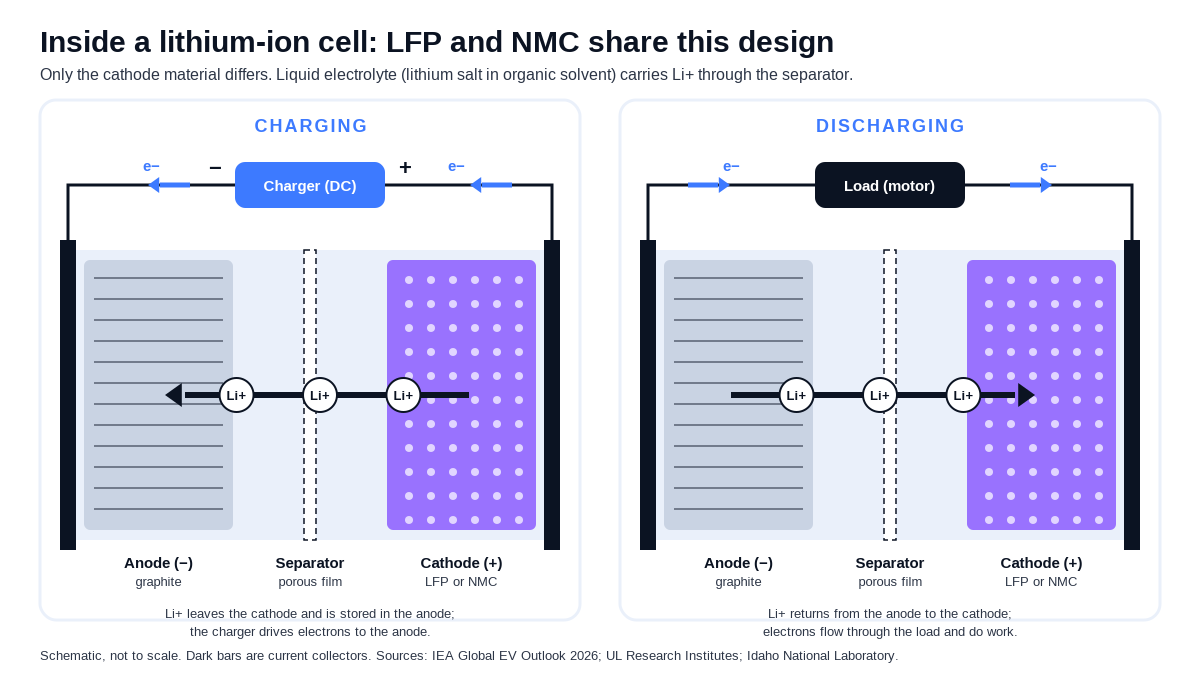
LFP and NMC are both lithium-ion batteries. They share the same basic design and differ in one layer: the positive electrode, or cathode.
The IEA describes four main constituents in every lithium-ion cell [1]:
- Cathode (positive electrode). Stores lithium ions. This is the layer that's either LFP or NMC.
- Anode (negative electrode). Also stores lithium ions. In today's cells it's usually graphite [5].
- Electrolyte. A liquid solution of organic solvents and a lithium salt that lets lithium ions move between the electrodes [1].
- Separator. A porous polymer film that keeps the electrodes from touching, which would cause a short circuit, while letting lithium ions pass [1][4].
On charge, lithium ions leave the cathode and are received by the anode [4]. The charger pushes electrons through the external circuit to the anode at the same time, so the charge balances.
On discharge, the anode releases lithium ions, which travel back through the electrolyte to the cathode. The electrons can't pass through the separator, so they take the external circuit through the motor or other load, and that current does the work [4].
Swapping the cathode material changes the voltage, how much lithium the cell can hold per kilogram, how it ages and how it behaves when abused. Those are the trade-offs this article covers.
What's different about the cathodes
LFP: an olivine crystal held together by phosphate
LFP's chemical formula is LiFePO₄. It has an olivine crystal structure, built around phosphate (PO₄) units. A 2022 review in Chemical Reviews explains the two properties that matter most [3]:
- The iron redox couple sits at about 3.4 V in the olivine structure. That's high enough to make iron, the most abundant transition metal, commercially useful as a cathode.
- The strong covalent P–O bond stabilizes oxygen in the lattice. Olivine cathodes have better thermal stability, and therefore safety, than layered ones.
The trade-off is that olivine cathodes have relatively poor ionic and electronic conductivity. Manufacturers make LFP as nanoparticles coated with conductive carbon to get usable charge and discharge rates [3]. LFP also has an intrinsically lower capacity and crystal density than layered oxides [3].
NMC: a layered oxide
NMC (also written NCM) is a layered oxide, LiNiₓMnᵧCo_zO₂. Lithium sits in sheets between layers of nickel, manganese and cobalt oxide. The numbers in names like NMC532, NMC622 and NMC811 give the rough nickel:manganese:cobalt ratio [1]. High-nickel versions rely on relatively small quantities of cobalt [1].
The layered structure packs more lithium into less space, which is why NMC cells reach higher energy density. But in a thermal runaway, charged layered cathodes can release oxygen, which feeds the reactions with the anode and electrolyte [3]. More manganese improves NMC's thermal stability, because the Mn⁴⁺–O bond is strong [3].
LFP vs NMC: side-by-side
Attribute | LFP | NMC |
|---|---|---|
Cathode structure | Olivine (phosphate) [3] | Layered oxide [3] |
Cobalt / nickel | None (LiFePO₄) [1][3] | Yes; NMC721 and NMC811 contain about 10% cobalt in their metal content [1] |
Energy density (latest generation, IEA) | Up to 205 Wh/kg [1] | 265 Wh/kg [1] |
Nominal voltage (cells tested by Sandia) | 3.3 V; 2.0–3.6 V range [2] | 3.6 V; 2.0–4.2 V range [2] |
Cycle life to 80% capacity (Sandia 18650 cells) | 2,500–9,000 equivalent full cycles [2] | 200–2,500 equivalent full cycles [2] |
Round-trip efficiency | Higher in all conditions tested [2] | Lower, especially at high discharge rates [2] |
Sensitivity to full 0–100% cycling | Little effect on capacity [2] | More sensitive [2] |
Thermal stability | Better; strong P–O bond stabilizes oxygen [3] | Lower; charged cathode can release oxygen [3] |
Pack cost (2025 average, IEA) | More than 40% cheaper per kWh [1] | Higher |
Global EV battery share (2025) | Over 55% [1] | Most of the remainder [1] |
Two cautions on reading this table. The energy density figures are the IEA's numbers for the latest generation of each chemistry, not for every cell on the market. The Sandia cycle-life ranges come from one specific set of commercial 18650 cells tested under varied lab conditions. They show relative trends, not a guarantee for any car's pack.
Energy density and range
NMC's higher energy density means a lighter, smaller pack for the same range, or more range in the same space. The IEA puts the latest generation of NMC batteries at 265 Wh/kg and the latest LFP batteries at up to 205 Wh/kg [1].
That's why NMC tends to suit long-range and high-performance models, while LFP's lower cost makes more sense where range targets are modest.
Cycle life and degradation
Sandia National Laboratories ran a multi-year cycling study of commercial LFP, NMC and NCA cells, varying temperature, depth of discharge and discharge rate [2]. The headline findings:
- LFP lasted longest. LFP cells reached 2,500 to 9,000 equivalent full cycles before falling to 80% capacity, compared with 200 to 2,500 for NMC and 250 to 1,500 for NCA. Most LFP cells hadn't even reached 80% when the NMC and NCA cells were done [2].
- The gap shrinks when you count energy. Measured by total energy delivered rather than cycles, the differences narrowed considerably, because each LFP cycle delivers less energy (lower capacity and voltage) [2].
- Conditions matter as much as chemistry. Even within manufacturer limits, cycle count at 80% varied by thousands of cycles depending on how the cells were used [2].
- LFP tolerates full-range cycling better. NMC and NCA cells were more sensitive to cycling across the full state-of-charge range. For LFP, the range had little effect on capacity [2].
That helps explain why charging guidance can differ by chemistry. Always follow your automaker's guidance, since pack design and software buffers differ between cars.
Temperature behavior
Temperature affects the two chemistries differently.
- Aging. In Sandia's tests between 15°C and 35°C, LFP faded faster as temperature rose, while NMC faded more slowly as temperature rose. That points to different dominant degradation mechanisms and different ideal thermal management [2].
- Cold-weather performance. The IEA notes that sodium-ion batteries perform significantly better at low temperatures than lithium-ion batteries, "particularly LFP chemistries" [1]. If you live somewhere cold, it is worth checking how an LFP-equipped car manages battery temperature in winter.
Safety
No lithium-ion chemistry is fireproof. Both use a flammable liquid electrolyte [1]. The difference lies in what the cathode does when a cell overheats.
Charged layered cathodes such as NMC can release oxygen during thermal runaway, and that oxygen fuels the self-accelerating reactions with the anode and electrolyte. Olivine cathodes like LFP hold their oxygen more tightly thanks to the strong P–O bond, and experiments show better thermal stability [3].
For perspective, the IEA's review of fire data finds EVs less prone to fires than combustion cars. In Norway, petrol and diesel cars were reported to catch fire four to five times more often than battery electric vehicles in 2023 [1].
Cost and supply chain
Cost. In 2025, LFP packs were more than 40% cheaper on average than NMC per kWh. The IEA notes that part of the gap reflects stationary storage, which mostly uses LFP and has lower energy-density requirements [1].
Materials. LFP contains no cobalt [1], and its formula, LiFePO₄, includes no nickel either [3]. That matters because cobalt prices doubled over the past year after the Democratic Republic of the Congo's export restrictions, and the DRC supplies almost two-thirds of global cobalt [1].
Where it's made. LFP production is concentrated in China, which leads in LFP battery and materials production [1]. In the United States, LFP's share of EV batteries almost halved in 2025 from an already low base. The IEA attributes this to higher tariffs on Chinese imports and sourcing rules tied to the EV tax credit that ended in the third quarter of 2025 [1]. Over 50 GWh of US battery manufacturing capacity, including LG Energy Solution and Ford lines, was reallocated toward LFP in 2025, mostly targeting stationary storage [1].
Beyond EVs. LFP accounted for over 90% of global stationary battery storage installations in 2025 [1]. Our explainer on battery energy storage systems covers why grid batteries favor it.
How to choose
For a car buyer, the chemistry is a proxy for a few practical questions:
- Do you need maximum range or performance? NMC's higher energy density gives more range per kilogram [1].
- Is your driving mostly daily commuting? LFP's long cycle life and tolerance of full charges suit high-mileage, routine use [2].
- Do you live somewhere very cold? Check how well the car preheats its battery, especially for LFP [1].
- Do you care about cobalt and nickel sourcing? LFP uses neither [1][3].
- Read the warranty, not just the chemistry. Real-world life depends on pack design, cooling and software as much as on cathode type [2].
What to watch
- LMFP. Adding manganese to LFP (lithium manganese iron phosphate) raises its voltage and energy density. The IEA counts LMFP with LFP in its statistics [1][3].
- US onshoring. Whether reallocated factory lines start supplying LFP cells for US-built EVs, not only grid storage [1].
- Sodium-ion. The latest sodium-ion cells reach up to 175 Wh/kg and perform better in the cold, which could make them a rival to LFP in small cars and storage [1].
- Solid-state. Semi-solid-state polymer batteries are already commercial, but the IEA says the almost- and all-solid-state designs behind most of the claimed benefits are still at the prototype stage [1].
Frequently asked questions
Is LFP better than NMC?
Neither is better overall. LFP is cheaper, lasts more cycles and is more thermally stable [1][2][3]. NMC stores more energy per kilogram, which means more range for the same weight [1]. The right choice depends on how far you drive and what you pay.
Can you charge an LFP battery to 100%?
In Sandia's tests, cycling across the full state-of-charge range had little effect on LFP capacity, while NMC and NCA cells were more sensitive to it [2]. That's lab data on bare cells, though. Follow the charging guidance in your vehicle's manual.
Do LFP batteries contain cobalt?
No. LFP batteries contain no cobalt [1], and the LiFePO₄ cathode contains no nickel [3]. NMC cathodes do contain cobalt, though high-nickel versions use relatively little [1].
Are LFP batteries safer?
LFP's olivine structure holds oxygen more tightly than layered NMC, giving it better thermal stability [3]. Both still use a flammable liquid electrolyte, so proper design and battery management matter for either chemistry [1].
Why don't more US EVs use LFP?
Most LFP cells and materials come from China. Tariffs and the sourcing rules tied to the former federal EV tax credit pushed LFP's US share down in 2025 [1]. Some US factories are shifting lines to LFP, mainly for grid storage so far [1].
Sources
- International Energy Agency. "Global EV Outlook 2026." May 2026. https://www.cleanenergyministerial.org/content/uploads/2026/05/globalevoutlook2026.pdf
- Preger, Y., et al. "Degradation of Commercial Lithium-Ion Cells as a Function of Chemistry and Cycling Conditions." Journal of the Electrochemical Society 167 (2020). DOI 10.1149/1945-7111/abae37. Sandia National Laboratories. https://www.osti.gov/pages/biblio/1650174
- Dong, Y., and Li, J. "Oxide Cathodes: Functions, Instabilities, Self Healing, and Degradation Mitigations." Chemical Reviews (2022). DOI 10.1021/acs.chemrev.2c00251. https://dspace.mit.edu/server/api/core/bitstreams/9c0c582b-b057-451f-b2fe-71cffd1cb611/content
- UL Research Institutes. "What Are Lithium-Ion Batteries?" https://ul.org/library/what-lithium-ion-battery-factsheet
- Chen, B.-R., et al. "Interfaces in All Solid State Li-metal Batteries: A Review on Instabilities, Stabilization Strategies, and Scalability." Idaho National Laboratory, INL/JOU-22-65627, March 2022. https://www.osti.gov/pages/servlets/purl/1923748