

How Solar Panels Work: From Photons to Power in Your Home
How solar panels turn sunlight into electricity: the p-n junction, electron-hole pairs, cells, modules and inverters, plus what limits efficiency and life.
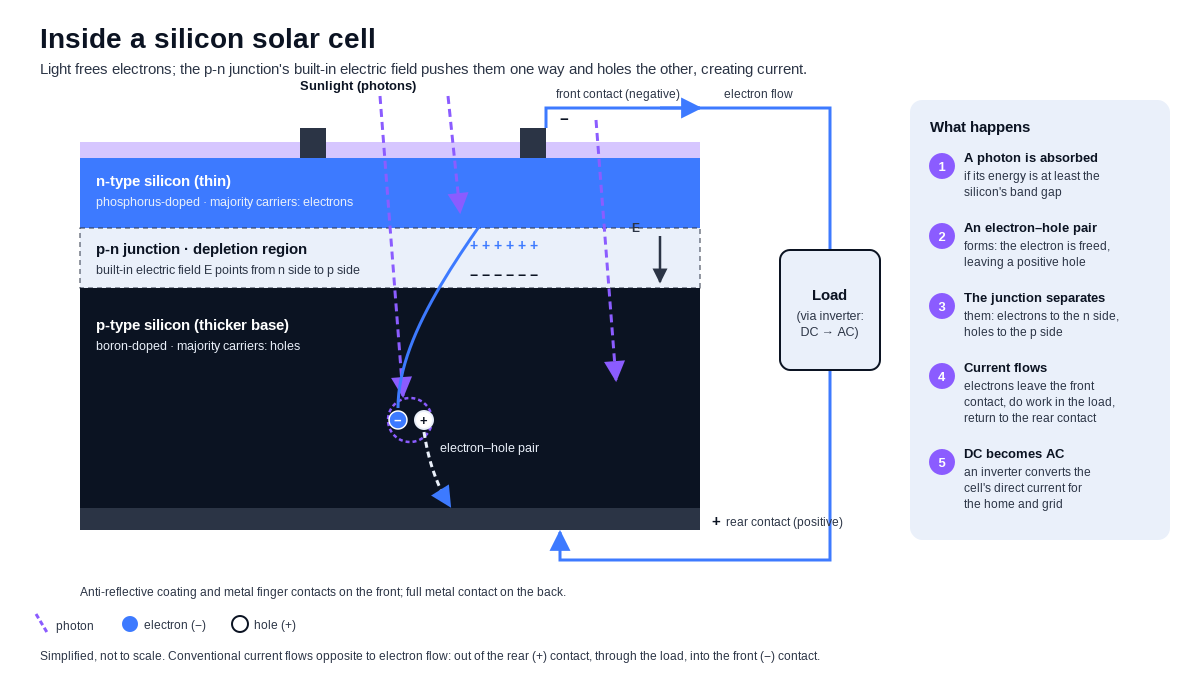
A solar panel turns sunlight into electricity using the photovoltaic effect. Each cell in the panel is a slice of semiconductor, usually silicon. When it absorbs light, the light's energy frees electrons, which can then flow as an electric current [1]. A built-in electric field at the cell's p-n junction pushes those electrons in one direction, so they leave through metal contacts as direct current (DC). An inverter then converts that current to the alternating current (AC) used by homes and the grid [4][6][8].
The short version, step by step
- Light arrives as photons, packets of energy with a range of wavelengths. Some are reflected, some pass through and some are absorbed [3].
- An absorbed photon frees an electron if it carries enough energy. The electron leaves its bond and becomes free to move, leaving behind a "hole" that acts like a positive charge [3][9].
- The junction sorts the charges. A built-in electric field between two differently treated layers of silicon sends electrons one way and holes the other [8].
- Electrons flow through an external circuit. They exit through the cell's metal contacts, do work in whatever is connected, and return to the other side of the cell [5][6].
- An inverter converts DC to AC for use in the home and on the grid [4][5].
Inside the cell: why silicon, and why two layers
A semiconductor sits in the middle
A PV cell contains a semiconductor, a material that conducts electricity better than an insulator but not as well as a metal [1]. Silicon is by far the most common semiconductor used in solar cells. It is also the second most abundant element on Earth after oxygen, and the most common semiconductor in computer chips [1].
The band gap: the energy toll for freeing an electron
In a semiconductor, electrons are normally held in bonds. The band gap is the minimum energy needed to free one so it can conduct [9]. A photon with less energy than the band gap cannot free an electron. A photon with more energy can, and the leftover energy turns into heat [3][9]. Freeing an electron also creates a hole, the empty spot it left. Neighboring electrons can hop into that spot, so the hole moves through the crystal like a positive charge. Both the electron and the hole carry current [9].
This is why no single material can turn all of sunlight into electricity. Sunlight runs from ultraviolet through visible light to infrared [3]. Any one band gap is too high for some photons and wastes energy from others.
Doping: making n-type and p-type silicon
Pure silicon does not, by itself, separate electrons from holes. Manufacturers change its balance of charge carriers by doping it with small amounts of other elements [7]:
- n-type silicon is doped with a group V element such as phosphorus. Each phosphorus atom has one more outer electron than silicon needs for bonding, and that extra electron is free to conduct. Electrons are the majority carriers [7].
- p-type silicon is doped with a group III element such as boron. Each boron atom has one electron too few, which leaves a hole. Holes are the majority carriers [7].
The p-n junction: a built-in one-way street
When n-type and p-type silicon meet, electrons from the n side spread into the p side and holes from the p side spread into the n side. As they cross, they leave behind fixed, charged atoms: positive on the n side, negative on the p side. Those fixed charges set up an electric field across a thin zone called the depletion region, along with a built-in voltage [8].
That field is the heart of the solar cell. When light creates an electron-hole pair near the junction, the field pushes the electron toward the n side and the hole toward the p side, and keeps them apart [8]. PVEducation describes the steps of solar cell operation as generating light-generated carriers, collecting them as current, building up a voltage across the cell and dissipating power in the load (and in parasitic resistances) [6].
In a typical design, light enters through a thin top layer (the "emitter") and is mostly absorbed in a thicker layer below it (the "base"). The emitter is kept thin so the junction sits close to where light is strongly absorbed, and the base is made thick enough to absorb most of the light [6]. Our diagram shows one standard arrangement: a thin n-type emitter on a thicker p-type base.
The EIA describes the same result from the outside. Electrons collect at the front surface and create a charge imbalance between the front and back of the cell, which acts like the negative and positive terminals of a battery [5].
Contacts, coatings and the finished cell
The current leaves through conductive metal contacts, the grid-like lines visible on a solar cell [1][4]. The front surface is also treated to reduce reflection. Untreated silicon reflects more than 30% of incoming light, so manufacturers use anti-reflective coatings and textured surfaces. That is why high-efficiency cells look dark blue or black [3].
A finished cell is small. It typically produces only about 1 or 2 watts and is often thinner than four human hairs [2].
From cell to panel to system
Level | What it is | What it adds |
|---|---|---|
Cell | One semiconductor device | About 1 to 2 watts [2] |
Module (panel) | Cells wired together and encased in protective layers | Higher power and weather protection [2] |
Array | Several modules connected together | Scales output to the job [2][5] |
System | Arrays plus inverter, wiring and grid connection | Usable AC power [2][5] |
Cells are connected into modules to raise power, and modules can be connected into arrays. One or more arrays connect to the grid as part of a complete PV system [2]. Because PV cells generate DC, and nearly all transmission and distribution systems carry AC, an inverter converts the power [5]. DOE's 2019 primer noted that a typical residential rooftop system had about 30 modules [4].
Orientation matters. Panels produce the most electricity when facing the sun directly. Most systems use fixed mounts angled to balance performance and cost, because tracking systems are expensive [5].
Types of solar cells
Technology | How it differs | Status (per DOE) |
|---|---|---|
Crystalline silicon | Silicon atoms in an ordered crystal lattice | By far the most common; high efficiency, low cost, long life [1] |
Cadmium telluride (CdTe) thin film | Thin layers deposited on glass, plastic or metal | Second-most common PV material after silicon; lower-cost manufacturing, efficiency not quite as high as silicon [1] |
CIGS thin film | Copper indium gallium diselenide | High lab efficiency, harder to manufacture at scale [1] |
Perovskite | Printed, coated or vapor-deposited layers | Lab efficiency rose from 3% in 2009 to 28% in 2026; durability still the hurdle [1] |
Multijunction / tandem | Stacked semiconductors, each with its own band gap | III-V multijunction cells exceed 45% but are costly; used mainly in space [1] |
Organic PV | Carbon-based compounds | About half as efficient as crystalline silicon, shorter life [1] |
Multijunction cells address the band gap problem directly. Each layer absorbs a different part of the spectrum, and light that passes one layer is caught by the next [1]. A cell with exactly two band gaps is called a tandem cell. DOE describes research into tandems that combine silicon with thin-film materials such as perovskites as promising [1].
For the commercial difference between the two common silicon types, see our upcoming comparison of monocrystalline vs polycrystalline panels. One manufacturing pressure point is silver for the cell contacts, covered in our report on solar panels moving away from silver.
What limits efficiency
Conversion efficiency is the percentage of the solar energy hitting a cell that becomes usable electricity [3]. Most sunlight is lost, for reasons DOE groups into four factors [3]:
- Wavelength mismatch. Some photons are reflected or pass through. Of those absorbed, some energy becomes heat rather than freeing electrons [3].
- Recombination. When a freed electron meets a hole before it reaches a contact, the two cancel out. This happens directly, or indirectly at impurities, crystal defects and interfaces, where the energy is lost as heat [3].
- Temperature. Cells work best when cool. Higher temperatures slightly raise current but cut voltage by much more, so a hot panel produces less power [3].
- Reflection. Light bounced off the surface never enters the cell, hence the coatings and texturing [3].
Some reference numbers, with their dates:
- DOE's 2019 primer put the theoretical maximum efficiency for a silicon solar cell at about 32% [4].
- The EIA says commercially available panels averaged under 10% efficiency in the mid-1980s, about 15% by 2015, and are now approaching 25% for state-of-the-art modules [5].
- NLR maintains the Best Research-Cell Efficiency Chart, which tracks the highest independently confirmed research-cell efficiencies for each technology since 1976. Its records are measured at standard test conditions with a 25°C reference temperature [10]. Check the chart for current records; they change often.
Lab efficiency is measured under a constant, standard light level at a fixed cell temperature [3]. Real rooftops see changing light and heat, so field output runs below the rated figure.
How long panels last
DOE says silicon modules are expected to last 25 years or more and still produce more than 80% of their original power after that time [1]. Perovskite cells, by comparison, still need to become stable enough to survive 20 years outdoors before they are commercially viable [1].
Real-world scale in the US
According to the EIA, utility-scale PV plants in the US generated about 292 billion kWh in 2025, up from 6 million kWh in 2004. Small-scale grid-connected systems, mostly rooftop systems under 1,000 kW, generated about 93 billion kWh in 2025 [5]. Most US PV systems have been grid-connected since 2004 [5].
Solar is also moving onto new kinds of sites. See our coverage of California's solar canal projects. Pairing panels with storage lets a home or grid use solar power after sunset [5]; our explainer on battery energy storage systems and our look at home solar and battery trends for 2026 cover that side.
What to watch if you're considering solar
- Efficiency vs cost per watt. Higher-efficiency panels make more power per square foot, which matters most when roof space is limited.
- Heat. Because voltage falls as temperature rises [3], check a panel's temperature performance if you live somewhere hot.
- Shading and orientation. Output is highest when panels face the sun directly [5], and it falls as the light reaching the cell gets weaker [1], so shade matters.
- Degradation warranty. Compare manufacturer warranties against DOE's benchmark of more than 80% output after 25 years [1].
- Incentives have changed (as of November 2026). The federal Residential Clean Energy Credit, worth 30% of qualifying costs, is not available for property placed in service after December 31, 2025, according to the IRS [11]. Check state and utility programs instead. For the full economics, see our upcoming guide to residential solar economics.
Outlook
DOE describes research on tandem cells, such as silicon combined with perovskites, as promising for high efficiencies, while perovskites alone still need to prove 20-year outdoor durability [1]. Those are research directions DOE identifies, not commercial timelines. The basic physics won't change: absorb a photon, free an electron, and use a junction's electric field to send it through a circuit.
Frequently asked questions
Do solar panels work on cloudy days?
They produce less. A cell's output depends on the intensity and wavelength of the light reaching it [1], and clouds cut intensity. Panels produce the most electricity when facing the sun directly [5].
Why do solar panels produce DC instead of AC?
The cell's junction pushes electrons in one direction only, which is direct current. An inverter converts it to AC for homes and the grid [4][5].
What is the p-n junction in a solar cell?
It is the boundary between n-type silicon (extra electrons) and p-type silicon (extra holes). Fixed charges on each side create an electric field that separates the electrons and holes freed by light, which is what makes current flow [7][8].
Why don't solar panels get more efficient in hot weather, when there's more sun?
Heat lowers a cell's voltage much more than it raises its current, so power falls as temperature rises [3]. Bright, cool days are ideal.
How long do solar panels last?
DOE says silicon modules are expected to last 25 years or more and still produce more than 80% of their original power [1].
Is there still a federal tax credit for home solar?
Not under the Residential Clean Energy Credit. The IRS says it is not available for property placed in service after December 31, 2025 [11]. State and utility incentives may apply.
Sources
- U.S. Department of Energy. "Solar Photovoltaic Cell Basics" (last updated July 22, 2026). https://www.energy.gov/cmei/systems/solar-photovoltaic-cell-basics (accessed November 2026)
- U.S. Department of Energy. "Solar Photovoltaic Technology Basics." https://www.energy.gov/cmei/systems/solar-photovoltaic-technology-basics (accessed November 2026)
- U.S. Department of Energy, Solar Energy Technologies Office. "Solar Photovoltaic Performance and Efficiency Basics" (last updated May 5, 2026). https://www.energy.gov/cmei/systems/solar-photovoltaic-performance-and-efficiency-basics (accessed November 2026)
- U.S. Department of Energy, Solar Energy Technologies Office. "PV Cells 101: A Primer on the Solar Photovoltaic Cell" (December 3, 2019). https://www.energy.gov/eere/solar/articles/pv-cells-101-primer-solar-photovoltaic-cell (accessed November 2026)
- U.S. Energy Information Administration. "Solar explained: Photovoltaics and electricity." https://www.eia.gov/energyexplained/solar/photovoltaics-and-electricity.php (accessed November 2026)
- Honsberg, C. and Bowden, S. "Solar Cell Structure." PVEducation. https://www.pveducation.org/pvcdrom/solar-cell-operation/solar-cell-structure (accessed November 2026)
- Honsberg, C. and Bowden, S. "Doping." PVEducation. https://www.pveducation.org/pvcdrom/pn-junctions/doping (accessed November 2026)
- Honsberg, C. and Bowden, S. "Formation of a PN-Junction." PVEducation. https://www.pveducation.org/pvcdrom/pn-junctions/formation-of-a-pn-junction (accessed November 2026)
- Honsberg, C. and Bowden, S. "Band Gap." PVEducation. https://www.pveducation.org/pvcdrom/pn-junctions/band-gap (accessed November 2026)
- National Laboratory of the Rockies (formerly NREL). "Best Research-Cell Efficiency Chart." https://www.nlr.gov/pv/cell-efficiency (accessed November 2026)
- Internal Revenue Service. "Residential Clean Energy Credit." https://www.irs.gov/credits-deductions/residential-clean-energy-credit (accessed November 2026)