EV Maintenance vs Gasoline Vehicle Maintenance
What EV maintenance involves versus a gas car: no oil changes, longer brake life, tire and coolant care, battery warranties, and AAA's 2026 cost data.
All-electric vehicles need less routine maintenance than gasoline cars because they have far fewer moving parts and fluids. There's no engine oil to change, and regenerative braking significantly reduces brake wear [1]. They still need tire care, brake-fluid checks, cabin-filter changes and, in some models, battery coolant checks [1][6]. AAA's 2026 data shows EV maintenance costs below comparable gas models in each category it compared, but the gap is often smaller than people expect, and a hybrid was cheapest in one category [4].
This guide covers the service side. For the full cost picture, including fuel, insurance and depreciation, see How Much Does It Cost to Own an EV?.
Why EVs need less maintenance
The Department of Energy's Alternative Fuels Data Center (AFDC) gives three reasons [1]:
- Fewer fluids. There's no engine oil requiring regular changes.
- Far fewer moving parts than an internal combustion engine.
- Less brake wear, thanks to regenerative braking, where the motor slows the car and recovers energy.
The AFDC adds that the battery, motor and associated electronics need "little to no regular maintenance" [1].
A gasoline car, by contrast, carries the full engine service list. Fueleconomy.gov's maintenance advice for gas cars centers on items an EV doesn't have: using the recommended grade of motor oil, replacing a clogged engine air filter, and responding promptly to the check-engine light [3].
Item-by-item comparison
Service item | Gasoline car | Battery-electric car | Hybrid / plug-in hybrid |
|---|---|---|---|
Engine oil and filter | Required | None [1] | Required (has an engine; maintenance similar to conventional) [1] |
Engine air filter | Required [3] | None (no engine) | Required |
Check-engine light | Yes [3] | Not applicable (no engine) | Yes |
Brake pads and rotors | Normal wear | Wear "significantly reduced" by regen [1] | Generally last longer than conventional [1] |
Brake caliper care in salt regions | As needed | Some makers schedule it, e.g. yearly cleaning and lubrication for Tesla Model 3 in salted-road areas [6] | As needed |
Brake fluid | Periodic | Still needed, e.g. a health check every 4 years for Model 3 [6] | Periodic |
Tires | Rotate and replace | Rotate and replace; EV weight and torque add load (manufacturer view) [8] | Rotate and replace |
Battery coolant | Engine coolant | Some battery systems use liquid coolant that "may require regular checks" [1] | Both systems may apply |
Cabin air filter, wipers | Periodic | Periodic, e.g. cabin filter every 2 years, wipers yearly for Model 3 [6] | Periodic |
High-voltage battery | None | Little to no regular maintenance; warranties commonly 8 years/100,000 miles [1] | Minimal scheduled maintenance [1] |
The Tesla intervals are one manufacturer's published schedule (as of November 2026), shown as an example. Always follow your own owner's manual.
Brakes: less wear, different care
Regenerative braking does most of the everyday slowing, so friction brakes see less use [1]. That shifts the concern from wear to disuse. Tesla's schedule for the Model 3 calls for cleaning and lubricating the brake calipers every year or 12,500 miles (20,000 km) in areas where roads are salted in winter [6]. Brake fluid still ages, so Tesla specifies a brake-fluid health check every four years, with more frequent checks after heavy braking such as towing or mountain descents [6].
Hybrids and plug-in hybrids benefit too. The AFDC says their brake systems "generally last longer" than those on conventional vehicles because of regenerative braking [1].
Tires: the biggest wear item on an EV
With no oil changes, tires become one of the main recurring wear costs for EV owners.
- Load and torque. Michelin says battery weight "increases the load on every tire with every mile," and that instant torque puts higher torsional stress on the driven tires during acceleration [8]. It recommends checking pressure regularly and rotating more often than the standard interval for combustion vehicles [8]. That's a manufacturer's guidance, not an independent wear study.
- Rotation intervals. Tesla specifies rotating Model 3 tires every 6,250 miles (10,000 km), or sooner if tread depth differs by 2/32 in (1.5 mm) or more [6].
- Replacement tires can cut range. Oak Ridge National Laboratory studied this for fueleconomy.gov after owners reported sudden range drops [7]. It found that replacing original tires with new tires of the same friction characteristics likely cuts range by 2–14%, depending on the vehicle, tires and speed. Tires with 20% higher rolling friction could cost 5–25% [7]. Worn original tires, meanwhile, likely add 4–15% range at steady highway speeds as the tread wears [7]. The practical tip: ask for low-rolling-resistance replacements similar to the originals.
- Pressure. For gas cars, fueleconomy.gov says proper inflation can improve mileage by 0.6% on average and up to 3%, and that properly inflated tires are safer and last longer [3]. The same physics applies to EV range.
The battery: maintenance-free, with a warranty
The high-voltage battery needs little or no regular maintenance [1]. Many manufacturers offer 8-year/100,000-mile warranties on EV batteries [1]. Fueleconomy.gov cites a DOE study suggesting EV batteries may last 12 to 15 years in moderate climates and 8 to 12 years in severe climates [2]. It also cautions that batteries are expensive, and replacement may be costly if one fails outside warranty [2]. We don't quote replacement prices, because they vary widely by model and change over time.
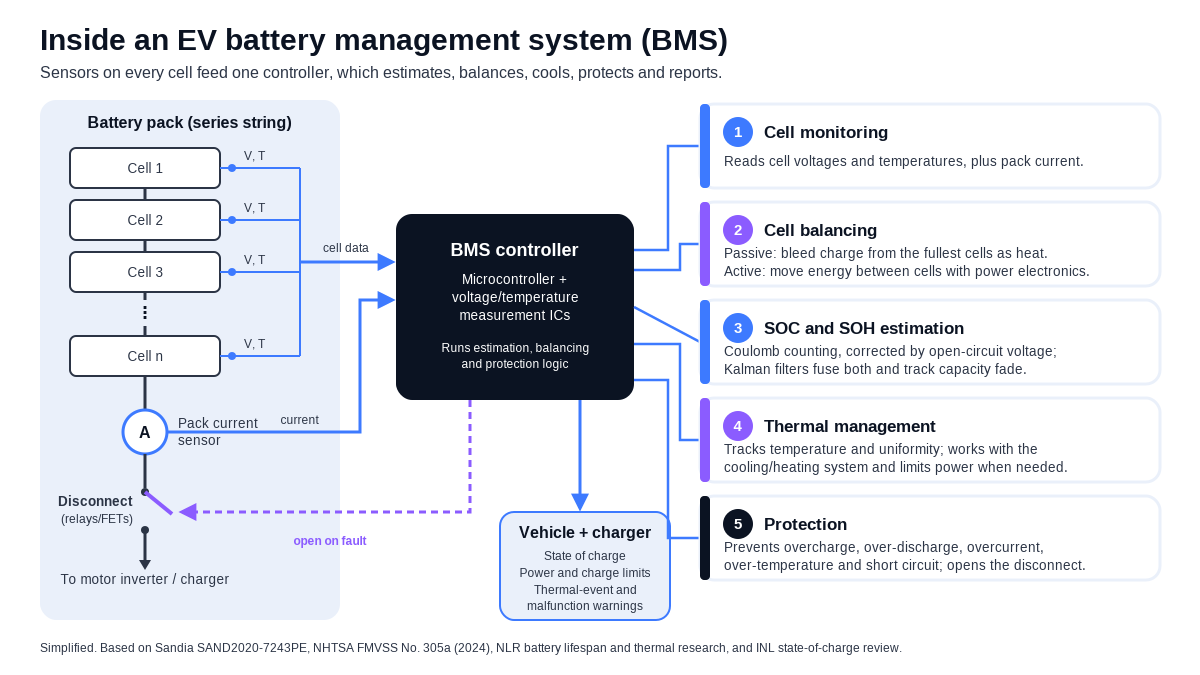
The battery management system handles cell balancing and protection automatically. Our upcoming BMS explainer covers how. For charging habits that protect the battery, your owner's manual is the authority.
What it costs: AAA's 2026 numbers
AAA's 2026 Your Driving Costs study evaluated 34 top-selling models across fuel, maintenance, repair and tire costs, among others [5]. Its side-by-side comparison of electric, gas and hybrid versions gives these annual maintenance figures at 15,000 miles a year [4]:
Category (2026 models) | Electric | Gas | Hybrid |
|---|---|---|---|
Medium sedan | $1,602 | $1,827 | $1,619 |
Compact SUV | $1,402 | $1,954 | $1,506 |
Medium SUV | $1,784 | $1,829 | $1,902 |
Pickup truck | $1,618 | $1,788 | $1,539 |
Source: AAA Your Driving Costs 2026 [4]. Averages for the specific models AAA selected; AAA notes the categories can't be compared directly with its overall averages.
Three things stand out:
- EVs beat comparable gas models on maintenance in every category, by $45 (medium SUV) to $552 (compact SUV) a year.
- The gap is modest compared with fuel. AAA found EV charging costs 66–70% lower than gas fuel costs across the categories studied [5].
- Hybrids are close. In pickups, the hybrid had the lowest maintenance figure [4].
Maintenance savings don't guarantee lower total costs. AAA found higher depreciation, fees and finance charges often outweighed EVs' fuel savings. Medium-sedan EVs, for example, cost 29.1% more to own per year than gas versions [5]. Our ownership cost guide breaks that down.
A hidden cost both share: driver-assist sensors
Modern gas cars and EVs alike carry cameras, radar and ultrasonic sensors for driver assistance, and repairs can be pricey. In AAA's 2023 study of three models, replacing a front radar sensor cost $500 to $1,300, and transferring and calibrating a windshield-mounted camera to new glass after a windshield replacement added $360 (2023 prices) [9]. See our upcoming ADAS explainer.
Safety note for DIYers
All-electric vehicles, plug-in hybrids and hybrids have high-voltage electrical systems that typically range from 400 to 1,000 volts [1]. Tesla's schedule notes that damage caused by opening the battery coolant reservoir isn't covered by its warranty [6]. Leave anything high-voltage to trained technicians.
How to plan EV maintenance
- Download the manufacturer's schedule. EV schedules are short, but they differ by brand and model year.
- Budget for tires first. Check pressure regularly, rotate on schedule, and choose replacements carefully to protect range [6][7][8].
- Don't forget the brakes. Less wear doesn't mean no service, especially where roads are salted [6].
- Keep the windshield and sensors clean. ADAS cameras behind the glass need a clear view (see our ADAS explainer).
- Know your battery warranty terms, including years, miles and exactly what's covered [1].
- Considering a hybrid instead? It keeps engine maintenance but shares the brake benefits; see EV vs Hybrid vs Plug-in Hybrid.
Shopping for a new model? Our roundups of 2026 EV releases and EVs to watch in 2026 are good starting points.
Frequently asked questions
Do electric cars need oil changes?
No. Battery-electric cars have no engine oil to change [1]. Hybrids and plug-in hybrids still have engines, and the AFDC says their maintenance requirements are similar to those of conventional vehicles [1].
Is EV maintenance really cheaper?
Generally, yes. In AAA's 2026 comparison, EVs had lower annual maintenance costs than comparable gas models in all four categories, by $45 to $552 a year at 15,000 miles [4]. A hybrid pickup came in lower still [4].
How often do EV brakes need replacing?
Less often, because regenerative braking significantly reduces wear [1]. Brakes still need periodic fluid checks and, in salted-road regions, caliper cleaning and lubrication; Tesla specifies yearly for the Model 3 [6].
Do EVs go through tires faster?
EVs put more load and torque through their tires, according to Michelin [8]. Independent figures vary, so follow the rotation schedule and keep tires inflated. Note that new replacement tires can reduce range by 2–14% or more, per Oak Ridge National Laboratory [7].
How long does an EV battery last?
Fueleconomy.gov cites a DOE study suggesting 12 to 15 years in moderate climates and 8 to 12 years in severe climates [2]. Many manufacturers warrant EV batteries for 8 years or 100,000 miles [1].
What maintenance does an EV still need?
Tire rotation and replacement, brake-fluid checks, brake caliper service in salty areas, cabin air filters, wipers, and battery coolant checks on some models [1][6].
Sources
- U.S. Department of Energy, Alternative Fuels Data Center. "Maintenance and Safety of Electric Vehicles." https://afdc.energy.gov/vehicles/electric-maintenance
- U.S. DOE and EPA. "All-Electric Vehicles." fueleconomy.gov. https://www.fueleconomy.gov/feg/evtech.shtml
- U.S. DOE and EPA. "Keeping Your Vehicle in Shape." fueleconomy.gov. https://www.fueleconomy.gov/feg/maintain.jsp
- AAA. "Your Driving Costs 2026." September 2026. https://newsroom.aaa.com/wp-content/uploads/2026/09/8-YDC-Brochure_2026-1.pdf
- AAA Newsroom. "AAA: New Vehicle Ownership Costs Hit $12,863 Annually." September 15, 2026. https://newsroom.aaa.com/2026/09/aaa-new-vehicle-ownership-costs-hit-12863-annually/
- Tesla. "Model 3 Do It Yourself: Vehicle Service Intervals." https://service.tesla.com/docs/Public/diy/model3/en_us/GUID-A84FDD77-7A8C-42F6-9385-E3F9CEE245A4.html
- Sluder, C. S., Davis, S. C., and Boundy, R. G. "Study of Electric Vehicle Range Loss Associated with Replacement Tires." Oak Ridge National Laboratory, ORNL/TM-2024/3368, April 2024. https://info.ornl.gov/sites/publications/Files/Pub212813.pdf
- Michelin. "Electric Mobility Guide: How to Reduce Tire Wear." https://www.michelinman.com/auto/auto-tips-and-advice/electric-mobility-guide/how-to-reduce-tire-wear
- AAA. "Fact Sheet: Advanced Driver Assistance Systems (ADAS) Repair Costs." December 2023. https://newsroom.aaa.com/wp-content/uploads/2023/12/ADAS-Repair-Fact-Sheet-FINAL-12.23.pdf