

EV Battery Management Systems: What the BMS Does and Why
What an EV battery management system does: cell monitoring, balancing, charge and health estimation, thermal management and protection, plus FMVSS 305a.
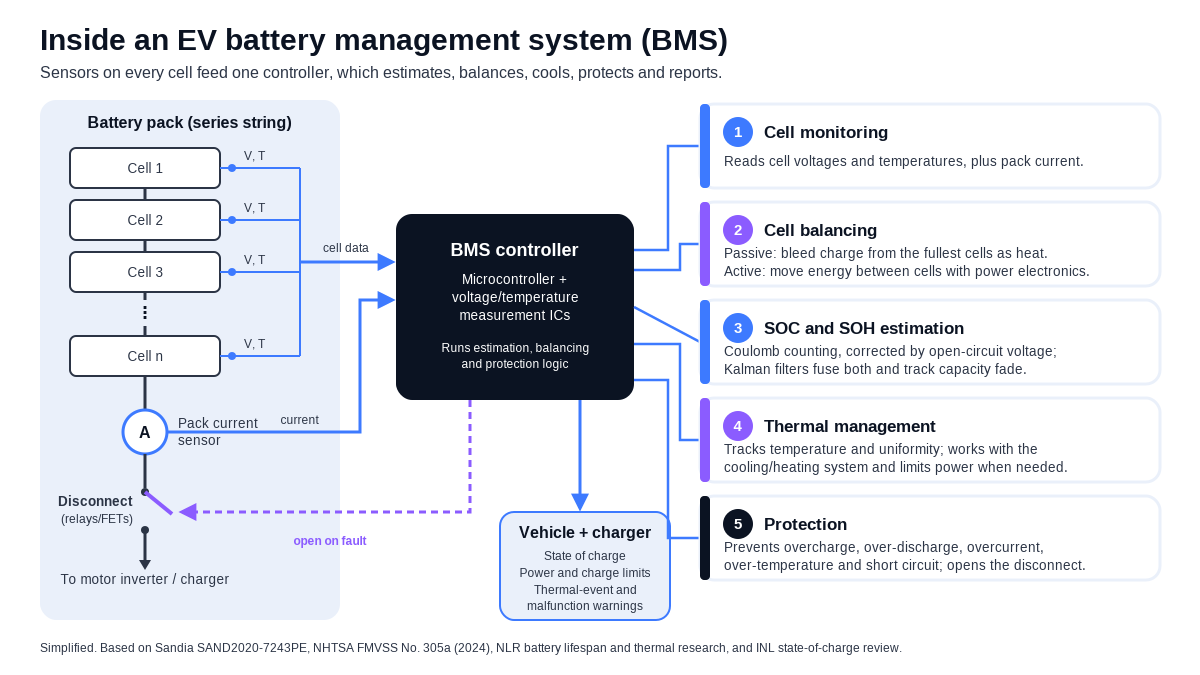
A battery management system (BMS) is the electronics and software that keep an EV battery pack safe, usable and long-lived. It measures every cell's voltage and temperature and the pack current. From those readings it estimates how much charge and health remain, keeps cells balanced, coordinates cooling and heating, and disconnects or limits the pack before a cell goes outside its safe range [1][2][5]. Sandia National Laboratories sums up its goals in five lines: keep cells safe, keep cells balanced, report capacity to the host, predict failures and detect poor health [1].
New to EV batteries? Start with our Electric Vehicles: Complete Beginner's Guide and LFP vs NMC Batteries.
Why a pack needs a manager
An EV pack can contain "hundreds or thousands of individual cells" [2]. Cells are wired in series to build voltage, and in a series string, performance is limited by the weakest cell [2].
No two cells are identical. Manufacturing tolerances, uneven temperatures across the pack and chemical aging create differences in capacity and internal resistance [2]. Without intervention, some cells reach their voltage limits early. That leaves the rest of the pack underused and can, in the worst case, lead to hazards such as thermal runaway [2].
The BMS exists to manage that spread.
The five core functions
Function | What it measures or does | Typical methods | What goes wrong without it |
|---|---|---|---|
Cell monitoring | Cell or cell-group voltages, temperatures, pack current | Voltage/temperature measurement chips, current sensor [1] | Cells drift outside safe limits unseen |
Cell balancing | Equalizes state of charge across series cells | Passive bleed resistors or active energy transfer [1][2] | Usable capacity shrinks to the weakest cell [1] |
State estimation (SOC, SOH) | Charge remaining, capacity fade, remaining life | Coulomb counting, voltage look-up, Kalman filters [3][7][8] | Wrong range readouts; over- or under-use of cells |
Thermal management | Keeps temperature in range and uniform | Temperature sensing; coordinating the pack's cooling system [4][5] | Faster aging, lower performance, safety risk [4] |
Protection | Stops overcharge, over-discharge, overcurrent, over-temperature, short circuit | Hardware or software cut-offs via FETs or relays [1][5] | Fire and electric-shock risk [5] |
1. Cell monitoring
Sandia's generic BMS block diagrams show the essentials: voltage and temperature monitoring for each cell, a current sensor, a microcontroller, and protection circuitry, all reporting to the host system [1]. Everything else the BMS does depends on these measurements.
2. Cell balancing
Why it matters. Sandia explains that if series cells have the same capacity but different states of charge, the highest-charged cell reaches the maximum safe voltage first during charging. The lowest-charged cell reaches the minimum safe voltage first during discharge. Pack capacity is then set by that difference [1]. "Keeping cell voltages equal increases the battery capacity," the Sandia slides note [1].
Passive balancing burns off excess charge from the fullest cells as heat through resistors. Sandia rates it easy to implement, easy to control and cheap, but inefficient, with high heat dissipation and slow charging [1]. The Mineta Transportation Institute's 2026 review adds that this extra heat raises thermal-management demands [2].
Active balancing moves energy from fuller cells to emptier ones with power electronics, using capacitors, inductors or DC-to-DC converters [2]. Sandia rates the cell-to-cell approaches as highly efficient, with little heat, at the cost of more complex switching hardware and control [1]. The MTI review describes a shift toward active balancing and "intelligent" balancing control [2].
How much do cells drift? In Sandia's own small-cell tests, capacity spread grew to only about 6% over 500 cycles. Extrapolating to a group of 41 cells wired in parallel, where the spread roughly halves, Sandia estimates cell capacity changes are likely less than 3% over 500 cycles [1]. That's one lab's data on small cells. Pack-level drift depends on design, temperature uniformity and use.
3. State of charge and state of health
The BMS can't measure state of charge (SOC) directly. It has to estimate it.
Coulomb counting (also called amp-hour counting) adds up the current flowing in and out. A review co-authored by an Idaho National Laboratory researcher calls it the most commonly used approach in practical applications [7]. Its weakness is accumulated error. A 2021 analysis by Movassagh and colleagues identifies four error sources: current-measurement error, integration approximation, uncertainty in the battery's true capacity, and drift in the timing oscillator. Some of these errors grow with time and, uncorrected, can make the estimate "utterly invalid in the long term" [8].
Voltage-based estimation looks up SOC from the cell's open-circuit voltage (OCV) using a lab-measured OCV-SOC curve [7][8]. It works best after the battery has rested, because voltage under load includes resistive drops. Even then, resting doesn't remove modeling error, hysteresis or measurement error [8]. The INL-hosted review describes using such correlations to calibrate the amp-hour count [7].
Fusion methods combine both. Movassagh and colleagues describe nonlinear filters such as the extended Kalman filter fusing voltage and current information [8]. The national lab formerly known as NREL has developed dual-Kalman filters that update both SOC and state of health from the battery's voltage response. They also estimate life-model parameters to calculate remaining useful life [3].
State of health (SOH) tracks how much capacity and power the cells have lost. NLR notes that health is hard to measure during operation. Its research aims for "cheap, rapid, and scalable" diagnostics and "health-aware" control that extends life while meeting performance targets [3].
Why this matters to drivers: the percentage on your dashboard is an estimate. When the BMS recalibrates its amp-hour count against a voltage reading, the displayed number can shift.
4. Thermal management
"Temperature and temperature uniformity both significantly affect the performance, lifespan, and safety of energy storage devices," according to NLR [4]. Its lifetime models include temperature among the main aging factors and flag uneven degradation caused by temperature imbalance in large cells [3].
The BMS reads temperature sensors and works with the vehicle's thermal management system. The federal FMVSS 305a test procedures refer to over-temperature conditions that can be triggered if "the thermal management system were effectively disabled," which shows how closely the two are linked [5].
The BMS also shapes how the battery is used. NLR names temperature, operating windows, charge and discharge rates, and fast charging as drivers of lifespan [3]. A Sandia cycling study found capacity fade rose with depth of discharge in every cell it tested, and its review of earlier calendar-aging studies found fade increased with state of charge regardless of chemistry [9]. Sandia's BMS slides note that narrowing the voltage window improves battery lifetime [1]. That's the logic behind charge limits and fast-charge power curves; see our EV charging levels explainer.
5. Protection
Sandia lists the scenarios a BMS must prevent: overvoltage, undervoltage, over-temperature during charge or discharge, and overcurrent including short circuit. It notes that protection can be done in hardware or software, using FETs, relays or diodes [1].
US federal rules now spell this out. NHTSA's FMVSS No. 305a, published December 20, 2024 and aligned with UN Global Technical Regulation No. 20, requires vehicle-level tests showing that the vehicle's controls protect the battery against overcharge, over-discharge, overcurrent, over-temperature and external short circuit [5]. The rule also requires:
- A thermal event warning. An audio-visual warning when temperature inside the battery is "significantly higher" than the manufacturer's maximum operating temperature while the vehicle is in active driving mode [5].
- A malfunction warning. Documentation of a driver warning if the controls managing safe battery operation malfunction [5].
- Thermal propagation documentation. Manufacturers must document how they mitigate single-cell thermal runaway from an internal short. NHTSA lists an "advanced battery management system with prognostics, and diagnostics" among primary mitigation strategies [5].
The rule's effective date was delayed to March 20, 2025 [6]. As published, and still in place as of November 2026, compliance for most requirements begins September 1, 2027 for vehicles with a gross vehicle weight rating of 4,536 kg (10,000 lb) or less, and September 1, 2028 for heavier vehicles [5]. Check the Federal Register for any later changes.
How the BMS talks to the rest of the car
Sandia lists "report capacity to host" as a core goal [1]. In practice, the BMS sends the vehicle and charger its SOC, its current power limits and any fault warnings. That's how the rest of the car, and the charger, know what the pack can safely deliver and accept at any moment.
Limitations and open problems
- Estimation is never perfect. Every SOC method has error sources, and errors grow as cells age and capacity changes [7][8].
- Field diagnosis is hard. NLR notes that lab-grade health measurements are difficult during real operation [3].
- Balancing trade-offs. Passive balancing wastes energy as heat. Active balancing adds cost and complexity [1][2].
- Real-time decisions. The MTI review highlights the difficulty of accurately understanding battery conditions and making real-time decisions as packs grow [2].
What to watch
- Smarter software. NLR's physics-based and machine-learning diagnostics and health-aware control point to BMSs that actively extend battery life [3].
- Active balancing. Expect more of it in vehicle packs, per the MTI review's trend analysis [2].
- Regulation. FMVSS 305a compliance dates in 2027 and 2028 put BMS warnings and controls under federal test [5].
- New chemistries. Solid-state and sodium-ion cells will need their own BMS tuning; see Solid-State Batteries Explained and our coverage of US EV battery startups.
Frequently asked questions
What does a BMS do in an electric car?
It monitors each cell's voltage and temperature and the pack current. It estimates state of charge and health, balances cells, coordinates thermal management, and protects against overcharge, over-discharge, overcurrent, over-temperature and short circuits [1][5].
What is cell balancing?
It's equalizing the charge across series-connected cells so no single cell hits its voltage limit first. Passive balancing bleeds excess energy off as heat. Active balancing moves energy between cells with power electronics [1][2].
How does a BMS calculate the battery percentage?
Mostly by counting current in and out (coulomb counting), corrected against voltage-based estimates. Advanced systems fuse both with Kalman filters [7][8]. The dashboard figure is an estimate, which is why it can shift slightly after a rest or a full charge.
Can a BMS prevent battery fires?
It reduces the risk by keeping cells within safe limits and warning the driver of thermal events, which FMVSS 305a now requires [5]. It can't prevent every failure, such as an internal short from a manufacturing defect. That's why the rule also requires documentation of thermal propagation mitigation [5].
Is a BMS the same as battery thermal management?
No. The thermal system (coolant, pumps, heaters) moves heat. The BMS measures temperatures and works with that system, and it limits power or charging when temperatures are out of range [3][4][5].
Sources
- Wesolowski, D. "Battery Management." Sandia National Laboratories, SAND2020-7243PE. https://www.osti.gov/servlets/purl/1809197
- Na, W., and Xie, Y. "Automated Battery Management Systems for Electric Vehicles." Mineta Transportation Institute Report 26-20, August 2026. https://rosap.ntl.bts.gov/view/dot/92983
- National Laboratory of the Rockies (formerly NREL). "Battery Lifespan." https://www.nlr.gov/transportation/battery-lifespan
- National Laboratory of the Rockies (formerly NREL). "Energy Storage Thermal Management." https://www.nlr.gov/transportation/energy-storage-thermal-mgmt
- National Highway Traffic Safety Administration. "Federal Motor Vehicle Safety Standards; FMVSS No. 305a Electric-Powered Vehicles: Electric Powertrain Integrity." Final rule, 89 FR 104318, December 20, 2024. https://www.federalregister.gov/documents/2024/12/20/2024-28707/federal-motor-vehicle-safety-standards-fmvss-no-305a-electric-powered-vehicles-electric-powertrain
- National Highway Traffic Safety Administration. "FMVSS No. 305a ... Final rule; delay of effective date." 90 FR 9609, February 14, 2025. https://www.federalregister.gov/documents/2025/02/14/2025-02582/federal-motor-vehicle-safety-standards-fmvss-no-305a-electric-powered-vehicles-electric-powertrain
- Li, Z., Huang, J., Liaw, B. Y., and Zhang, J. "On State-of-Charge Determination for Lithium-Ion Batteries." Idaho National Laboratory, INL/JOU-17-40852, April 2017. https://inldigitallibrary.inl.gov/sites/sti/sti/Sort_1351.pdf
- Movassagh, K., Raihan, A., Balasingam, B., and Pattipati, K. "A Critical Look at Coulomb Counting Approach for State of Charge Estimation in Batteries." Energies 14, 4074 (2021). https://ntrs.nasa.gov/api/citations/20220008848/downloads/2021.07%20-%20Energies%20-%20A%20Critical%20Look%20at%20Coulomb%20Counting%20Approach%20for%20State%20of%20Charge%20Estimation.pdf
- Preger, Y., et al. "Degradation of Commercial Lithium-Ion Cells as a Function of Chemistry and Cycling Conditions." Journal of the Electrochemical Society 167 (2020). Sandia National Laboratories. https://www.osti.gov/pages/biblio/1650174