
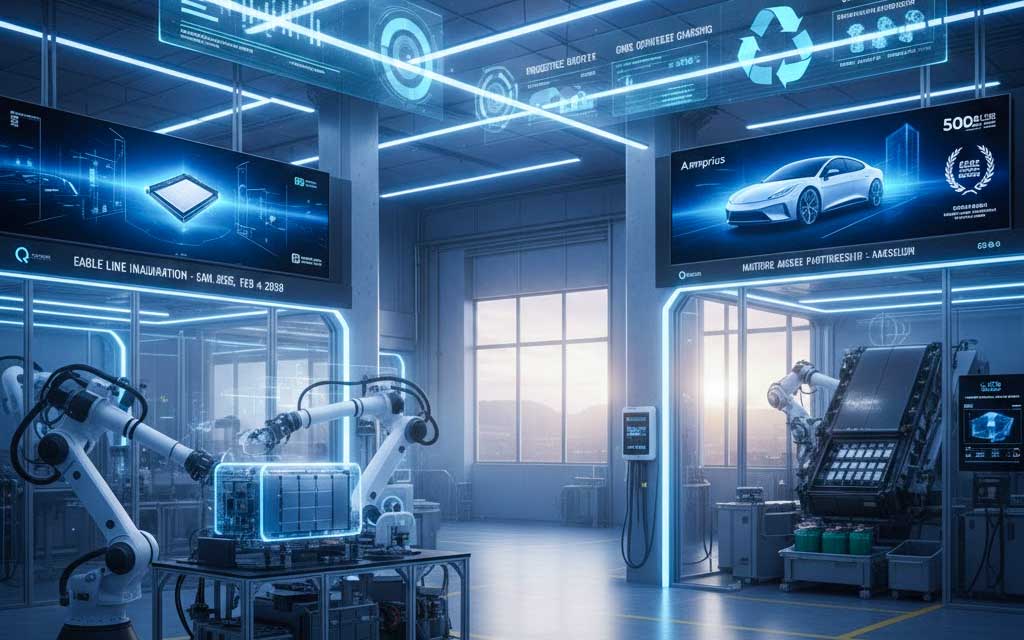
US EV startups are racing to onshore battery tech and charging innovations, reducing reliance on foreign supply chains amid geopolitical tensions and the push for energy independence. In February 2026, key announcements from US EV Battery Startups 2026 leaders like QuantumScape and Amprius highlight breakthroughs in solid-state and silicon-anode tech, while robotics advance sustainable recycling—directly addressing range anxiety and supporting longer-range EVs that could ease consumer hesitation in a softening market.
February 2026 Breakthroughs: Solid-State and Silicon Advances
- QuantumScape’s Eagle Line Inauguration (February 4, 2026): The company celebrated the launch of its Eagle Line pilot production facility in San Jose, California. This highly automated line produces QSE-5 solid-state lithium-metal battery cells using the Cobra process for scalable manufacturing. It supports customer sampling, OEM testing (including ongoing work with Volkswagen’s PowerCo), technology demos, and integration efforts. The milestone de-risks scaling from lab to production blueprint, with 2026 focus on uptime, yield, and cost metrics. QuantumScape shipped Cobra-based samples in 2025 and reported first customer billings, positioning for potential licensing deals.
- Amprius Silicon Anode Progress: Amprius secured a strategic U.S.-based manufacturing partner (Nanotech Energy) in early February 2026 to scale domestic production of high-performance silicon-anode batteries, strengthening supply for defense and aerospace (e.g., L3Harris). Its 520 Wh/kg cells—recognized as a CES 2026 Best of Innovation in Sustainability & Energy Transition—offer nearly double the energy density of standard graphite cells, enabling extended range in EVs, drones, and electric aviation. This supports NDAA-compliant domestic chains and high-value applications.
- EV Charging Robotics and Recycling: Advances in automated disassembly (e.g., R3 Robotics’ €20M funding for AI/robotics platforms handling battery packs, e-drives, and components) improve recycling efficiency, safety, and material recovery—critical for circular economy and reducing critical mineral dependencies.
These tie into broader US domestic battery pushes, with policies like Project Vault (strategic reserves) and ongoing IRA incentives accelerating onshore production despite market adjustments.
Tying to EV Sales: Longer Range Counters Hesitation
Solid-state (QuantumScape) promises higher energy density, faster charging, and safety gains, while silicon anodes (Amprius) boost range significantly—e.g., turning a 310-mile graphite EV into 500+ miles. In a market with early 2026 EV softness, these address key barriers like range anxiety and charging times, appealing to families and fleets shifting from hybrids or gas vehicles.
AI Insights Enhancing Battery and Charging Ecosystems
AI plays a pivotal role:
- Predictive battery health → Monitors degradation, thermal anomalies, and cycle life in real-time for proactive alerts and extended longevity.
- Grid-optimized charging networks → AI schedules sessions during low-demand/off-peak periods, integrates V2G/V2H, and balances loads to cut costs and support renewables.
- Robotics and disassembly → AI-driven vision and tooling automate recycling, improving yield of lithium, cobalt, etc., for sustainable supply.
These reduce ownership costs and boost reliability.
Policy Angle: IRA Incentives and Strategic Independence
From my analysis at events like COP, IRA credits (despite tweaks) continue incentivizing domestic manufacturing, job creation, and supply security. Combined with tariffs and initiatives like Project Vault, they foster independence from China-dominated chains.
Balanced View: Scaling Delays vs. Strategic Wins
Challenges include production scaling hurdles (QuantumScape’s Eagle Line ramp requires proving metrics; Amprius focuses on niche-to-broader transition) and cash burn amid losses. Yet successes in pilot lines, partnerships, and domestic partnerships position US startups for leadership in next-gen tech—potentially accelerating mass EV adoption through superior performance and secure sourcing.
About the Author Ethan Brooks is an automotive journalist and EV enthusiast with deep experience covering electrification. He’s attended multiple Tesla and Rivian events, tested the Toyota bZ4X extensively, and driven countless hybrids/EVs. His focus: practical insights on reliability, real-world performance, and how emerging tech like AI shapes the future of driving.
Explore more at VFuture Media: Check our coverage
AI Job Disruption 2026: Trucking and Logistics Hit
You made it to the end, which means you actually care about this stuff. So do we. Check out our AI and EV sections for more stories worth your time.
Leave a Comment