Lithium-Ion Battery Chemistry Explained
How lithium-ion cells store energy: intercalation, cathode families (NMC, NCA, LFP), graphite and silicon anodes, electrolyte, SEI and why cells age.
A lithium-ion battery stores energy by moving lithium ions between two solid "host" materials, the anode and the cathode, through a liquid electrolyte, while electrons take the long way round through the external circuit [3]. The cathode material largely sets the cell's voltage, energy density and cost, and today's EVs mostly use either nickel-based layered oxides (NMC, NCA) or lithium iron phosphate (LFP) [1][4]. Cells age because side reactions slowly consume lithium and electrolyte and damage the electrode materials [4][5][6].
This explainer covers the chemistry inside every cell. For a head-to-head buying comparison of the two main cathodes, see LFP vs NMC Batteries. For the bigger EV picture, start with our Electric Vehicles: Complete Beginner's Guide.
The parts of a cell
UL Research Institutes and the EPA describe the same basic anatomy [2][3]:
- Anode (negative electrode). In today's cells, usually graphite [4].
- Cathode (positive electrode). A lithium-containing metal oxide or phosphate. The EPA notes that lithium-ion chemistries are usually named after the cathode [2].
- Electrolyte. Usually a liquid that carries lithium ions between the electrodes. It is flammable, which is why damaged or discarded cells are a fire risk [2].
- Separator. A porous polymer film that keeps the electrodes apart while letting ions pass [3].
- Current collectors. Thin conductive foils on each electrode that connect to the cell terminals [3]. The EPA lists copper and aluminum foils among common cell materials [2].
Cells come in three physical formats: cylindrical, prismatic and pouch [2]. Prismatic cells are now the most common, at over 60% of EV batteries globally (as of the IEA's May 2026 report) [1]. An EV pack groups hundreds or thousands of cells, traditionally into modules [2]. Newer cell-to-pack and cell-to-chassis designs drop the module layer to raise energy density [1].
How it works: intercalation, the "rocking chair"
The key idea is intercalation. Lithium ions slot into the crystal structure of the electrode materials without breaking it apart, then slide back out. Dong and Li trace this back to a titanium disulfide cathode demonstrated in 1976. Later oxide cathodes made it possible to pair a cathode with a lithium-free anode such as graphite, which is safer than lithium metal and was "historically critical" to the success of lithium-ion batteries [4].
On charge, the charger pulls lithium ions out of the cathode, and the anode receives them [3]. Electrons flow through the external circuit to the anode at the same time.
On discharge, the anode releases lithium ions, which travel back through the electrolyte to the cathode. The electrons can't cross the separator, so they flow through the motor or other load, and that current does the work [3].
Because ions simply shuttle back and forth, a cell can be charged "hundreds to thousands of times" [3].
Where the voltage comes from
A cell's voltage is the difference in electrical potential between its two electrodes, and the cathode chemistry dominates it. Sandia's published specifications for three commercial 18650 cells show the spread [5]:
Cell chemistry (tested by Sandia) | Nominal voltage | Manufacturer voltage range |
|---|---|---|
LFP (A123) | 3.3 V | 2.0–3.6 V |
NCA (Panasonic) | 3.6 V | 2.5–4.2 V |
NMC, nickel-rich (LG Chem) | 3.6 V | 2.0–4.2 V |
Energy is voltage times charge, so a higher-voltage cathode stores more energy for the same amount of lithium moved. That higher voltage has a cost. Sandia suggests the oxide cathodes' higher top-of-charge voltage (4.2 V versus 3.6 V for LFP) could promote electrolyte oxidation, which is one reason NCA and NMC cells aged faster when cycled across their full range [5].
The cathode families
Dong and Li group commercial and research cathodes by crystal structure [4]. That structure decides how tightly the material holds its lithium and oxygen.
Family | Structure | Examples | Where you'll find it |
|---|---|---|---|
Layered oxides | Lithium sits in flat layers between metal-oxide sheets | NMC (nickel manganese cobalt), NCA (nickel cobalt aluminum), LCO (lithium cobalt oxide) | NMC and NCA in many EVs; LCO common in consumer electronics [2][4] |
Lithium- and manganese-rich layered | Layered, with extra lithium | Li-/Mn-rich NMC variants | Research and development [4] |
Spinel | Three-dimensional framework | LiMn₂O₄ (LMO), LiNi₀.₅Mn₁.₅O₄ | Niche and research uses [4] |
Polyanion (olivine) | Phosphate groups lock oxygen in place | LiFePO₄ (LFP), lithium iron manganese phosphate | Over 55% of EV batteries deployed in 2025 [1] |
Disordered rocksalt | Lithium-excess, cation-disordered | Various | Research [4] |
Reading the NMC numbers. Names like NMC811 give the ratio of nickel, manganese and cobalt. The IEA groups NMC333, 442 and 532 as "low-nickel" and NMC622, 721, 811, NCA and NMCA as "mid- and high-nickel" [1]. NMC721 and NMC811 contain around 10% cobalt in their metal content, excluding lithium [1]. More nickel generally means more energy, but Dong and Li note that pushing these cathodes to higher voltages and fuller delithiation speeds up capacity loss [4].
Energy density today. The IEA puts the latest cells at up to 205 Wh/kg for LFP and up to 265 Wh/kg for NMC (as of its May 2026 report) [1].
Cost. The cathode active material is the single most important driver of cell production cost. It accounted for 40–50% of the cost of an NMC cell and 25–30% of an LFP cell, based on 2024 Chinese production [1].
The anode: graphite, silicon and lithium metal
Graphite is the standard anode. It stores lithium between its carbon layers and contains no lithium itself when the cell is made [4].
Silicon can hold far more lithium per gram, which is why the DOE has funded it for years. Its targets for silicon anodes include more than 1,000 mAh/g, 350+ Wh/kg cells, a 10-year life and 1,000 cycles [7]. The problem is mechanical and chemical. Silicon expands by roughly 320% as it takes up lithium, and DOE's 2023 review found that silicon cells' calendar life reached only about 10% of the target. The review attributes this to the failure of a stable protective layer to form on the silicon [7].
Lithium metal is the ultimate anode. It is the main reason for solid-state designs, covered in Solid-State Batteries Explained.
The electrolyte and the SEI
The electrolyte is a lithium salt dissolved in organic solvents. One example from Sandia's literature review is 1 M LiPF₆ in a mix of ethylene carbonate and diethyl carbonate [5].
Organic electrolytes aren't stable at the extreme potentials found at either electrode. At the anode, a thin film called the solid electrolyte interphase (SEI) forms from reduced electrolyte. A stable SEI passivates the surface and lets the cell keep working. But it keeps growing slowly, and each bit of growth locks away lithium that can no longer carry charge [5][6]. The cathode side grows its own film, the cathode-electrolyte interphase (CEI) [4].
Why lithium-ion cells age
Degradation is the sum of many small reactions. Dong and Li list impedance growth, surface and bulk phase changes, cracking of cathode particles, side reactions that consume electrolyte, interphase overgrowth, gassing, and transition-metal dissolution. Dissolved metals can migrate to the anode and destabilize the SEI [4].
The lab research points to three main levers:
- State of charge. In Sandia's calendar-aging work, capacity fade increased with state of charge across chemistries, because lower anode potentials speed electrolyte reduction and SEI growth [5].
- Temperature. The lab formerly known as NREL models fade across temperatures and flags nonuniform degradation from temperature imbalance in large cells [6].
- How the cell is cycled. Charge and discharge rates, operating windows and fast charging all affect lifespan [6]. NCA and NMC cells were more sensitive to deep cycling than LFP in Sandia's tests [5].
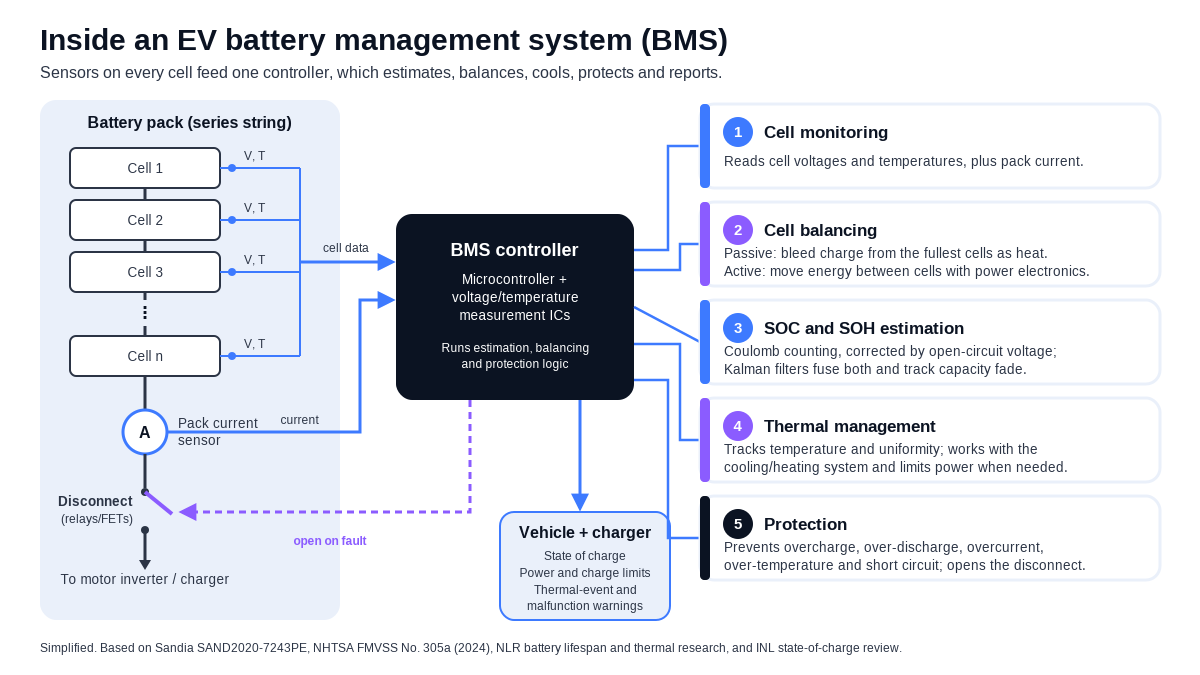
This is why EVs use a battery management system to keep cells inside safe voltage and temperature windows. Our upcoming EV battery management systems explainer covers how that works.
Safety in brief
The same traits that make lithium-ion useful, high energy and power density, also create fire risk if cells are abused or damaged [3]. The EPA notes that most discarded lithium-ion batteries would likely count as ignitable and reactive hazardous waste [2]. Chemistry matters here too. Dong and Li note that olivine cathodes such as LFP, with their strong phosphorus-oxygen bonds, have better thermal stability than layered oxides [4] (see our LFP vs NMC comparison).
How to use this when reading a spec sheet
- Chemistry name = cathode. "LFP," "NMC" and "NCA" tell you the cathode. The anode is almost always graphite unless the maker says otherwise.
- Pack energy (kWh) depends on chemistry and packaging. A lower-density chemistry can still deliver a competitive pack through cell-to-pack design [1].
- Charging advice is chemistry-specific. Lab data shows LFP tolerates full-range cycling better than nickel-rich cells [5]. Your automaker's guidance takes precedence.
- Watch for anode news. Silicon-rich anodes promise more energy, but calendar life has been the sticking point in DOE research [7].
Outlook
The IEA's data shows the industry splitting by need. LFP has taken over half the EV market on cost, while nickel-based NMC keeps an energy-density edge, up to 265 Wh/kg versus 205 Wh/kg for the latest LFP cells [1]. Sodium-ion cells, which swap lithium for sodium and graphite for hard carbon, are entering scale-up for cold-climate and low-cost uses [1]; see our upcoming sodium-ion explainer. Further out, silicon and lithium-metal anodes are where the energy gains are, if their lifetime problems can be solved [7]. When those cells reach end of life, recycling recovers the metals; our battery recycling explainer covers how.
Frequently asked questions
What is the chemistry of a lithium-ion battery?
Lithium ions intercalate, or slot into, a graphite anode during charging and return to a metal-oxide or phosphate cathode during discharge. A lithium salt in organic solvent carries the ions, and electrons flow through the external circuit [3][4][5].
Why are lithium-ion batteries named after the cathode?
The cathode varies most between products and drives voltage, energy density and much of the cost, while the anode is usually graphite [1][2]. That's why you see labels like LFP, NMC and NCA.
What does NMC811 mean?
It's a nickel-manganese-cobalt cathode with the metals in roughly an 8:1:1 ratio. The IEA classes it as high-nickel. It contains around 10% cobalt in its metal content, excluding lithium [1].
What is the SEI layer?
The solid electrolyte interphase is a thin film that forms on the anode from reduced electrolyte. It protects the electrode, but its slow growth consumes lithium and is a main cause of capacity fade [5][6].
Why don't EVs use silicon anodes yet?
Some cells blend in silicon, but pure silicon swells by roughly 320% when it takes up lithium. DOE's 2023 review found silicon cells' calendar life at only about 10% of the program target [7].
Do lithium-ion batteries contain lithium metal?
Not in conventional cells. The lithium is stored as ions inside the cathode and anode materials. Lithium-metal anodes are a goal of solid-state and next-generation designs [4].
Sources
- International Energy Agency. "Global EV Outlook 2026." May 2026. https://www.cleanenergyministerial.org/content/uploads/2026/05/globalevoutlook2026.pdf
- U.S. Environmental Protection Agency. "Lithium-Ion Battery Recycling." Last updated September 18, 2026. https://www.epa.gov/hw/lithium-ion-battery-recycling
- UL Research Institutes. "What Are Lithium-Ion Batteries?" https://ul.org/library/what-lithium-ion-battery-factsheet
- Dong, Y., and Li, J. "Oxide Cathodes: Functions, Instabilities, Self Healing, and Degradation Mitigations." Chemical Reviews (2022). DOI 10.1021/acs.chemrev.2c00251. https://dspace.mit.edu/server/api/core/bitstreams/9c0c582b-b057-451f-b2fe-71cffd1cb611/content
- Preger, Y., et al. "Degradation of Commercial Lithium-Ion Cells as a Function of Chemistry and Cycling Conditions." Journal of the Electrochemical Society 167 (2020). Sandia National Laboratories, SAND2020-8433J. https://www.osti.gov/pages/biblio/1650174
- National Laboratory of the Rockies (formerly NREL). "Battery Lifespan." https://www.nlr.gov/transportation/battery-lifespan
- Cunningham, B. "BAT343: Silicon and Intermetallic Anode Portfolio Strategy Overview." U.S. DOE Vehicle Technologies Office, 2023 Annual Merit Review, June 13, 2023. https://www1.eere.energy.gov/vehiclesandfuels/downloads/2023_AMR/bat343_cunningham_2023_o.pdf