
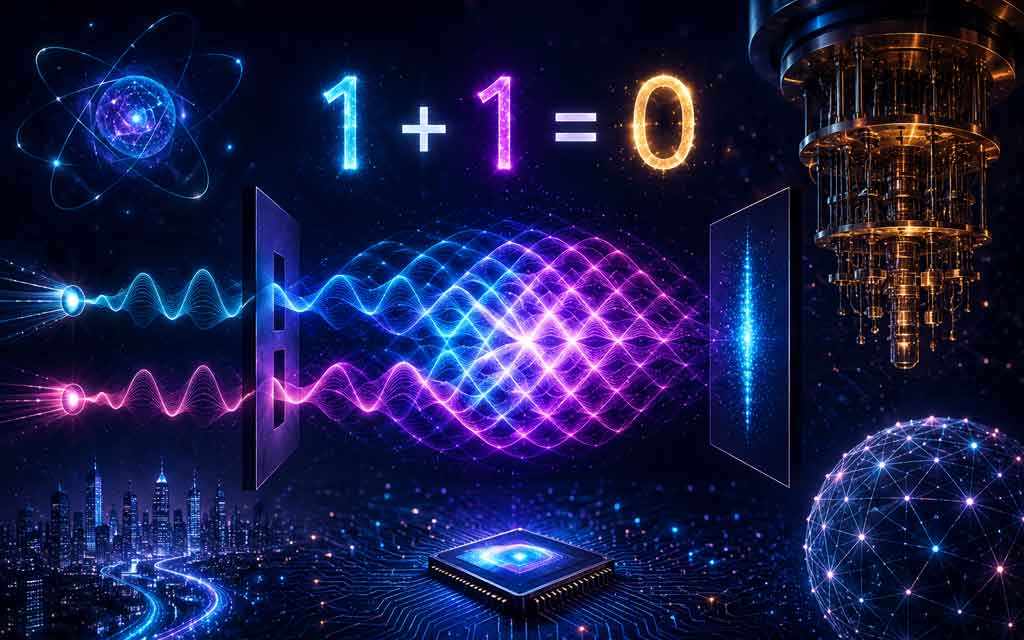
A wave of excitement (and confusion) is spreading after recent discussions around quantum mechanics suggesting that in certain conditions, basic addition can behave in unexpected ways — with some viral claims even stating “1 + 1 = -1.” While classical mathematics remains unchanged (1 + 1 will always equal 2 in everyday arithmetic), a deeper look at quantum interference reveals why such counterintuitive ideas are gaining attention and what they could mean for the future of computing, communication, and technology.
The Science Behind the Claim
In quantum mechanics, particles like electrons and photons behave as both particles and waves. When two quantum waves overlap, they don’t simply add their intensities — their amplitudes (which can be positive or negative) combine through interference.
- Constructive interference: Waves align and reinforce each other (amplitudes add up).
- Destructive interference: Waves are out of phase and cancel each other out (amplitudes subtract).
This is why, in the famous double-slit experiment, electrons can create interference patterns where certain spots on the screen receive zero probability of detection — even though particles are being fired. In effect, two paths that should each contribute probability can cancel each other completely.
This is the closest real phenomenon to the viral “1 + 1 = -1” idea. In quantum terms, probability amplitudes can interfere destructively, leading to outcomes that defy classical intuition. It’s not that arithmetic breaks — it’s that quantum reality operates on complex numbers and phases, not simple positive numbers.
Recent experimental advances in controlling quantum interference at scale (in quantum computers, sensors, and communication systems) have made these effects more visible and practical, sparking renewed public interest.
Why This Matters: Real-World Impacts
While the viral framing is oversimplified, the underlying physics is driving genuine breakthroughs with massive implications:
1. Quantum Computing Power Destructive interference is one of the key reasons quantum computers can outperform classical ones for certain problems. Algorithms like Grover’s search and Shor’s factoring use interference to amplify correct answers and cancel out wrong ones. This is why companies like Google, IBM, and startups are racing to build fault-tolerant quantum machines.
Impact: If scaled successfully, quantum computers could revolutionize drug discovery, materials science, cryptography, and optimization problems that are currently intractable.
2. Ultra-Secure Quantum Communication Quantum key distribution (QKD) relies on the no-cloning theorem and interference effects. Any attempt to eavesdrop disturbs the quantum states, making secure communication possible in principle.
Impact: Governments and banks are already deploying early quantum-secure networks. A mature version could make current encryption obsolete and force a global upgrade of digital security infrastructure.
3. Quantum Sensors and Metrology Interference-based sensors can detect tiny changes in gravity, magnetic fields, or time with unprecedented precision. This has applications in navigation (GPS-independent), mineral exploration, and fundamental physics research.
Impact: Quantum sensors could transform industries from defense to healthcare (e.g., brain imaging without large machines).
4. Philosophical and Foundational Shifts The ability of quantum systems to produce results that feel like “1 + 1 = 0 or even negative” challenges our classical view of reality. It fuels ongoing debates about interpretations of quantum mechanics (Copenhagen, Many-Worlds, QBism, etc.) and raises questions about the nature of probability, observation, and reality itself.
The Viral “1 + 1 = -1” Narrative
The recent online discussion appears to stem from popular explanations of quantum interference and superposition being taken too literally. In reality:
- Classical arithmetic is unchanged.
- Quantum mechanics uses complex probability amplitudes.
- Destructive interference can make combined outcomes zero or near-zero in probability — which some describe dramatically as addition producing “negative” or canceling results.
This kind of simplification helps grab attention but can mislead people into thinking fundamental math is broken. The real story is far more interesting: we are learning to engineer these interference effects for practical technology.
What Comes Next?
Over the next 5–10 years, we are likely to see:
- Early fault-tolerant quantum computers solving useful problems.
- Widespread quantum-secure communication networks.
- Quantum-enhanced AI and machine learning through better optimization.
- New industries built around quantum sensing and simulation.
At the same time, the gap between public understanding and actual quantum science will need better communication to avoid hype cycles and misconceptions like “quantum breaks math.”
Bottom Line
The idea that “1 + 1 = -1 in quantum” is a catchy but inaccurate shorthand. What is true is that quantum interference allows nature to perform a kind of subtraction at the most fundamental level — and we are finally learning how to harness it.
This capability doesn’t invalidate classical physics or mathematics. Instead, it opens an entirely new layer of technological possibility that could reshape computing, security, sensing, and our understanding of reality itself in the coming decades.
The real breakthrough isn’t that arithmetic is broken — it’s that we’re beginning to master a deeper layer of physics that was hidden until recently.



Leave a Comment