
As someone who has tracked the EV boom, robotics breakthroughs, and green innovation shifts for years at VFutureMedia.com, one debate refuses to cool down in January 2026: Battery Electric Vehicles (EVs) vs Hydrogen Fuel Cell Vehicles (FCEVs).
With global EV adoption crossing 25–30% of new car sales in many regions—and hydrogen still confined to niche markets—the big question remains:
Which technology actually wins the future of clean transportation?
Short answer (2026 verdict): Battery electric vehicles dominate passenger cars. Hydrogen isn’t dead—but it’s becoming a specialist technology where batteries struggle.
This in-depth, SEO-optimized guide compares efficiency, cost, infrastructure, performance, environmental impact, and real-world adoption, drawing on 2025–2026 insights from the IEA, BloombergNEF, MIT Climate Portal, and industry data.
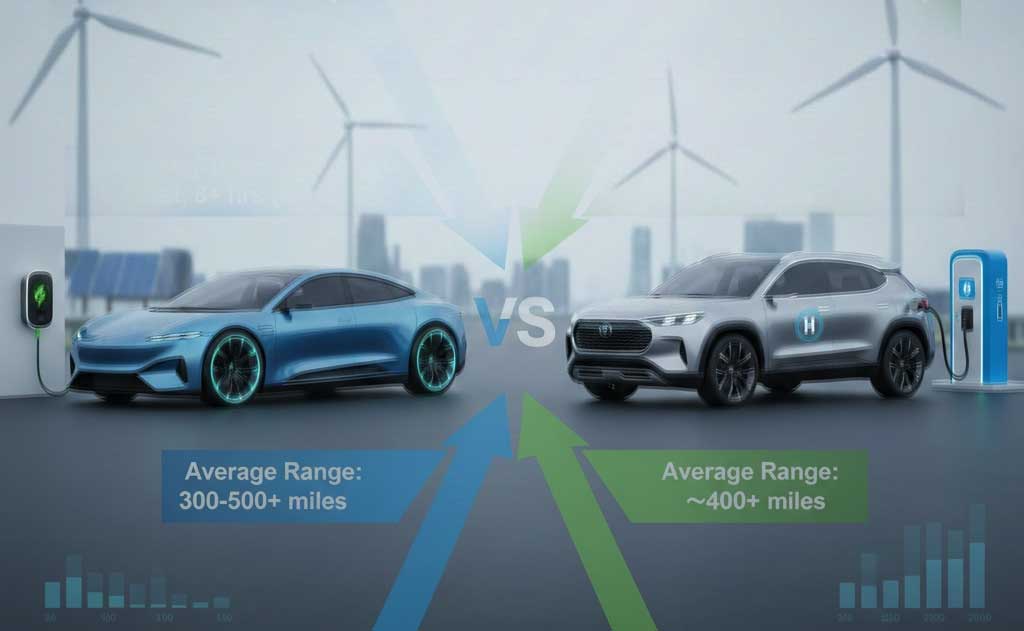
EVs vs Hydrogen Cars at a Glance (2026)
- Well-to-wheel efficiency
- Charging vs refueling time
- Average driving range
- Global sales volume
Alt text suggestion: EV vs Hydrogen Fuel Cell Car comparison chart 2026 efficiency range cost
How EVs and Hydrogen Cars Work (Quick Primer)
Battery Electric Vehicles (BEVs)
Battery EVs store electricity in lithium-ion or next-generation solid-state battery packs. The electricity directly powers an electric motor.
- Charged from the grid (home or public chargers)
- Zero tailpipe emissions
- Minimal mechanical complexity
Hydrogen Fuel Cell Vehicles (FCEVs)
Hydrogen cars generate electricity onboard using a fuel cell stack. Hydrogen reacts with oxygen to produce electricity, emitting only water vapor.
- Hydrogen stored in high-pressure tanks
- Small buffer battery included
- Electric motors drive the wheels
Key insight: FCEVs are electric cars with a hydrogen-powered generator.
Efficiency: Why EVs Dominate in 2026
Efficiency is the single biggest differentiator.
Well-to-Wheel Efficiency
- Battery EVs: ~70–90%
- Hydrogen FCEVs: ~25–40%
Hydrogen loses energy at every stage:
- Electrolysis (70–80%)
- Compression & transport (80–90%)
- Fuel cell conversion (50–60%)
Result: For the same renewable energy input, an EV travels 2–3× farther than a hydrogen car.
Cost Comparison: EVs Win on Price and Ownership
Vehicle Purchase Price (2026)
- Entry-level EVs: Under $30,000 in many markets
- Hydrogen cars:
- Toyota Mirai: ~$52,000 MSRP
- Hyundai Nexo: ~$55,000+ expected
Hydrogen remains expensive due to platinum catalysts and low production volumes.
Fuel & Energy Costs
- EV charging: $0.04–$0.10 per mile
- Hydrogen fuel: $0.12–$0.20+ per mile
Maintenance & Reliability
- EVs: Fewer moving parts, minimal servicing
- FCEVs: Fuel cell durability improving, but still complex
Total Cost of Ownership (10 years)
EVs save thousands of dollars in fuel and maintenance, especially as battery prices fall toward $80–100/kWh by late 2026.
Infrastructure: The Deciding Factor
EV Charging Network
- 170,000+ public chargers in the US
- Millions globally
- 350 kW fast chargers deliver ~200 miles in 15–20 minutes
- Home charging covers 80%+ of daily needs
Hydrogen Refueling Stations
- ~50–70 stations in the US (mostly California)
- Few hundred globally
- Extremely expensive to scale
Hydrogen faces a classic chicken-and-egg problem. EVs scale easily using existing electrical grids.
Performance & Daily Practicality
Driving Range
- Hydrogen cars: ~400+ miles
- Modern EVs: 300–500+ miles
- Solid-state EVs: Targeting 600+ miles
Refueling vs Charging
- Hydrogen: 3–5 minutes
- EV fast charging: 20–40 minutes (80%)
- Home charging: Zero daily inconvenience
Driving Experience
Both deliver instant torque, smooth acceleration, and quiet cabins. Hydrogen vehicles carry extra tank weight.
Verdict: Hydrogen suits fleets and long-haul use. EVs win daily driving.
Environmental Impact: Both Clean, EVs Edge Ahead
- Zero tailpipe emissions for both
- Lifecycle emissions depend on energy source
Hydrogen Reality Check
- Most hydrogen today is grey hydrogen (natural gas-based)
- Green hydrogen remains limited and costly
EVs grow cleaner automatically as grids decarbonize.
Real-World Adoption in 2026
Battery EVs
- 25–30%+ global new car share
- China: ~50%+
- Millions sold annually
Hydrogen Cars
- <30,000 passenger vehicles per year
- Limited to California, Japan, select EU regions
- Stronger momentum in buses and heavy trucks
Market momentum overwhelmingly favors EVs.
The Future Outlook: EVs Lead, Hydrogen Specializes
By 2030
- EVs: 40–60% global share
- Hydrogen cars: <5% passenger share
- Hydrogen growth: trucks, buses, shipping, industrial use
Battery innovation (solid-state, silicon anodes) is outpacing hydrogen infrastructure expansion.
FAQ: EV vs Hydrogen Cars (2026)
Which is better for most drivers in 2026?
Battery electric vehicles—cheaper, more efficient, and far easier to own.
Do hydrogen cars have any real advantages?
Yes. Ultra-fast refueling and long range suit commercial fleets and long-haul routes.
Are hydrogen cars truly zero-emission?
At the tailpipe, yes. Lifecycle emissions depend on hydrogen production methods.
Will hydrogen ever overtake EVs?
Unlikely for passenger cars. Batteries scale faster and cheaper.
Which is greener overall?
EVs—higher efficiency means lower lifecycle emissions.
Final Verdict: EVs Win the 2026 Clean Mobility Race
In 2026, the outcome is clear:
Battery electric vehicles dominate in efficiency, cost, infrastructure, and real-world adoption.
Hydrogen fuel cell vehicles are not a failure—they are precision tools for applications where batteries struggle.
The clean transportation future isn’t either/or. But for everyday drivers, EVs are the undeniable winner.
What’s your take—going full EV, or waiting on hydrogen’s breakthrough? Share your thoughts, subscribe to VFutureMedia.com, and explore our related deep dives on global EV adoption and green hydrogen innovation.
Ethan Brooks is a technology journalist and staff writer at VFuture Media, an independent media outlet focused on AI, electric vehicles, future tech, and green innovation. With hands-on event coverage including CES 2026 and ongoing daily reporting across VFuture Media’s six editorial verticals, Ethan brings both breadth and depth to complex technology stories. His writing is known for balancing technical accuracy with accessible, reader-first explanations. He is based in the United States and covers global technology developments.
VFutureMedia | X @EthanBrookVFM

Leave a Comment