
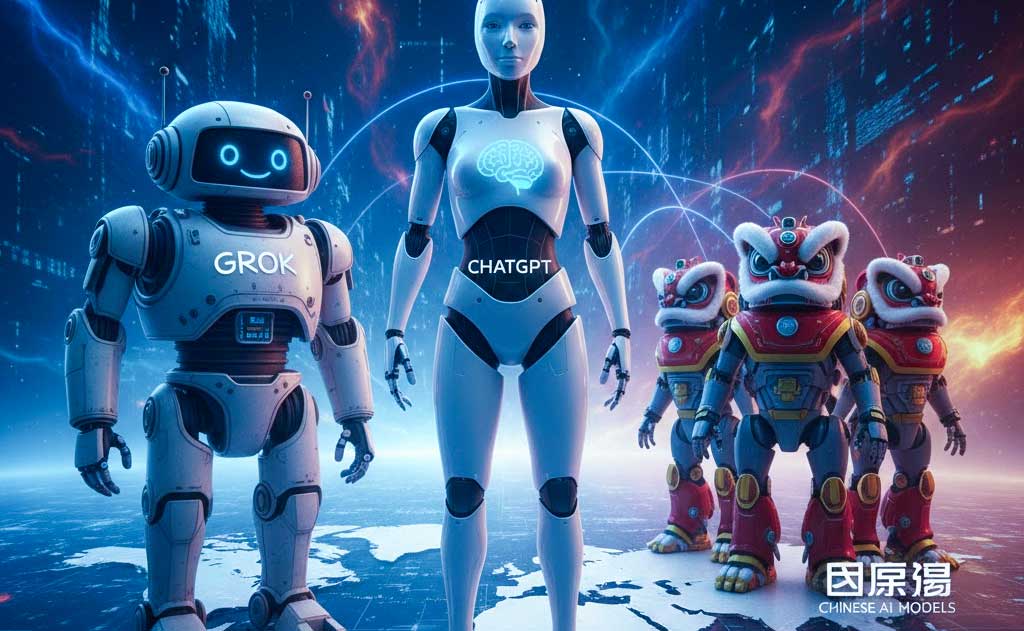
The global AI landscape in 2026 resembles a high-stakes technological showdown, often dubbed the “AI Cold War.” The United States, with powerhouses like OpenAI’s ChatGPT, xAI’s Grok, Google’s Gemini, and Anthropic’s Claude, has long dominated innovation, scaling, and multimodal capabilities. Meanwhile, China has surged forward with efficient, cost-effective models from companies like DeepSeek, Alibaba’s Qwen, Moonshot AI’s Kimi, and Zhipu AI’s GLM, closing the gap dramatically despite U.S. chip export restrictions.
From an American perspective, this competition raises critical concerns about national security, economic leadership, and technological sovereignty. U.S. firms lead in raw intelligence for frontier tasks, real-time integration, and ecosystem advantages, but Chinese models excel in affordability, open-source accessibility, and rapid deployment—potentially shifting global adoption toward Beijing-aligned tech. This article dives deep into a detailed technology comparison of Grok (xAI), ChatGPT (OpenAI), and leading Chinese AI models, highlighting why Americans should pay close attention to this escalating race.
The Current State of the AI Race: U.S. Leadership Under Pressure
As of January 2026, the U.S. maintains an edge in top benchmarks for reasoning, multimodal processing, and integrated tools. Models like Gemini 3 Pro, Grok 4, and Claude Opus 4.5 frequently top leaderboards such as Artificial Analysis Intelligence Index and LMSYS Arena. However, Chinese breakthroughs—particularly DeepSeek’s R1/V3 series and Alibaba’s Qwen3—have narrowed the performance gap to months rather than years.
Chinese models often achieve near-parity at 5-10x lower training costs, thanks to innovative architectures like Mixture-of-Experts (MoE) and optimized post-training. This efficiency threatens U.S. dominance, as developing nations and cost-sensitive enterprises increasingly adopt open-weight Chinese alternatives. Elon Musk has warned that chip fabrication control could decide the long-term winner, emphasizing America’s current software lead but highlighting vulnerabilities in hardware supply chains.
For Americans, the stakes are high: AI drives military applications, economic productivity, and global influence. A Chinese lead could mean exported models embedding values misaligned with Western principles, while U.S. restrictions spur Chinese self-reliance and innovation.
Key Players in Focus
- Grok (xAI): Founded by Elon Musk, Grok 4 (and variants like Grok 4.1 Thinking) emphasizes “truth-seeking,” real-time data from X (formerly Twitter), uncensored responses, and advanced reasoning. It’s integrated deeply with the X platform for live insights.
- ChatGPT (OpenAI): The mainstream leader via models like GPT-5.1 or o-series (e.g., o3-mini), known for polished multimodal features (text, voice, image, video), structured outputs, and broad ecosystem integration through Microsoft partnerships.
- Chinese Models — Leading contenders include:
- DeepSeek R1/V3 series: Open-weight MoE models (e.g., 671B parameters, 37B active) renowned for efficiency, reasoning, and low-cost access.
- Alibaba Qwen3 (e.g., Qwen3 235B A22B): Massive MoE with strong multilingual support (119+ languages), coding, and multimodal capabilities.
- Others like Moonshot Kimi K2, Zhipu GLM-4/5, and Baidu Ernie offer specialized strengths in math, coding, and enterprise deployment.
Detailed Technology Comparison
1. Reasoning and Benchmark Performance
U.S. models often edge out in high-difficulty reasoning, but Chinese ones close in fast.
- Grok 4 excels in deep reasoning and real-time chain-of-thought, scoring high on GPQA Diamond and AIME (e.g., ~93% on math competitions with extended compute).
- ChatGPT (GPT-5.1/o3) balances speed and depth, leading in STEM tasks like MATH-500 and LiveCodeBench.
- Chinese models shine in efficiency: DeepSeek R1 matches or beats GPT-4o on many fronts; Qwen3 outperforms on multilingual MMLU-Pro (~85-92%).
Americans value Grok’s “uncensored” approach for unbiased insights and ChatGPT’s reliability for professional use, while Chinese models offer comparable power without heavy safety filters—appealing globally but raising concerns about misinformation risks.
2. Real-Time Data and Integration
Grok stands out here with native X integration for live trends, news, and sentiment analysis—ideal for Americans tracking fast-moving events on social media.
ChatGPT relies on browsing tools but lacks Grok’s seamless real-time X pull.
Chinese models like DeepSeek and Qwen focus on internal efficiency rather than Western social feeds, though some integrate Chinese platforms (e.g., Weibo). This gives U.S. models an advantage in English/Western-centric real-time awareness.
3. Multimodal Capabilities
All top models handle text, images, and more, but differences emerge:
- ChatGPT leads in polished voice/video understanding and creative generation.
- Grok 4 adds multimodal vision and tool execution.
- Qwen3 supports 119 languages with strong image/video/audio, making it superior for global/multilingual use.
For American users, ChatGPT and Grok provide intuitive, high-quality multimodal experiences integrated with U.S. apps.
4. Cost and Accessibility
Chinese models dominate affordability:
- DeepSeek offers near-free access with no strict limits, training costs ~$5-10M vs. billions for U.S. equivalents.
- Qwen open-weights versions allow customization at low cost.
Grok requires X Premium (~$8-16/month), ChatGPT Plus $20/month—premium but with polished UX.
From a U.S. viewpoint, this cost gap enables Chinese models to flood markets in Asia, Africa, and Latin America, potentially eroding American soft power.
5. Open-Source vs. Proprietary
Chinese labs lead open-weight releases (e.g., DeepSeek R1 on Apache/MIT licenses), fueling global adoption and customization.
U.S. models like Grok and ChatGPT remain mostly proprietary, prioritizing control and monetization—beneficial for safety but limiting developer freedom.
Americans benefit from proprietary polish but risk falling behind in open ecosystems.
6. Specialized Strengths
- Coding: Claude often tops, but DeepSeek and Qwen crush real-world tasks; Grok strong in tool use.
- Math/STEM: Gemini and Grok lead; Chinese models competitive on AIME/MATH.
- Multilingual: Qwen dominates.
- Personality/Safety: Grok’s witty, less-restricted style appeals to freedom-focused users; ChatGPT more aligned/safe.
Why This Matters to Americans in 2026
The U.S. invented modern generative AI with ChatGPT’s 2022 launch, but China’s rapid catch-up—via models like DeepSeek surpassing expectations despite sanctions—signals urgency. American advantages in talent, compute ethics, and innovation persist, but hardware dependencies (e.g., TSMC) and cost disparities threaten long-term lead.
Policymakers and businesses must invest in domestic chip production, talent retention, and ethical AI to counter risks. For everyday Americans, tools like Grok offer uncensored, real-time utility, while ChatGPT provides versatile productivity—both superior for Western contexts compared to Chinese alternatives.
Conclusion: The Race Is Far From Over
In 2026, Grok brings bold, real-time truth-seeking; ChatGPT delivers refined, multimodal excellence; and Chinese models like DeepSeek and Qwen prove efficiency can rival scale. The “AI Cold War” isn’t just tech—it’s about values, security, and global influence.
America’s edge holds for now, but sustaining it demands vigilance. As Elon Musk notes, chip control could tip the balance. The future belongs to those who innovate By Ethan Brooks
Published on vfuturemedia
We started VFuture Media because we wanted tech news written by people who actually follow this industry — not content farms chasing keywords. If that resonates, we’d love to have you as a regular reader. Pull up a chair.

Leave a Comment