
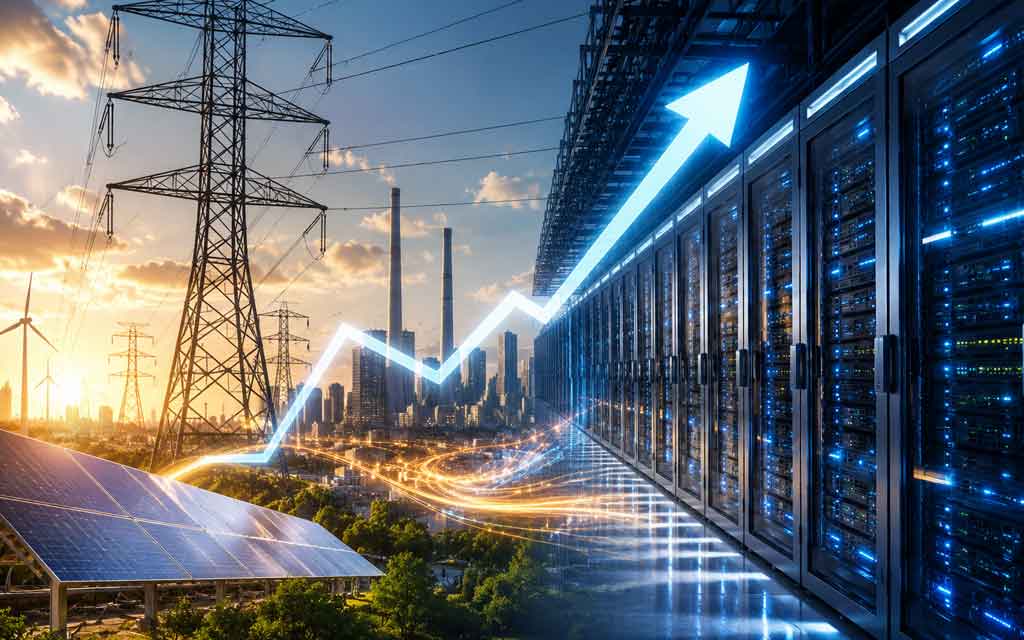
The explosive growth of AI data centers is set to drive U.S. electricity prices higher, with forecasts pointing to average annual increases of around 6% in coming years as surging power demand strains the grid. This projection reflects the massive infrastructure buildout required to support the next generation of artificial intelligence — from training frontier models like GPT-5.6 to running agentic systems and scaling hyperscale computing.
While higher electricity costs represent a real challenge for households and businesses, they also underscore a deeper truth: America’s leadership in AI depends on building the physical foundation to power it.
The Scale of AI-Driven Power Demand
Data centers already account for a growing share of U.S. electricity consumption, and AI is accelerating that trend dramatically. Goldman Sachs Research has projected that data centers could represent as much as 40% of electricity demand growth through the end of the decade. Other analyses show U.S. data center power demand potentially doubling between 2025 and 2028 as hyperscalers and AI companies race to deploy new capacity.
Gartner forecasts worldwide data center electricity consumption will rise 26% in 2026 alone, reaching 565 terawatt-hours. In the United States, the Energy Information Administration expects overall power demand to hit record highs in both 2026 and 2027, with AI infrastructure as a primary driver alongside electrification trends.
This isn’t incremental growth. AI workloads — especially training and inference for large models — require dense clusters of high-performance GPUs that consume far more power per rack than traditional computing. High-bandwidth memory chips, advanced cooling systems, and the supporting infrastructure all add to the load. The result is a step-change in electricity needs concentrated in key regions.
Why Prices Are Expected to Rise
When demand grows faster than new supply can come online, wholesale and retail electricity prices respond. Multiple factors are converging:
- Capacity constraints: Many regions face multi-year wait times for new grid connections. In markets like PJM (which serves much of the East Coast and Midwest), capacity prices have already soared due to data center demand, translating into higher costs passed on to ratepayers.
- Peak demand pressure: AI data centers often run at high utilization around the clock, adding load during periods when the grid is already stressed.
- Infrastructure investment: Utilities are planning major upgrades to transmission, substations, and generation. These capital expenditures eventually flow into customer rates.
- Fuel and market dynamics: While natural gas prices have helped moderate some increases, the sheer volume of new demand is tightening supply-demand balances in several markets.
Goldman Sachs analysts have specifically noted that households could see electricity prices rise an additional 6% through 2027 due to data center growth, with inflation then moderating as more supply comes online. Other studies project national average bill increases in the 6-29% range by 2030 depending on how aggressively new generation is built.
Regional Impacts and Consumer Effects
The effects are not uniform across the country. States and regions with heavy data center concentration — such as Northern Virginia, parts of Texas, the Midwest, and the Pacific Northwest — are already seeing sharper price pressure. In some PJM zones, data centers have been linked to billions in added costs for the capacity market, directly affecting monthly bills.
Residential customers in affected areas have reported noticeable jumps. Some utilities have filed rate cases explicitly tied to data center-driven investments. At the same time, data centers are often large, creditworthy customers that can help utilities spread fixed grid costs — but only if new supply keeps pace with demand.
For American families and small businesses, even a 6% annual increase compounds. Over several years, it can meaningfully affect household budgets, especially in regions already facing higher baseline rates.
The Innovation Response: Powering AI’s Future
The challenge is also spurring innovation and investment across the energy and technology sectors. Major tech companies are pursuing multiple paths to secure reliable, affordable power:
- On-site and behind-the-meter generation: Many hyperscalers are signing direct deals with power producers or developing their own generation assets, including natural gas plants, solar-plus-storage, and fuel cells.
- Nuclear revival: Interest in small modular reactors (SMRs) and restarting existing nuclear plants has surged. Tech firms are actively exploring co-location or dedicated nuclear supply.
- Efficiency and advanced cooling: New chip architectures, liquid cooling, and workload optimization are reducing power per computation, though overall demand growth still outpaces these gains.
- Grid modernization and policy support: The CHIPS and Science Act, along with broader infrastructure investments, aims to accelerate permitting and buildout of transmission and generation. The Trump administration’s focus on AI infrastructure includes efforts to streamline energy project approvals.
These responses highlight how the AI boom is catalyzing broader American energy innovation. The same companies pushing the frontier of intelligence are now deeply engaged in reshaping the power sector — a dynamic that strengthens U.S. technological and industrial leadership.
Economic and Strategic Implications
Higher electricity prices are a trade-off in the race for AI dominance. On one side, they represent a cost that could slow adoption in some sectors or add to inflationary pressures. Goldman Sachs has estimated modest drags on consumer spending and GDP growth from rising power costs through 2027.
On the other side, the buildout supports high-value jobs in construction, engineering, manufacturing (including advanced chips and memory), and energy. It reinforces America’s position as the home of the world’s most advanced AI ecosystem — from model developers to the infrastructure that runs them.
Critically, the U.S. cannot lead in AI if it cannot power the data centers that train and serve the models. The current power bottleneck is therefore both a constraint and a catalyst for the next wave of infrastructure investment.
Frequently Asked Questions
Will electricity prices really rise 6% every year? Projections vary by region and depend on how quickly new generation and transmission come online. Goldman Sachs and other analysts have modeled scenarios around 6% cumulative pressure through 2027, with potential moderation afterward as supply catches up.
Who is most affected? Residents and businesses in high-growth data center regions (e.g., Virginia, Texas, Midwest, parts of the West) face the greatest near-term impact. National averages will be lower but still noticeable.
Are tech companies paying their fair share? Large data center operators often negotiate special rates or contribute to grid upgrades. However, some policymakers argue for stronger mechanisms to ensure new large loads do not disproportionately burden existing ratepayers.
What solutions are being pursued? On-site generation, nuclear (including SMRs), efficiency improvements, demand response, and faster permitting for new power plants and transmission lines.
Will this slow AI progress? Power constraints are already causing some project delays. However, the industry is adapting quickly through private power deals and innovation, suggesting the buildout will continue — albeit with higher costs and more creative energy strategies.
The Bottom Line
The projected rise in electricity prices tied to the AI data center boom is a tangible reminder that artificial intelligence has a physical footprint. Training and running ever-more-capable models requires vast amounts of reliable power, and meeting that demand will reshape America’s energy landscape for years to come.
For U.S. innovation leadership, this is both a challenge and an opportunity. The companies and regions that solve the power equation fastest — through new generation, efficiency gains, and smart policy — will maintain the edge in the global AI race.
The data center boom is not just about chips and models. It is about building the energy backbone that will power the next era of American technological dominance.
Higher electricity bills are one visible cost. The long-term prize is continued leadership in the defining technology of our time.
How do you think the U.S. should balance rapid AI infrastructure growth with affordable energy for households and businesses? Share your thoughts in the comments.




Leave a Comment