
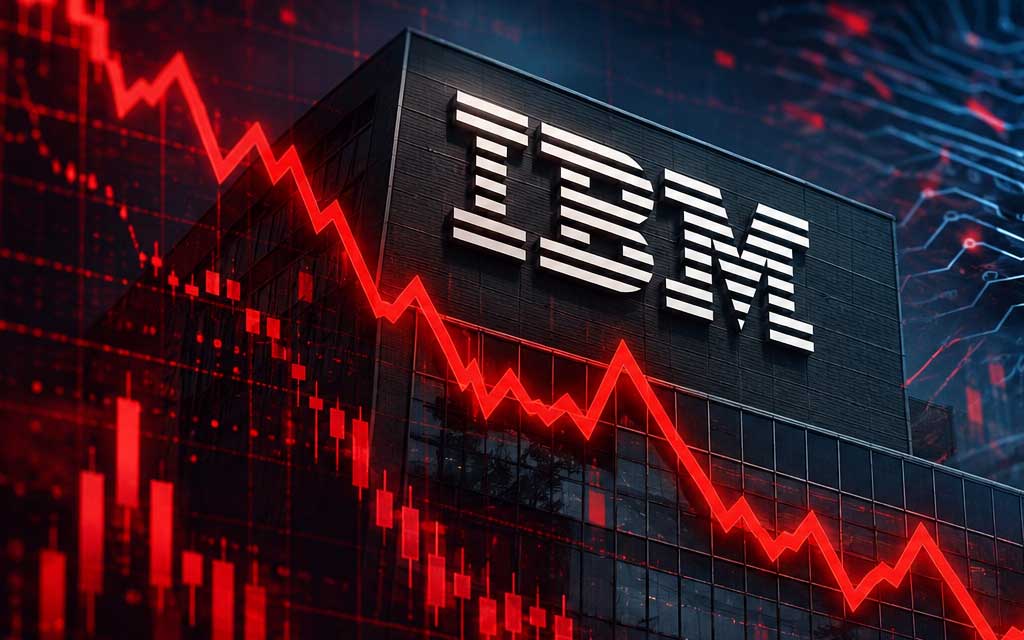
In one of the most dramatic single-day stock collapses in recent memory, IBM shares plunged over 25% on July 14–15, 2026, erasing approximately $67–70 billion in market value. The stock dropped from around $290 to roughly $217, marking the worst single-session decline in the company’s 115-year history — surpassing even the infamous 1987 Black Monday drop for IBM.
As an American tech reporter covering AI, EVs, autonomy, and global competition at www.vfuturemedia.com, this isn’t a simple earnings miss. It’s a stark illustration of how the AI boom is reshaping enterprise tech spending — and exposing vulnerabilities in legacy giants. For American investors, policymakers, and innovators, the key question is: Is the AI bubble bursting, or is AI accelerating disruption that IBM failed to navigate? The evidence points squarely to the latter.
What Happened: The Numbers Behind IBM’s Historic Crash
IBM issued a surprise pre-earnings warning, projecting Q2 2026 revenue of just $17.2 billion — well below Wall Street expectations of ~$17.9 billion. Adjusted EPS came in at $2.93, missing forecasts of $3.02. Infrastructure revenue fell 7%, software growth was a tepid 5% (short of double-digit targets), and consulting was essentially flat.
CEO Arvind Krishna’s letter to investors was blunt: “What played out was worse than our expectations… We did not adapt and move quickly enough.” Numerous large deals failed to close on schedule.
The market’s reaction was merciless. The selloff dragged down other software and enterprise names like Microsoft, ServiceNow, Salesforce, and Workday, sparking broader sector fears.
The Real Reason: AI-Driven Spending Shift, Not Bubble Burst
This collapse is not evidence of an AI bubble bursting. Instead, it reflects AI’s disruptive power accelerating faster than IBM anticipated:
- Enterprise customers are redirecting budgets toward AI infrastructure — servers, memory chips, storage, and data center hardware — to hedge against shortages and rising prices fueled by the AI boom.
- This shift hurt IBM’s traditional strengths in software, mainframes (Z systems), and consulting. Companies are hoarding cash for hardware rather than signing big software or services deals.
- IBM “faltered” in adapting to this new reality, where AI demand is reshaping IT priorities overnight.
Far from a bubble deflating, this shows AI’s capital-intensive phase in full swing. Demand for GPUs, memory, and power infrastructure is skyrocketing — the same dynamics benefiting companies like NVIDIA, TSMC, and data center plays, while pressuring legacy software and hybrid cloud providers.
This mirrors broader patterns we’ve tracked at VFutureMedia:
- China’s humanoid robot deployments and EV export dominance leverage hardware scale.
- U.S. policies like the Inflation Reduction Act (IRA) and CHIPS Act aim to build domestic resilience in AI-enabling hardware (batteries, semiconductors).
Is the AI Bubble Bursting? No — It’s Maturing Painfully
AI Bubble Narrative: Some commentators are quick to draw dot-com parallels, citing high valuations and selective winners/losers. IBM’s drop, combined with earlier software sector weakness, fuels this talk.
Reality Check:
- AI Demand is Real: The infrastructure buildout is just beginning. Corporate adoption of generative AI, agents, and embodied robotics (as in China’s thousands of humanoids) continues accelerating.
- Winners and Losers Emerging: Pure-play AI infrastructure and frontier model companies thrive; slower adapters in legacy IT suffer. This is creative destruction, not collapse.
- Broader Market Context: While IBM cratered, the overall tech sector remains resilient. AI leaders in autonomy, EVs, and software-defined systems (Tesla, etc.) continue posting strong momentum.
- Historical Precedent: Tech transitions (cloud, mobile) created massive winners and temporary losers. AI is no different.
From an American perspective, this validates strategic investments in hardware sovereignty. The U.S. must double down on domestic chip, data center, and energy infrastructure to avoid ceding ground to China.
Implications for American Investors, Tech, and Policy
For Investors:
- Opportunity in Disruption: Look beyond the headline panic. Companies enabling AI hardware, power solutions, and efficient software could benefit long-term.
- Risk Management: Diversify across AI value chain — not just hype names. IBM may rebound if it pivots aggressively to AI services and hybrid solutions.
- Valuation Reset: This event could lead to healthier market differentiation.
For U.S. Tech Leadership:
- Legacy giants must accelerate AI integration or risk irrelevance. IBM has quantum and Watson assets but lagged in this spending wave.
- Ties to EVs/Auto: AI-driven design, simulation, and factory robotics (humanoids) will transform manufacturing. IBM’s struggles highlight the need for agility in software-defined vehicles.
Policy Angle: Reinforce IRA, CHIPS Act, and new incentives for AI infrastructure. America’s edge lies in innovation and alliances (e.g., with India via Anthropic’s expansion), not just volume.
What’s Next for IBM and the AI Sector?
IBM’s full Q2 report (expected soon) and strategic updates will be critical. The company is investing heavily in AI, but execution speed matters. Expect continued volatility as the market prices in AI’s uneven impact across enterprise tech.
Broader sector: Watch for more differentiation. Strong AI infrastructure and application players should weather any rotation, while pure legacy plays face pressure.
This event reinforces a core VFutureMedia theme: AI is not a bubble — it’s a tectonic shift reshaping industries from filmmaking (George Lucas’s endorsement) to music generation, robotics, and mobility.
Conclusion: AI Isn’t Bursting — It’s Rewriting the Rules
IBM’s 25% stock collapse is painful but instructive. It wasn’t caused by AI hype deflating; it was triggered by AI’s explosive real-world demand catching a legacy leader off guard. For America, this is a reminder to embrace disruption, invest in foundational technologies, and lead the AI-auto-EV convergence.
At www.vfuturemedia.com, we remain bullish on American ingenuity navigating this transition. The AI future isn’t fading — it’s intensifying. Investors and companies that adapt fastest will win, just as the U.S. must in the global tech race.
Stay tuned as we track every twist in AI, EVs, robotics, and beyond.
By Ethan Brooks


Leave a Comment