Agentic RAG Architecture Explained
Agentic RAG puts an AI agent in charge of retrieval: planning queries, choosing tools and checking evidence. How it works, key patterns, costs and risks.
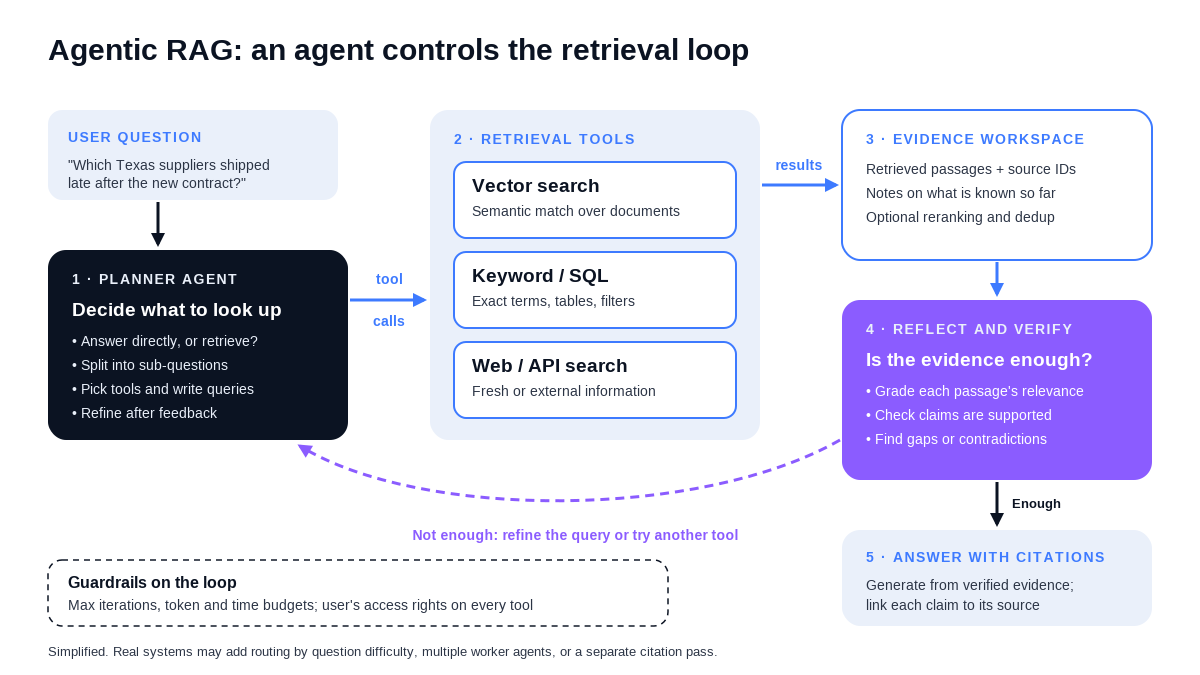
Agentic RAG is retrieval-augmented generation in which an AI agent, rather than a fixed pipeline, controls the retrieval. Instead of embedding the question, fetching the top few chunks once and generating an answer, the agent plans what to look up, chooses between retrieval tools, judges whether the evidence is good enough, and searches again if it isn't. The payoff is better answers to complex, multi-part questions; the price is more latency, more tokens and more ways for things to go wrong.
If you need a refresher on the basic pattern first, start with our explainer on retrieval-augmented generation (RAG).
The problem with one-shot retrieval
Classic RAG runs the same steps for every query: embed the question, search a vector database, paste the top results into the prompt, generate. It works well for simple, single-fact questions. It struggles in three situations:
- Multi-hop questions. "Which of our suppliers in Texas had late shipments after the new contract took effect?" needs one lookup to find the contract date and another that depends on it. The IRCoT authors argued that one-step retrieve-and-read is insufficient for such questions because "what to retrieve depends on what has already been derived" [3].
- Bad first retrieval. Standard RAG depends heavily on the relevance of what comes back, so it is fragile when retrieval misses [5].
- Wrong source. Some questions belong in a SQL table, some in a document store, some on the live web. A single fixed retriever can't tell the difference.
A 2025 survey of the field describes traditional RAG as "constrained by static workflows" and defines agentic RAG as embedding autonomous agents into the pipeline to address that rigidity [1].
How agentic RAG works
The survey identifies four agentic design patterns that show up across systems: planning, tool use, reflection and multi-agent collaboration [1]. In a working system they combine into a loop.
1. Planner
A language model reads the question and decides what to do. It may answer directly, break the question into sub-questions, or pick a retrieval strategy. This is the reasoning-and-acting pattern described in the ReAct paper, where a model interleaves reasoning traces with actions such as querying a knowledge base; on question answering and fact verification, that reduced hallucination compared with reasoning alone [2].
2. Retrieval tools
Retrieval becomes a set of tools the planner can call through ordinary function calling or MCP servers. Typical tools include:
- Semantic search over a vector index (see embedding models and chunking strategies).
- Keyword or hybrid search for exact terms such as part numbers and names (see hybrid search).
- Structured queries against SQL databases or APIs.
- Web search for information newer than the internal corpus.
- A reranker to reorder candidates by relevance (see reranking models).
3. Evidence workspace
Retrieved passages, their sources and the agent's notes accumulate in a working memory. The agent can rewrite its query based on what it has found so far. IRCoT showed the value of this feedback: interleaving retrieval with chain-of-thought steps, so each reasoning step guides the next lookup, improved retrieval by up to 21 points and downstream question answering by up to 15 points with GPT-3 across four multi-hop datasets [3].
4. Reflection and verification
Before answering, the system checks its evidence. Is each passage relevant? Does the evidence actually support the draft answer? Is anything missing? If the check fails, control loops back to the planner with a refined query or a different tool. Several research systems formalize this step (see below).
5. Generation with citations
Once the evidence passes, the model writes the answer and ties each claim to a source. Some systems add a separate citation pass after generation.
6. Limits
Every loop needs a stopping condition. Anthropic's guidance on agents notes it is common to include stopping conditions "such as a maximum number of iterations" to keep control [9]. Production systems add token and time budgets too.
Key research patterns
Agentic RAG grew out of a run of papers that each added one form of control. They are worth knowing because product documentation often borrows their names.
Pattern | What it adds | How it decides | Source |
|---|---|---|---|
ReAct | Interleaved reasoning and tool actions | Model reasons, acts, observes, repeats | [2] |
IRCoT | Retrieval at each reasoning step | Each chain-of-thought sentence drives the next query | [3] |
Self-RAG | On-demand retrieval plus self-critique | Model trained to emit "reflection tokens" about when to retrieve and whether output is supported | [4] |
Corrective RAG (CRAG) | A retrieval quality check with fallback | Lightweight evaluator scores retrieved documents; low confidence triggers corrective actions such as web search | [5] |
Adaptive-RAG | Strategy chosen by question difficulty | Small classifier routes to no retrieval, single-step or multi-step retrieval | [6] |
Search-R1 | Learned search behaviour | Reinforcement learning teaches the model when and what to search while reasoning | [7] |
A few details stand out:
- Self-RAG trains a single model to decide when retrieval is needed and to critique both passages and its own output; the authors report gains in factuality and citation accuracy over retrieval-augmented baselines [4].
- CRAG adds a "decompose-then-recompose" step that strips irrelevant content from retrieved documents and is designed to plug into other RAG approaches [5].
- Adaptive-RAG is the cost-saving pattern: simple questions skip the expensive multi-step loop entirely [6].
- Search-R1 shows the field moving from prompted agents to trained ones; the authors report outperforming RAG baselines by 41% with a 7-billion-parameter Qwen model and 20% with a 3-billion-parameter one across seven QA datasets [7].
Architecture variants
Single-agent router
One agent with several retrieval tools. It's the simplest form and the right starting point for most teams.
Multi-agent (orchestrator-worker)
A lead agent splits the task and hands sub-questions to worker agents that search in parallel. Anthropic's Research feature, described in June 2025, works this way: a lead agent plans and spawns subagents that each run their own iterative searches, then a separate citation agent attributes claims to sources [8]. Anthropic contrasts this with traditional RAG's "static retrieval" of chunks most similar to the query [8]. Our explainer on multi-agent systems covers the coordination trade-offs.
Workflow-style agentic RAG
Not every system needs a free-roaming agent. Anthropic distinguishes workflows, where "LLMs and tools are orchestrated through predefined code paths," from agents that steer themselves [9]. A fixed sequence such as "rewrite query, retrieve, grade, retry once, answer" captures much of the benefit with far more predictability.
Classic RAG vs agentic RAG
Dimension | Classic RAG | Agentic RAG |
|---|---|---|
Control flow | Fixed pipeline | Model-driven loop |
Retrieval calls per question | Usually one | One to many |
Sources | Usually one index | Multiple tools: vectors, keyword, SQL, web, APIs |
Handles multi-hop questions | Poorly | Well, by design |
Self-checking | None by default | Relevance grading and answer verification |
Latency and cost | Low and predictable | Higher and variable |
Debugging | Inspect one retrieval | Trace a multi-step trajectory |
Attack surface | Indexed content | Indexed content plus every tool and web result |
Real-world use
Documented production examples are still fewer than vendor marketing suggests. Anthropic's write-up is one of the most detailed: on its internal research evaluation, a multi-agent setup with Claude Opus 4 leading Claude Sonnet 4 subagents outperformed single-agent Claude Opus 4 by 90.2% [8]. It also reported the cost side: agents typically used about four times more tokens than chat, and multi-agent systems about 15 times more, making them economically viable only for high-value tasks [8].
The survey lists healthcare, finance, education and enterprise document processing as application areas [1]. Enterprise software makers are moving the same way, as our coverage of agentic AI in SaaS, Microsoft Copilot's multi-model agent updates and agentic AI's shift toward autonomous decisions shows.
Benefits
- Better answers to hard questions, especially multi-hop, comparative and research-style queries [3][8].
- Recovery from bad retrieval through grading and re-querying [5].
- The right source for each question, from SQL to the web.
- Cost control when done well, by skipping retrieval for easy questions [6].
- Better traceability when the system logs each search and cites its evidence.
Limitations and risks
- Cost and latency. Each loop adds model calls and tokens; Anthropic's 15x figure for multi-agent systems is a useful warning [8].
- Compounding errors. A wrong sub-question early in the plan sends every later search in the wrong direction.
- Evaluation is harder. The survey names evaluation, coordination, memory management, efficiency and governance as open challenges [1].
- Verification is not proof. A model grading its own evidence can still be wrong, so agentic RAG reduces hallucinations without eliminating them.
- Bigger attack surface. OWASP's 2025 guidance on vector and embedding weaknesses (LLM08:2025) warns of poisoned knowledge sources, cross-tenant leaks and unauthorized access in retrieval systems [10]. Research on knowledge poisoning found that inserting five crafted texts per target question into a database of millions achieved about a 90% attack success rate against the RAG systems tested [11]. An agent that also reads web pages and calls tools widens that surface. See our guide to RAG security, prompt injection and guardrails.
How to decide if you need it
Ask these questions before adding an agent:
- Do most of your queries need more than one lookup? If not, improve classic RAG first: better chunking, hybrid search and reranking often fix more than an agent would.
- Do answers need multiple sources? If you must combine a document store with a database or the web, a router agent earns its keep.
- Can you afford variable latency? Customer-facing chat with tight response-time targets may need a capped workflow rather than an open loop.
- Can you measure it? Build an evaluation set with multi-hop questions and grade both answers and retrieval steps before and after.
- Is the data permissioned? Retrieval tools must enforce the end user's access rights, not the agent's.
If you're still deciding between retrieval and training, RAG vs fine-tuning covers that choice.
Outlook
The research trend runs from prompted loops (ReAct, IRCoT) to models trained to retrieve and critique (Self-RAG, Search-R1) [2][3][4][7]. Expect more retrieval behaviour to move inside the model's training rather than hand-written orchestration code. That is an inference from the papers above, not a forecast any of them makes. The open problems the survey names, especially evaluation and governance, are likely to decide how quickly agentic RAG moves from demos to regulated workloads [1].
Frequently asked questions
What is the difference between RAG and agentic RAG?
Classic RAG runs a fixed pipeline: retrieve once, then generate. Agentic RAG lets an agent plan queries, pick among retrieval tools, check the evidence and retrieve again when needed [1]. It handles complex questions better at the cost of more latency and tokens.
Is agentic RAG the same as Self-RAG?
No. Self-RAG is one specific research method that trains a model to decide when to retrieve and to critique its own output using reflection tokens [4]. Agentic RAG is the broader architecture category, which can use Self-RAG-style reflection, corrective checks, routing or multiple agents.
Does agentic RAG eliminate hallucinations?
No. Verification steps catch some unsupported claims, and research systems report better factuality [4][5], but the model doing the checking can still err. Keep citations visible so people can check sources themselves.
Do I need a multi-agent system for agentic RAG?
Usually not. A single agent with a few retrieval tools covers most needs. Multi-agent designs help with broad research tasks that split into independent threads, but Anthropic reports they used about 15 times more tokens than chat [8].
How do I stop an agentic RAG loop from running forever?
Set hard limits on iterations, tokens and time, and define what "enough evidence" means for the verifier. Anthropic recommends stopping conditions such as a maximum number of iterations [9].
Sources
- Singh, A. et al. "Agentic Retrieval-Augmented Generation: A Survey on Agentic RAG." arXiv:2501.09136, January 2025 (v4, April 2026). https://arxiv.org/abs/2501.09136
- Yao, S. et al. "ReAct: Synergizing Reasoning and Acting in Language Models." arXiv:2210.03629, October 2022. https://arxiv.org/abs/2210.03629
- Trivedi, H. et al. "Interleaving Retrieval with Chain-of-Thought Reasoning for Knowledge-Intensive Multi-Step Questions." ACL 2023. arXiv:2212.10509. https://arxiv.org/abs/2212.10509
- Asai, A. et al. "Self-RAG: Learning to Retrieve, Generate, and Critique through Self-Reflection." arXiv:2310.11511, October 2023. https://arxiv.org/abs/2310.11511
- Yan, S.-Q. et al. "Corrective Retrieval Augmented Generation." arXiv:2401.15884, January 2024. https://arxiv.org/abs/2401.15884
- Jeong, S. et al. "Adaptive-RAG: Learning to Adapt Retrieval-Augmented Large Language Models through Question Complexity." NAACL 2024. arXiv:2403.14403. https://arxiv.org/abs/2403.14403
- Jin, B. et al. "Search-R1: Training LLMs to Reason and Leverage Search Engines with Reinforcement Learning." arXiv:2503.09516, March 2025. https://arxiv.org/abs/2503.09516
- Anthropic. "How we built our multi-agent research system." June 13, 2025. https://www.anthropic.com/engineering/multi-agent-research-system
- Anthropic. "Building effective agents." December 19, 2024. https://www.anthropic.com/engineering/building-effective-agents
- OWASP GenAI Security Project. "LLM08:2025 Vector and Embedding Weaknesses." https://genai.owasp.org/llmrisk/llm082025-vector-and-embedding-weaknesses/
- Zou, W. et al. "PoisonedRAG: Knowledge Corruption Attacks to Retrieval-Augmented Generation of Large Language Models." USENIX Security 2025. arXiv:2402.07867. https://arxiv.org/abs/2402.07867