
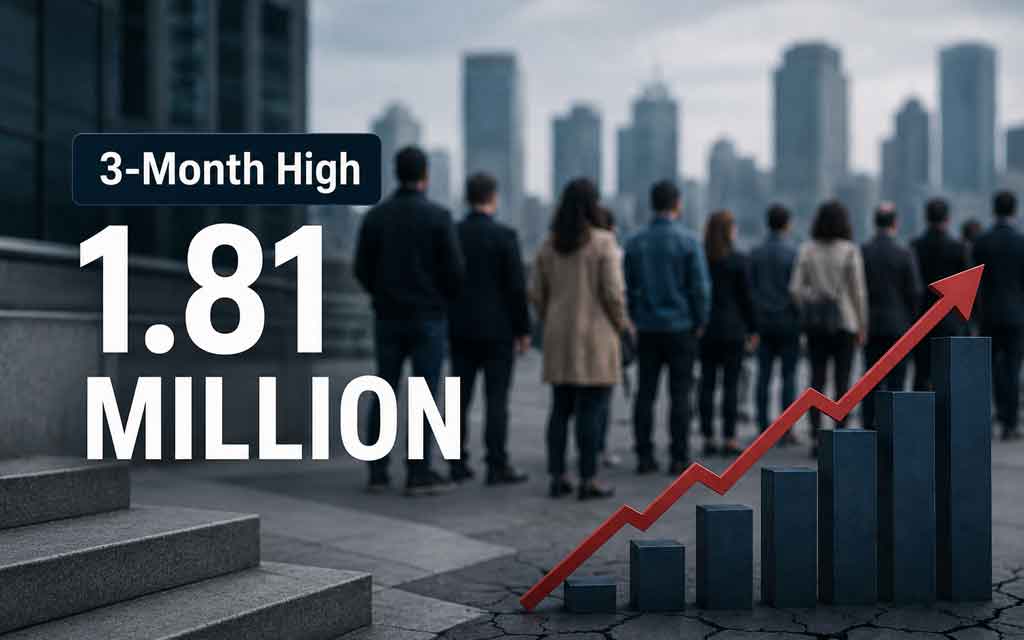
The number of Americans collecting unemployment benefits has climbed to its highest level in three months.
According to the latest data from the U.S. Department of Labor, continuing jobless claims — which track people who have been receiving unemployment insurance for more than one week — rose to 1.81 million for the week ending June 6, 2026. That’s up from 1.786 million the previous week and marks the highest reading since early March.
While the increase is modest and the overall level remains historically low, the steady uptrend in people staying on unemployment rolls is one of the clearer signs yet that the U.S. labor market is cooling.
Latest Jobless Claims Data (Week Ending June 6, 2026)
| Metric | Latest Figure | Change from Prior Week | Notes |
|---|---|---|---|
| Continuing Claims | 1,810,000 | +24,000 | Highest in ~3 months |
| Initial Claims | ~226,000 | -4,000 | Relatively stable |
| 4-Week Moving Average (Initial) | ~223,250 | Slight rise | Still low historically |
| Insured Unemployment Rate | 1.2% | Unchanged | Near historic lows |
Source: U.S. Department of Labor
Initial claims (new filings) have been more volatile but remain in a range consistent with a stable — though no longer red-hot — labor market. The more telling signal right now is the rise in continuing claims, which suggests that people who lose their jobs are taking longer to find new ones.
Why Continuing Claims Matter More Right Now
Initial jobless claims get most of the headlines because they reflect new layoffs. However, continuing claims are often a better gauge of underlying labor market health because they show how long people remain unemployed.
A rising trend in continuing claims typically indicates:
- Slower hiring by companies
- Longer job search times for workers
- A gradual loosening of the labor market
This doesn’t necessarily signal an imminent recession. The current level of 1.81 million is still well below the peaks seen during previous downturns. But it does mark a clear shift from the extremely tight labor market of 2022–2024, when continuing claims often hovered near or below 1.7 million.
Broader Context: A Cooling but Resilient Labor Market
The U.S. economy has been walking a fine line between avoiding recession and accepting slower growth. Recent jobless claims data fits that narrative:
- Layoffs remain relatively contained (initial claims are not spiking dramatically).
- However, companies appear more cautious about hiring.
- Certain sectors — particularly tech, media, and some areas of retail and finance — have seen prolonged hiring freezes or slower rehiring.
For tech workers and knowledge economy employees, the rise in continuing claims is especially relevant. Many who were laid off in the 2022–2024 tech correction have faced extended job searches, and newer entrants into the AI-impacted job market are feeling the effects of higher competition and more selective hiring.
What’s Driving the Trend?
Several factors appear to be contributing to the gradual rise in unemployment duration:
- Higher interest rates — Even with expected cuts, borrowing costs remain elevated, leading companies to delay expansion and hiring.
- AI and automation effects — While AI is creating new roles, it is also reducing demand for certain junior and mid-level positions, lengthening job searches in affected fields.
- Sectoral shifts — Strength in some areas (government, healthcare, certain professional services) is being offset by weakness in others.
- Normalization after pandemic distortions — The ultra-low unemployment of recent years was partly artificial. A return toward more normal levels was always expected.
Implications for Workers, Tech, and the Economy
For American workers:
- Job searches are taking longer on average.
- Competition for open roles remains high in many white-collar fields.
- Upskilling and targeted networking are becoming even more important.
For the tech sector:
- Hiring has been selective rather than broad-based for over two years.
- AI-related roles continue to see demand, but overall tech headcount growth has slowed significantly.
- The rise in continuing claims suggests that even laid-off tech workers are facing a tougher re-employment environment than in 2021–2022.
For markets and policy:
- The Federal Reserve will be watching these numbers closely. A sustained rise in continuing claims could strengthen the case for interest rate cuts later in 2026.
- So far, the data does not point to a sharp deterioration — more of a “soft landing” cooling than a recessionary spike.
The Bottom Line
The number of Americans collecting unemployment benefits hitting a 3-month high is not cause for panic. At 1.81 million, continuing claims remain low by historical standards. However, the direction of the trend is clear: the labor market is loosening.
This gradual cooling has been the Federal Reserve’s stated goal for some time. The risk now is whether this slow thaw turns into something more pronounced if hiring continues to weaken or if economic growth slows further.
For now, the data shows a labor market that is normalizing rather than collapsing — but one that is clearly no longer as strong as it was 12–18 months ago.
Workers and companies should treat the current environment as one that rewards preparation, adaptability, and realistic expectations around job search timelines.
FAQs
What are continuing jobless claims? Continuing claims measure the number of people who have already filed for unemployment benefits and are still receiving them. They are considered a better indicator of how long people remain unemployed than initial claims.
Is 1.81 million continuing claims high? It is the highest level in about three months, but it remains relatively low compared to historical norms and recession levels. It signals a cooling labor market rather than a crisis.
How does this affect tech workers? Many tech professionals laid off in recent years have faced extended job searches. The rise in continuing claims suggests that re-employment is taking longer across the broader economy, including in knowledge work.
Does this mean a recession is coming? Not necessarily. The data so far points to a gradual cooling rather than a sharp downturn. However, sustained increases in continuing claims would be a warning sign worth monitoring.
When is the next jobless claims report? The Department of Labor releases new data weekly, typically on Thursdays.


Leave a Comment