

Autonomous Mobile Robots (AMRs): How They Work vs AGVs
What autonomous mobile robots are, how they map, plan and avoid people, how they differ from AGVs, and which US safety standards apply to deploying them.
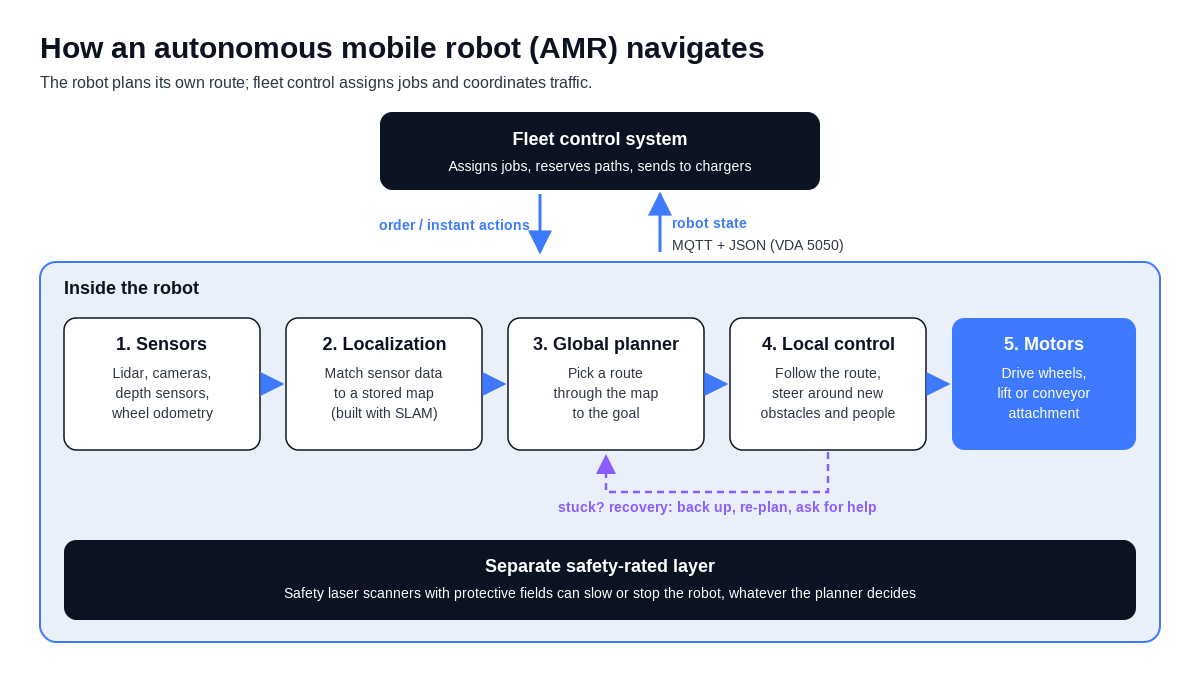
An autonomous mobile robot (AMR) is a wheeled robot that moves materials through a facility by building or using a map, working out where it is, and planning its own route around obstacles and people. An automated guided vehicle (AGV), by contrast, follows a predefined path. AMRs trade some predictability for flexibility: you can change routes in software instead of re-laying tape or wire.
AMR vs AGV: the core difference
The clearest definitions come from VDA 5050, the open, vendor-neutral fleet-communication specification from the German associations VDA and VDMA. It distinguishes line-guided mobile robots, which "follow predefined trajectories" sent by fleet control or stored on the robot, from freely navigating mobile robots, which "plan their own trajectories" [2].
US safety standards draw the line in a similar place. The ANSI explanation of the R15.08 series notes that older standards were built for fixed robot arms (ANSI/A3 R15.06) or for line-guided AGVs (ANSI/ITSDF B56.5). Neither covered robots that change their paths dynamically around workers or carry robot arms. R15.08 was written to fill that gap [1].
AGV (line-guided) | AMR (freely navigating) | |
|---|---|---|
Route | Fixed path, defined in advance [2] | Plans its own path on a map [2] |
Changing the layout | Re-define or re-install the path | Update the map and rules in software |
Obstacle in the way | Cannot leave its path, so it waits | Can plan around it if there is room |
Predictability | High: same path every time | Lower: path can vary run to run |
Main US safety standard | ANSI/ITSDF B56.5 [1] | ANSI/A3 R15.08 series [1] |
Typical fit | Stable, high-volume routes | Changing layouts, mixed traffic |
Neither is "better". A high-volume line feeding the same two stations all day may be well served by an AGV. A site whose layout shifts every season usually favors AMRs.
How an AMR navigates
Most AMRs run a loop with five parts. The diagram above shows how they connect.
- Sensing. Lidar, cameras and depth sensors see the surroundings, and wheel encoders and inertial sensors track motion. For a comparison of these sensors, see LiDAR vs radar vs camera.
- Localization. The robot matches what it senses against a stored map to estimate its position. Many systems build that map first with SLAM (simultaneous localization and mapping).
- Global planning. Given a destination, a planner picks a route through the map.
- Local control. A controller follows that route while steering around obstacles that weren't on the map, such as a pallet or a person.
- Recovery. When the robot gets stuck, it runs fallback behaviors such as backing up, re-planning or asking for help.
The open-source Navigation2 (Nav2) stack for ROS 2 is a useful public reference. Its authors describe it as using a behavior tree to orchestrate navigation tasks, with methods designed for dynamic environments and modern sensors. They tested it by running a robot alongside students on a university campus [3]. Commercial AMRs use their own software, but the same building blocks recur.
The safety layer is separate
The navigation software decides where to go. A separate, safety-rated layer, usually laser scanners with protective fields, decides when the robot must slow or stop. That separation matters: an error in the planner should not be able to override the stop. Risk assessment and safety rules for robots that change their paths dynamically, including how they are integrated into a site, are what the R15.08 standards set out [1].
Types of industrial mobile robots
R15.08-2 covers three types of industrial mobile robots (IMRs), first described in Part 1 [1]:
- Type A: an AMR without attachments.
- Type B: an AMR with passive or active attachments other than an arm, such as roller tables, conveyors or lift devices.
- Type C: an AMR or AGV used as a mobile platform carrying a robot arm.
Type C robots raise the hardest safety questions, because both the base and the arm can move. For the arm side, see our guide to collaborative robots in manufacturing.
Fleet management and interoperability
One AMR is a gadget; fifty are a traffic system. A fleet manager assigns jobs, reserves paths, sends robots to chargers and resolves deadlocks.
Mixed fleets are where open interfaces matter. VDA 5050 defines how a central fleet control talks to robots from different vendors. It runs over MQTT with JSON messages [2]. The mandatory topics include an order topic for jobs, instantActions for immediate commands, a state topic where the robot reports back, a connection topic, and a factsheet describing each robot's capabilities [2]. Version 3.0.0 is current as of November 2026 [2]. The spec is explicitly optional and non-binding, so check vendor support rather than assuming it [2].
At the very large end, fleet coordination is turning into an AI problem of its own. Amazon says its DeepFleet foundation model coordinates robot movement across its network and improves fleet travel time by 10%, a company figure without independent verification [5].
Where AMRs are used
- Warehouses and fulfillment. Moving totes, shelves, carts and pallets. See AI-powered warehouse automation.
- Factories. Feeding parts to assembly lines and moving finished goods to shipping. The ANSI summary of R15.08-2 notes that mobile robots once confined to fulfillment centers are now being introduced onto active factory floors [1].
- Hospitals and labs. Delivering supplies and samples along corridors.
Logistics dominates. The IFR's World Robotics 2026 report counts 117,500 transportation and logistics robots sold in 2025, up 21% and 47% of the professional service robot market [4].
Benefits
- Flexible routes. Layout changes are mostly software changes [2].
- Scalable fleets. Add robots as volume grows, often on a subscription; the IFR says robots-as-a-service is already the dominant model in the US [4].
- Less manual hauling. OSHA lists overexertion from lifting and being struck by powered industrial trucks among the most common warehouse injuries [6]. AMRs can take over much of that carrying.
Limitations and risks
- Less predictable paths. Free navigation means paths and timing can vary, which complicates tightly synchronized processes.
- Mixed traffic. People, forklifts and robots sharing aisles need clear rules, training and site design. R15.08-2 assumes trained people in structured or semi-structured spaces [1].
- Wireless dependence. Fleet control assumes connection failures and lost messages will occur, so robots must behave safely when they lose contact [2].
- Floors and clutter. Ramps, doors, elevators, reflective surfaces and blocked aisles all cause trouble.
- Robots as a hazard. OSHA lists robotics among warehouse hazards [6].
How to choose
- Map the flows. Which loads, from where to where, how often, and how stable is the route?
- AGV or AMR? Stable, repetitive routes may favor AGVs. Changing layouts and mixed traffic favor AMRs.
- Pick the type. Do you need a bare base (Type A), conveyor or lift tops (Type B), or a mobile arm (Type C) [1]?
- Ask about R15.08. Who handles safety requirements for integration (Part 2), and what does Part 3 require of you as the user in managing the operating environment [1]?
- Ask about interfaces. VDA 5050 support or an equivalent matters if you'll mix vendors [2].
- Pilot in the busiest aisle. That's where deadlocks and safety stops show up.
Outlook
Logistics demand is pulling AMR volumes up [4], and the standards now cover the whole lifecycle, from manufacturer to integrator to user [1]. Expect more mobile arms (Type C) and more cross-vendor fleets. For the wider picture of robots that sense, plan and act, see how autonomous robots work.
Frequently asked questions
What's the difference between an AMR and an AGV?
An AGV follows predefined paths; an AMR plans its own path on a map and can route around obstacles. VDA 5050 calls them line-guided and freely navigating mobile robots [2].
Are AMRs safe to work around?
They can be when deployed to the applicable standards and with trained staff. In the US, the ANSI/A3 R15.08 series sets requirements for manufacturers, integrators and users of industrial mobile robots [1].
Do AMRs need special infrastructure?
Usually less than AGVs: no tape, magnets or wires. They still need a reliable wireless network, mapped and reasonably uncluttered floors, chargers, and integration with your warehouse or factory software [2].
What is VDA 5050?
An open, vendor-neutral specification for communication between a fleet control system and mobile robots, using MQTT and JSON. Version 3.0.0 is current as of November 2026 [2].
What is a Type C mobile robot?
Under R15.08-2, it's a mobile platform, either an AMR or an AGV, carrying a robot arm [1].
Sources
- ANSI. "ANSI/A3 R15.08-2-2023: Integrating Industrial Mobile Robots." The ANSI Blog. https://blog.ansi.org/ansi/ansi-a3-r15-08-2-2023-industrial-mobile-robots/
- VDA / VDMA. "VDA 5050: Interface for the Communication between Mobile Robots and a Fleet Control," version 3.0.0. https://github.com/VDA5050/VDA5050
- Macenski, S., Martín, F., White, R., Ginés Clavero, J. "The Marathon 2: A Navigation System." arXiv:2003.00368. https://arxiv.org/abs/2003.00368
- International Federation of Robotics. "Global Sales of Professional Service Robots Surge 24%." September 30, 2026. https://ifr.org/ifr-press-releases/news/global-sales-of-professional-service-robots-surge-24-percent
- Amazon (Scott Dresser). "Amazon deploys over 1 million robots and launches new AI foundation model." June 30, 2025. https://www.aboutamazon.com/news/operations/amazon-million-robots-ai-foundation-model
- OSHA. "Warehousing - Overview." https://www.osha.gov/warehousing
