Collaborative Robots in Manufacturing: How Cobots Work Safely
How collaborative robots work beside people: speed and separation monitoring, hand guiding, power and force limiting, and the 2025 ISO 10218 rules.
A collaborative robot, or cobot, is an industrial robot used in an application designed for direct interaction with workers. OSHA's definition is about that interaction: collaborative applications are "designed for direct interaction with workers" [1]. Instead of fences, they rely on built-in safety functions. The robot slows or stops as a person approaches, moves only under a worker's hand, or limits its force so that contact won't injure [1]. Cobots made up 11% of industrial robot installations worldwide in 2025, about 66,000 units [4].
The most important idea in modern cobot safety is that collaboration belongs to the application, not the robot. The 2025 revision of the international robot safety standard explicitly drops the term "collaborative robot," because, as A3 puts it, "human-robot collaboration relates to the application and not to the robot alone" [6]. Collaboration is "exclusively a property of the application, rather than the machine itself," in the words of one comparative analysis [3]. A robot sold as a cobot, holding a sharp blade at full speed, is not a safe collaborative application.
For background on robot types, see our complete guide to robotics and industrial vs service robots.
How collaborative robots stay safe
OSHA's technical manual describes three technologies a collaborative application uses in automatic mode [1].
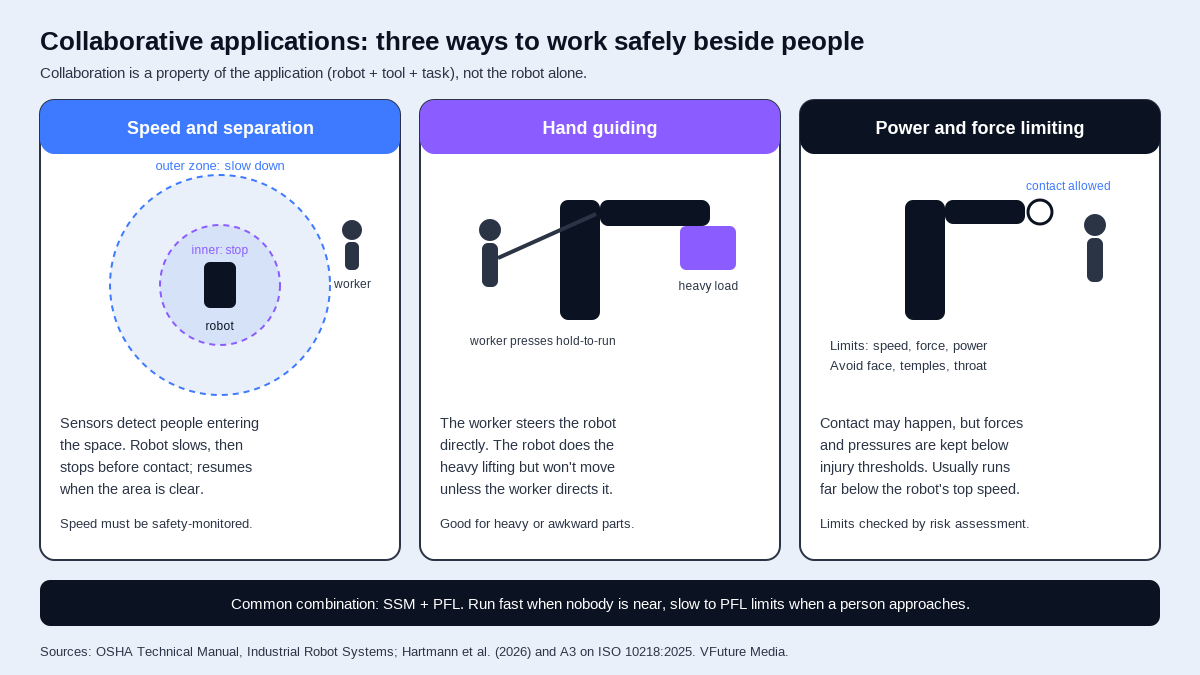
Speed and separation monitoring (SSM). Presence-sensing devices detect workers. At minimum, the robot stops during an intrusion and resumes once the area is clear. More refined setups slow the robot when someone enters an outer zone and stop it before contact if they come closer [1]. OSHA adds that when speed is used for safety, a safety function must monitor that the speed limit isn't exceeded [1].
Hand guiding (HGC). The worker directly controls the robot's motion for the collaborative part of a task, much like a powered-assist tool. For example, a worker can guide the robot to grasp a heavy box and place it on a truck. The robot does the lifting but won't move unless the worker is directing it with a hold-to-run control [1].
Power and force limiting (PFL). Here, contact between the robot and a worker "is expected and permitted," as long as forces and pressures are limited so there's no injury [1]. PFL can come from inherently safe design, such as low payload and speed, or from control means: safety functions using sensors such as joint torque sensors that slow or stop the robot [1]. OSHA notes that PFL applications usually run "at much lower speeds and payloads than they are physically capable," so a collision doesn't carry enough energy to injure. Contact with sensitive regions such as the face, temples and throat must be prevented or avoided [1].
Combinations. OSHA says it's common to combine SSM with PFL. The robot runs at high speed when no one is nearby, then slows to PFL limits when a person approaches [1].
Safety-rated monitored stop (SMS). A fourth method appears in the 2012 US standard. The robot stays stopped, with the stop safety-monitored, while a person is in the shared space, with power to the actuators retained, so it can resume once the person leaves [1]. OSHA explains that it isn't used alone; it works together with SSM, hand guiding or PFL [1]. The 2025 standard replaces the term with "monitored standstill," which applies to both collaborative and non-collaborative applications [6].
Which method fits which task?
OSHA's guidance links the choice to the expected contact [1]:
If the task... | Suitable method |
|---|---|
Needs the person and moving robot to touch, or contact is likely | PFL |
Shares space, but contact while moving isn't intended | SSM, or SSM combined with PFL |
Requires the worker to steer heavy or awkward loads | Hand guiding |
Needs high speed or heavy payload most of the time | Conventional guarded cell, or SSM that keeps people out while the robot is fast |
Before choosing, OSHA suggests asking whether collaboration is needed at all. Is a person's presence integral to the task? Must they share a workstation or work on the same part at the same time? Do they need physical contact with the robot while it moves [1]? If not, a conventional guarded robot may be simpler and faster.
What changed in ISO 10218:2025
ISO's robot safety standard, ISO 10218, has two parts. Part 1 covers the robot and Part 2 covers its integration into an application [2]. It was revised in 2025, replacing the 2011 edition [3]. A peer-reviewed comparative analysis by Hartmann and colleagues summarizes the main changes [3]:
- Collaborative requirements became normative. The 2011 edition only briefly listed four collaboration methods. Detailed guidance lived in a separate, informative technical specification, ISO/TS 15066:2016. The 2025 edition folds most of that material into Part 2 itself, with detailed requirements for each method [3][6].
- Contact assessment. For PFL, the new edition sets out a method for assessing two kinds of contact [3]. Quasi-static contact is clamping or crushing, where the body part can't recoil. Transient contact is an impact the body part can recoil from. It also lists ways to reduce contact risk, such as rounded edges, larger surface areas and soft surfaces [3].
- Robot classes. Robots are divided into Class I and Class II. The analysis reports Class I as a manipulator mass of 10 kg or less, maximum force of 50 N or less and speed of 250 mm/s or less. Robots above those limits are Class II [3].
- Functional safety levels. Required performance levels are specified per class: PL d or SIL 2 for Class II robots, PL b or SIL 1 for Class I [3].
- Cybersecurity. For networked robots, both parts add cybersecurity requirements, such as user authentication and encrypted protocols where a threat assessment shows a security risk [3][6].
- More safety functions. A3 reports that the number of listed safety functions grew from single digits to more than three dozen in each part [6].
The US picture. OSHA says there are "currently no specific OSHA standards for the robotics industry." Its standards page points to ANSI/RIA R15.06-2012, the US adoption of the 2011 ISO 10218, and to RIA TR R15.606, the US adoption of ISO/TS 15066 [2]. OSHA's technical manual explains that RIA's policy is to adopt revised ISO standards nationally and that R15.06 would be updated after the ISO 10218 revision [1]. That update has arrived: in September 2025, A3 and ANSI published ANSI/A3 R15.06-2025, a national adoption of ISO 10218-1:2025 and ISO 10218-2:2025 that replaces ANSI/RIA R15.06-2012, which will be withdrawn [6][7]. OSHA's standards page, as of November 2026, still lists the 2012 edition [2]. Integrators should check which edition their customers, insurers and notified bodies expect.
Where cobots fit in manufacturing
Common collaborative applications follow from the methods:
- Machine tending and pick-and-place next to an operator, typically with PFL at modest speeds.
- Assembly assistance, where the robot holds or presents parts while a person does dexterous work.
- Heavy-part handling with hand guiding, where the robot carries the load and the worker steers.
- Mixed cells using SSM, where the robot runs fast while the area is clear and slows when someone walks up.
The appeal is sharing work instead of separating it. In OSHA's hand-guiding example, the robot does all the heavy lifting while the worker steers [1]. The IFR notes that standardized, modular cells and simpler programming help reduce integration cost and project risk [5].
The trade-offs
- Speed and payload. PFL applications deliberately run slower and lighter than the robot's physical capability [1]. For high-throughput work, a guarded cell is often faster.
- Risk assessment is still mandatory. OSHA notes that the 2011 standard required PFL power and force parameters to be set through a risk assessment, with quasi-static and transient contact limits evaluated [1]. The end-effector and workpiece count too. A gentle arm holding a sharp tool can still injure.
- Growth is slowing. In 2025, cobot installations grew 7%. That was below the industrial robot market as a whole for the first time since the IFR started tracking cobots [4].
Outlook
The 2025 standard makes collaborative safety requirements more explicit. Hartmann and colleagues say its new classifications are meant to allow more precise risk assessment and certification [3]. Meanwhile, cobot growth has cooled relative to conventional robots, according to the IFR's 2025 data [4]. The standard's shift from "collaborative robot" to "collaborative application" also points buyers toward evaluating whole applications rather than robot labels [3]. Humanoids are the next test of working closely beside people; see our humanoid robots explainer.
Frequently asked questions
What is the difference between a cobot and an industrial robot?
A cobot is an industrial robot used in a collaborative application, where it is designed to interact directly with workers using safety functions rather than fences [1]. The IFR counts cobots within industrial robot installations [4]. The 2025 ISO standard frames collaboration as a property of the application, not the machine [3].
Do cobots need safety fences?
Not necessarily. A properly designed collaborative application uses SSM, hand guiding, PFL or a combination instead of physical guards [1]. A risk assessment may still call for guarding, for example if the end-effector or workpiece is hazardous.
How much force can a cobot apply to a person?
There's no single number. Allowed limits depend on the body region and the type of contact, quasi-static or transient. They come from tables in the standards and are applied through risk assessment [1][3]. Contact with the face, temples and throat must be avoided [1].
What are the four collaborative operation modes?
The 2011 standards listed safety-rated monitored stop, hand guiding, speed and separation monitoring, and power and force limiting [3]. OSHA notes that the monitored stop is used together with the other methods, not alone [1]. The 2025 edition calls it "monitored standstill" and details requirements for each method [3][6].
How many cobots are installed each year?
About 66,000 in 2025, or 11% of all industrial robot installations worldwide, according to the IFR [4].
Sources
- OSHA, "OSHA Technical Manual, Section IV, Chapter 4: Industrial Robot Systems and Industrial Robot System Safety." https://www.osha.gov/otm/section-4-safety-hazards/chapter-4
- OSHA, "Robotics: Standards." https://www.osha.gov/robotics/standards
- Daniel Hartmann, Kristýna Hamříková, Aleš Vysocký, Vendula Laciok and Aleš Bernatík, "Evolution of Safety Requirements in Industrial Robotics: Comparative Analysis of ISO 10218-1/2 (2011 vs. 2025) and Integration of ISO/TS 15066," arXiv:2602.17822, February 2026 (Results in Engineering). https://arxiv.org/abs/2602.17822
- Jane Heffner, International Federation of Robotics, "President's Report," September 24, 2026. https://ifr.org/ifr-press-releases/news/presidents-report-by-jane-heffner-3-2026
- IFR Statistical Department, "Executive Summary, World Robotics 2026 – Industrial Robots," September 2026. https://ifr.org/img/worldrobotics/Executive_Summary_WR_2026_-_Industrial_Robots.pdf
- Brian Heater, Association for Advancing Automation (A3), "ANSI, A3 Publish Revised R15.06 Industrial Robot Safety Standard," September 10, 2025. https://www.automate.org/robotics/industry-insights/ansi-a3-publish-revised-r15-06-industrial-robot-safety-standard
- ANSI Webstore, "ANSI/A3 R15.06-2025: Industrial Robots and Robot Systems - Safety Requirements." https://webstore.ansi.org/standards/ria/ansia3r15062025