

Robotics Explained: A Complete Guide to How Robots Work
What makes a machine a robot, how robots sense, decide and act, the main robot types from factory arms to humanoids, and where the industry stands in 2026.
A robot is a machine that senses its environment, decides what to do and physically acts, with at least some ability to do so without a person directing each move. The international robotics vocabulary standard, ISO 8373, makes autonomy part of the definition: robots need "a degree of autonomy," meaning the "ability to perform intended tasks based on current state and sensing, without human intervention" [2]. Factory robots are the best-counted group, with about 5.08 million in operation worldwide at the end of 2025. Sales of professional service robots, led by mobile robots that move goods, are growing faster [3][4].
This guide explains how robots work, the main types and where the technology is heading. Our follow-up guides go deeper on industrial vs service robots, humanoid robots, how autonomous robots work and collaborative robots.
What counts as a robot?
Not every automated machine is a robot. Standards bodies draw the lines.
- Industrial robot. ISO 8373:2021, as used by the International Federation of Robotics (IFR), defines it as an "automatically controlled, reprogrammable multipurpose manipulator, programmable in three or more axes." It can be fixed in place or mounted on a mobile platform, for use in industrial automation [1]. "Reprogrammable" means its motions can change without physical alteration [1].
- Service robot. A "robot in personal use or professional use that performs useful tasks for humans or equipment" [2]. Robot vacuums, warehouse transport robots and hospital delivery robots all fall here.
- Medical robot. ISO 8373:2021 adds this as a third category: robots intended for use as medical electrical equipment [2].
Machines that lack some robot characteristics, such as a purely teleoperated manipulator or an unpowered exoskeleton, are called "robotic devices" [2].
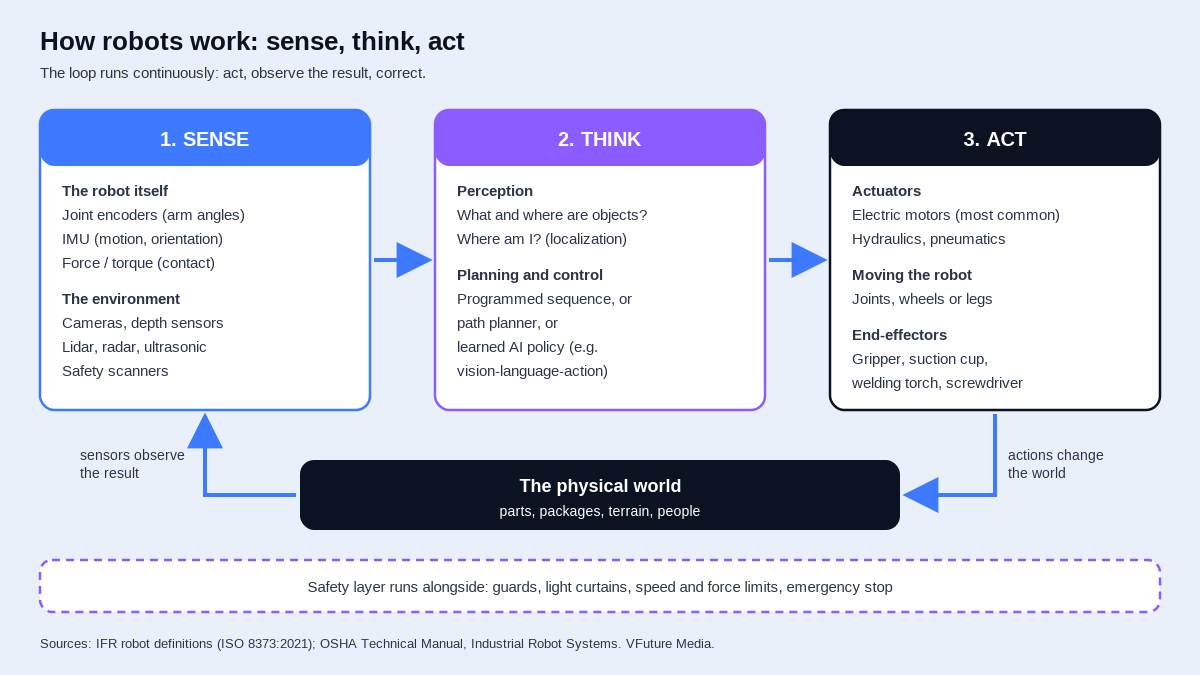
How robots work: sense, think, act
Almost every robot runs a loop with three parts.
Sense. Sensors report the robot's own state and its surroundings. Joint encoders measure arm angles. Inertial measurement units track motion and orientation. Force and torque sensors feel contact. Cameras, lidar and depth sensors see the environment. In the IFR's assessment, machine vision for detection and robot guidance is "already established and industry-grade" [3].
Think. A controller turns sensor data into decisions. In a classic factory cell, that's a pre-programmed sequence: move here, close gripper, move there. In a mobile robot it includes localization (where am I?), mapping, path planning and obstacle avoidance. Increasingly it includes learned AI models; more on that below.
Act. Actuators move the robot. These are usually electric motors driving joints, wheels or legs, sometimes hydraulics or pneumatics. The end-effector does the work at the end of an arm: a gripper, suction cup, welding torch or screwdriver.
The loop runs continuously. The robot acts, senses the result and corrects. A robot arm placing a part at sub-millimeter precision and a Mars rover picking its way across rocks both depend on it. NASA says Perseverance's AutoNav system "makes 3D maps of the terrain ahead, identifies hazards, and plans a route around any obstacles without additional direction from controllers back on Earth" [7].
Main types of robots
Industrial robots are usually classified by mechanical structure [1]:
Type | How it moves | Typical jobs |
|---|---|---|
Articulated | Three or more rotary joints, like a human arm | Welding, painting, assembly, machine tending |
SCARA | Two parallel rotary joints, compliant in one plane | Fast pick-and-place, small-part assembly |
Cartesian (gantry) | Three linear (prismatic) axes | Large-area handling, 3D printing, palletizing |
Parallel (delta) | Arms linked in a closed loop | Very fast picking on packaging lines |
Cylindrical and polar | Mixes of rotary and linear joints | Older or specialized handling tasks |
Beyond factory arms, the main families are:
- Mobile robots: wheeled robots that navigate warehouses, hospitals and streets.
- Collaborative robots (cobots): arms designed for work close to people.
- Humanoids: robots with a human-like body plan.
- Field robots: robots for agriculture, inspection, mining and space.
For a practical look at robots in fields and on farms, see our piece on AI and robotics in agriculture.
Where robots are used, by the numbers
The IFR's World Robotics 2026 report, published in September 2026, gives the most complete global figures [3][4]:
- Factory installations hit a record. 603,307 industrial robots were installed worldwide in 2025, up 11%. The operational stock passed 5 million units (5,079,078) [3].
- Electronics overtook automotive. The electrical/electronics industry was the largest customer (142,235 units), just ahead of automotive (138,429) [3].
- The US is the second-largest market. It installed 38,428 industrial robots in 2025, up 12%, passing Japan, which fell to third [3][9].
- Service robots are growing faster. Sales of professional service robots, excluding medical robots, rose 24% in 2025. Transportation and logistics was by far the largest application: nearly every second professional service robot sold was built to move goods [4].
- Humanoids are a small, early market. Almost 6,900 humanoids were reported sold globally in 2025. The IFR says many are offered "primarily for testing, research, and pilot projects rather than for broad commercial deployment" [4].
US warehouses are one of the busiest deployment areas; our report on AI-powered robotics in US warehouses covers recent rollouts.
How AI is changing robots
Traditional industrial robots are precise but rigid. They repeat programmed paths and struggle with variation. AI is loosening that in stages. The IFR's 2026 assessment is a useful reality check [3]:
- Industry-grade now: machine vision for detection and guidance.
- Increasingly used: AI for predictive maintenance, process optimization and inspection.
- Not yet industry-grade: general-purpose "Physical AI," and robots that learn from simulation and experience.
At the research frontier, companies are adapting large AI models to control robots directly. Google DeepMind, for example, describes Gemini Robotics as a "vision-language-action (VLA) model." It is built on Gemini 2.0 "with the addition of physical actions as a new output modality for the purpose of directly controlling robots" (company description, March 2025) [6]. Such models aim to let robots follow plain-language instructions and handle objects they weren't explicitly programmed for. For the AI basics, see our guide to artificial intelligence.
Safety: why robots are fenced, and when they aren't
Robots are powerful machines, and OSHA lists the hazards: struck-by and caught-between injuries from unexpected movement, crushing and trapping, struck-by projectiles, and electrical, hydraulic and pneumatic hazards [5].
Conventional industrial robots are therefore separated from people by guards, interlocked doors, light curtains or safety scanners. They stop when someone enters the safeguarded space [5]. When a worker must be inside, for example to teach a program, the robot runs in manual mode at reduced speed, no more than 250 mm/s (10 in/s). The worker holds a three-position enabling device, usually on the teach pendant. It must be held in its center position, or the robot's motion is inhibited [5].
Collaborative applications relax the fencing by using speed and separation monitoring, hand guiding, or power and force limiting [5]. We explain those modes in our upcoming collaborative robots guide. In the US, OSHA says "there are currently no specific OSHA standards for the robotics industry." It points to general OSHA standards and to industry consensus standards such as ANSI/RIA R15.06-2012 (the US adoption of the ISO 10218-1 and -2 robot safety standards), ISO/TS 15066 for collaborative robots, and RIA technical reports [8].
Limits and open problems
- Dexterity and generalization. Robots still struggle with unstructured tasks that people find trivial, such as handling soft, varied or tangled objects.
- Cost and integration. A robot needs integration, programming and safety engineering before it does useful work. The IFR notes that standardized and modular cells, simpler programming and faster commissioning can reduce integration costs and project risks [3].
- Reliability for humanoids. The IFR says widespread industrial deployment of humanoids "will depend on substantial improvements in reliability, safety, operating time, and economic viability" [3].
Outlook
The IFR forecasts that annual industrial robot installations will rise 9% in 2026 to about 655,000 units, reaching about 806,000 in 2029, and that the operational stock will exceed six million units in 2028 (IFR forecast) [3]. In service robotics, it expects labor shortages, demographic change and Robotics-as-a-Service subscription models to keep driving adoption [4]. Whether humanoids join that growth at scale is still open: the IFR calls the humanoid market "still at a very early stage" and says it is uncertain whether all of today's developers will reach market readiness [4].
Frequently asked questions
What is the difference between a robot and automation?
Automation is any technology that performs a task with little human input, including fixed machines built for one job. A robot, under ISO 8373, is reprogrammable and has some autonomy based on sensing, so it can be redirected to new tasks without being rebuilt [1][2].
What are the three main parts of a robot?
Sensors that perceive the robot and its environment, a controller that decides what to do, and actuators with end-effectors that act on the physical world. Together they form the sense-think-act loop.
Which industry uses the most robots?
In 2025 the electrical/electronics industry installed the most new industrial robots worldwide (142,235 units), narrowly ahead of automotive (138,429), according to the IFR [3].
Are robots taking over jobs?
Robots automate specific tasks, and adoption is often driven by labor shortages, according to the IFR [4]. How that affects employment varies by industry and region and goes beyond what installation statistics can show.
How many robots are there in the world?
The IFR counted about 5.08 million industrial robots in operation in factories worldwide at the end of 2025 [3]. Service robots are counted separately, by annual sales rather than total stock [4].
Sources
- International Federation of Robotics, "Industrial Robots: Definition," citing ISO 8373:2021. https://ifr.org/industrial-robots
- International Federation of Robotics, "Service Robots: Definition," citing ISO 8373. https://ifr.org/service-robots
- IFR Statistical Department, "Executive Summary, World Robotics 2026 – Industrial Robots," September 2026. https://ifr.org/img/worldrobotics/Executive_Summary_WR_2026_-_Industrial_Robots.pdf
- IFR Statistical Department, "Executive Summary, World Robotics 2026 – Service Robots," September 2026. https://ifr.org/img/worldrobotics/Executive_Summary_WR_2026_-_Service_Robots.pdf
- OSHA, "OSHA Technical Manual, Section IV, Chapter 4: Industrial Robot Systems and Industrial Robot System Safety." https://www.osha.gov/otm/section-4-safety-hazards/chapter-4
- Carolina Parada, Google DeepMind, "Gemini Robotics brings AI into the physical world," March 12, 2025 (company blog). https://deepmind.google/discover/blog/gemini-robotics-brings-ai-into-the-physical-world/
- Pat Brennan, NASA Jet Propulsion Laboratory, "NASA's Self-Driving Perseverance Mars Rover 'Takes the Wheel'," July 1, 2021. https://www.jpl.nasa.gov/news/nasas-self-driving-perseverance-mars-rover-takes-the-wheel/
- OSHA, "Robotics: Standards." https://www.osha.gov/robotics/standards
- International Federation of Robotics, "Five Million Robots now Operate in Factories Globally," press release, September 24, 2026. https://ifr.org/ifr-press-releases/news/five-million-robots-now-operate-in-factories-globally
