

Digital Twins in Manufacturing: How They Work and Where They Help
What a manufacturing digital twin is, how ISO 23247 structures one, the uses that pay off, and the data, accuracy and security problems to plan for first.
A digital twin in manufacturing is a digital representation of a real machine, product, process or line that stays synchronized with it using live data. It lets you monitor, analyze, predict and sometimes control the physical thing through its model. The international standard for this, ISO 23247, defines it as a "fit for purpose digital representation" of an observable manufacturing element "with synchronization between" the two [2].
The phrase "fit for purpose" matters. There's no single twin of a factory. There are many twins, each built for a job.
What makes a digital twin different from a model or a simulation
Factories have used CAD models and simulations for decades. NIST's 2025 report on digital twins says the technology "covers what currently exists in modeling and simulation but then casts a broader vision" [1]. The difference is the live connection: digital twins allow "real-time monitoring of entities while dynamically updating their digital twins" [1].
CAD model | Simulation | Digital twin | |
|---|---|---|---|
Represents | Geometry | Behavior under assumptions | A specific real asset or process |
Data | Design data | Input scenarios | Live and historical operating data |
Updated | When the design changes | Per study | Continuously, at a rate set by the application [2] |
Typical question | "What does it look like?" | "What if we did X?" | "What is happening now, and what next?" |
NIST also stresses that there is still "no agreed-upon definition" of a digital twin, and that vendors label many things as twins [1]. Ask what is actually synchronized, and how often.
How ISO 23247 structures a manufacturing twin
ISO 23247, the "Digital Twin Framework for Manufacturing", was published in 2021 [3]. NIST's analysis summarizes its four original parts: an overview, a reference architecture, digital representation of manufacturing elements, and information exchange [2]. NIST lists newer work on a Part 5 for the digital thread and a proposed Part 7 on verification, validation and uncertainty quantification [3].
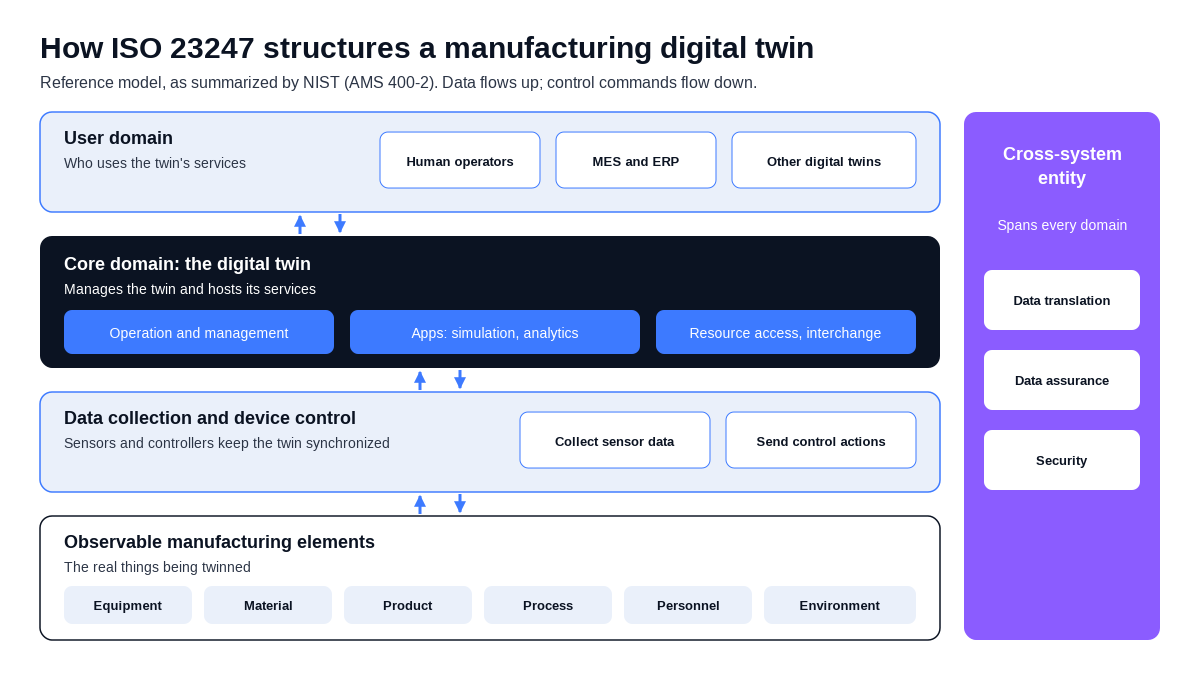
The reference model (see diagram) has four domains [2]:
- Observable manufacturing elements (OMEs). The real things being twinned. NIST's summary lists personnel, equipment, material, process, facility, environment, product or supporting document [2].
- Data collection and device control. Collects sensor data from the OMEs and sends control commands back. This is where shop-floor protocols live [2].
- Core. The digital twin itself. It manages the twin and hosts applications such as simulation, analytics and optimization [2].
- User. Humans, enterprise systems such as MES and ERP, or other digital twins that use the core's services [2].
A cross-system entity spans the domains to handle data translation, data assurance and security [2]. The standard also asks implementers to reuse existing information standards where possible. NIST's examples include IEC 62264 for object attributes and MTConnect for machine tool data [2].
What manufacturers use twins for
NIST lists typical manufacturing applications [2]:
- Analytics twins: descriptive (what happened), diagnostic (why), predictive (what's likely) and prescriptive (what to do).
- Real-time control twins: monitor and adjust equipment as it runs.
- Equipment health twins: track condition to schedule maintenance; see predictive maintenance with AI.
- Scheduling and routing twins: decide job order and material flow.
- Virtual commissioning twins: test controller designs and control strategies, even without the physical system.
Virtual commissioning deserves a special mention. NIST notes it lets you test and validate control strategies "without the need of installing or purchasing the real manufacturing equipment" [2], so a bug in control logic found against a model doesn't damage real equipment.
The building blocks
- Sensors and connectivity on the equipment, plus controllers that expose data.
- Information models so the twin knows what each data point means. One standardized format is the Asset Administration Shell (AAS). The Industrial Digital Twin Association's specifications define its metamodel, APIs, data specifications, security and package file format [4].
- Models: physics-based, data-driven, or hybrid.
- A platform to run the twin, store history and serve users.
- Integration with MES, ERP and quality systems, the "user domain" in ISO 23247 terms [2].
For how these connect across a plant, see smart factories and connected manufacturing and Industry 4.0.
Benefits
- See and fix problems earlier. Synchronized data plus analytics surfaces drift and anomalies.
- Test before touching the line. Virtual commissioning and what-if studies on a current model.
- Coordinate across organizations. NIST notes that if partners can share digital twin definitions, they can model interactions "prior to the realization of the output product" [1].
- Better use of existing data. Many plants already collect machine data that no one analyzes.
Limitations and risks
- Interoperability. NIST says internal representations "tend to be highly proprietary," so digital artifacts "are not easily shared" and applications are not interoperable [1]. Standards like ISO 23247 and the AAS aim to fix that [2][4].
- Accuracy and trust. A twin is only useful if it matches reality closely enough for its purpose. That's why NIST is working on verification, validation and uncertainty quantification [3].
- Cost for smaller firms. NIST's program page says building twins correctly "is challenging, especially for small and medium-sized enterprises," and points to a lack of standards for vocabulary, design, interoperability and V&V [3].
- Security. NIST names at least five novel features of digital twins that need special cybersecurity attention. They are massive instrumentation of objects, centralization of measurements, visualization of operation, remote control of objects, and standards that allow universal access [1]. Centralization is the big one: "If the digital twin is compromised, the attacker has total access to all data about the instrumented object" [1]. A twin that can control equipment is part of your operational technology and should be secured as such [5].
How to start
- Pick one question. "Why does line 3 lose 40 minutes a shift?" beats "build a factory twin".
- Choose the element and fidelity. A machine, a cell or a process, and how closely the twin must match.
- Check your data. Which signals exist, at what rate, with what meaning? Plan for information models from day one [2][4].
- Decide read-only vs control. Monitoring twins are lower risk. Control twins need OT security engineering [5].
- Validate. Compare twin predictions with reality before trusting them [3].
- Design for reuse. Use standard information models so the next twin is cheaper [2][4].
Outlook
The standards are maturing: ISO 23247's core parts are published, with digital thread and V&V work underway [3]. NIST has published security and trust guidance [1]. Expect more twins built from standard components, more AI models inside the core domain, and more emphasis on proving accuracy. Digital twins are spreading beyond factories too; for an example in buildings, see how digital twins are cutting emissions in green building design.
Frequently asked questions
What is a digital twin in manufacturing?
A digital representation of a real manufacturing element, such as a machine, product, process or line, kept synchronized with it. ISO 23247 calls it a "fit for purpose digital representation" of an observable manufacturing element [2].
Is a digital twin just a 3D model?
No. A 3D model shows geometry. A digital twin is tied to a specific real asset and updated with operating data, so it can show current state and predict behavior [1].
What is ISO 23247?
The international "Digital Twin Framework for Manufacturing", published in 2021. It sets out general principles, a reference architecture, how to represent manufacturing elements, and how information is exchanged [2][3].
What's the difference between a digital twin and a digital thread?
A twin represents an asset or process. A digital thread links data about it across its lifecycle, from design to production to maintenance. ISO 23247 work includes a part on the digital thread [3].
Are digital twins a cybersecurity risk?
They can be. NIST warns that centralizing data and control in a twin means a compromise can expose all data about the instrumented object [1]. Twins that can control equipment should be secured as operational technology [5].
Sources
- Voas, J., Mell, P., Laplante, P., Piroumian, V. "Security and Trust Considerations for Digital Twin Technology." NIST IR 8356, February 2025. https://nvlpubs.nist.gov/nistpubs/ir/2025/NIST.IR.8356.pdf
- Shao, G. "Use Case Scenarios for Digital Twin Implementation Based on ISO 23247." NIST AMS 400-2, 2021. https://nvlpubs.nist.gov/nistpubs/ams/NIST.AMS.400-2.pdf
- NIST. "Digital Twins for Advanced Manufacturing" (project page). https://www.nist.gov/programs-projects/digital-twins-advanced-manufacturing
- Industrial Digital Twin Association. "Asset Administration Shell specifications." https://industrialdigitaltwin.org/en/content-hub/aasspecifications
- NIST. "Guide to Operational Technology (OT) Security." SP 800-82 Rev. 3, September 2023. https://csrc.nist.gov/pubs/sp/800/82/r3/final
