

Predictive Maintenance With AI: How It Works and What It Saves
How AI predictive maintenance works: sensors, anomaly detection and remaining-useful-life models, what DOE and NIST data show, and why projects fail.
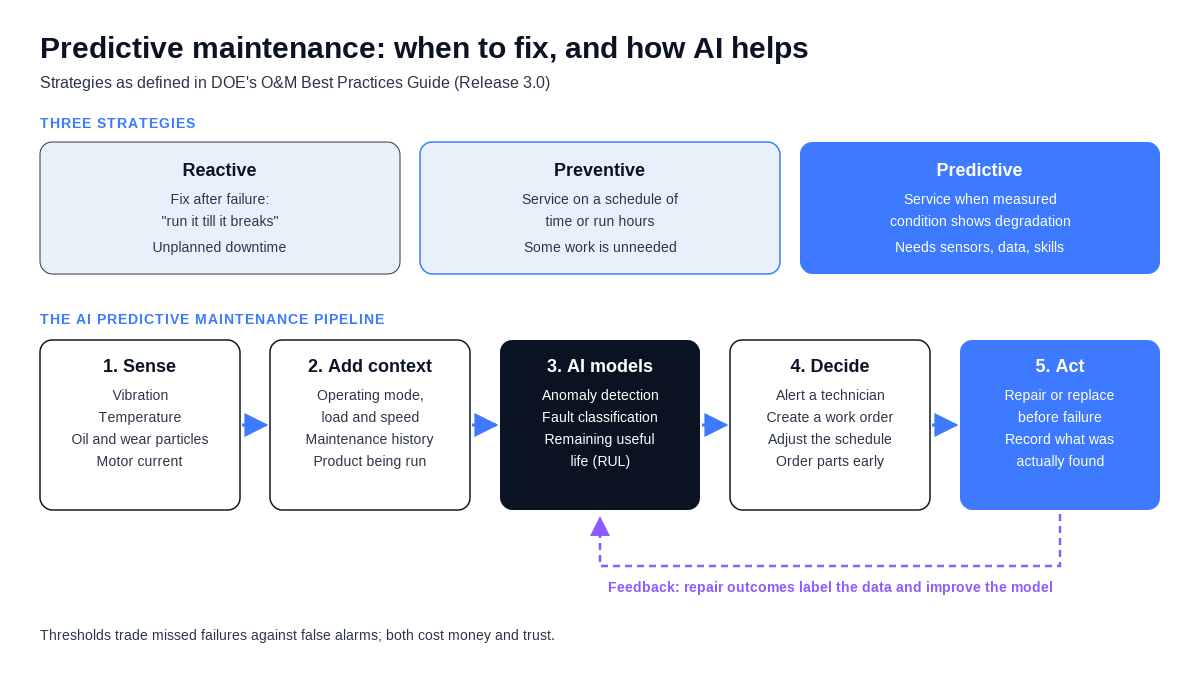
Predictive maintenance means servicing equipment based on its measured condition, so you fix it shortly before it would fail rather than on a fixed schedule or after it breaks. AI makes that practical at scale. Models learn what "normal" looks like from sensor data, flag early signs of degradation, and in some cases estimate how much useful life is left. Done well, it cuts both unplanned downtime and unnecessary maintenance.
Three maintenance strategies
The US Department of Energy's long-running O&M Best Practices Guide (Release 3.0, 2010) lays out the main approaches [1]:
Strategy | When work happens | Strengths | Weaknesses |
|---|---|---|---|
Reactive | After failure: "run it till it breaks" [1] | Low upfront cost, few staff | Unplanned downtime, overtime labor, secondary equipment damage [1] |
Preventive | On a schedule of time or run hours | DOE cites an estimated 12% to 18% cost saving over reactive [1] | Still has catastrophic failures; does unneeded maintenance [1] |
Predictive | When measurements show "the onset of system degradation" [1] | DOE cites an estimated 8% to 12% saving over preventive [1] | Needs diagnostic equipment and staff training; savings not readily seen by management [1] |
DOE's guide explains the difference with a car analogy. Changing oil every 3,000 to 5,000 miles is preventive, because it's based on run time. Analyzing the oil and changing it only when its condition calls for it is predictive [1].
A broader term you'll see is prognostics and health management (PHM): diagnosing what's wrong ("what happened") and forecasting when something will fail ("when something will happen") [4].
What the data says about benefits
Two US government sources are most cited. Read both with their dates in mind.
- DOE (2010): A functioning predictive program can save 8% to 12% over preventive maintenance alone. DOE says facilities heavily reliant on reactive maintenance "could easily recognize savings opportunities exceeding 30% to 40%" [1]. The guide also quotes unnamed "independent surveys" with higher numbers. Treat those as indicative, not as benchmarks.
- NIST (survey of 2016 data, published 2020): On average, establishments reported 17.3% predictive, 31.8% preventive and 45.7% reactive maintenance. The establishments most reliant on reactive maintenance had 3.3 times more downtime and 16 times more defects. Among establishments relying mainly on preventive and predictive maintenance (less than 50% reactive), the top half in predictive maintenance was associated with 15% less downtime and an 87% lower defect rate. Preventable maintenance losses totaled an estimated $119.1 billion [3]. These are associations from survey data, not proof that predictive maintenance caused the differences.
How AI predictive maintenance works
The diagram above shows the pipeline.
1. Sense
Sensors capture the physical signs of wear. DOE's guide lists common predictive technologies, including vibration monitoring and analysis, lubricant and fuel analysis, wear particle analysis, bearing temperature analysis and performance monitoring [2]. It maps each to equipment such as pumps, electric motors, diesel generators, condensers, heat exchangers and circuit breakers [2]. Its table also lists infrared thermography, ultrasonic noise detection, motor current signature analysis and electrical monitoring [2].
2. Add context
A vibration spike means nothing without knowing what the machine was doing. Useful data includes the operating mode, load, speed, the product being run, and the maintenance history. NIST's prognostics work stresses collecting the right data at the appropriate times and production levels "to minimize the collection of 'big data'" [4].
3. Model
Common AI approaches:
- Anomaly detection. Learn normal behavior and flag deviations. This is useful when you have little failure data.
- Classification. Recognize specific fault types, such as bearing wear versus misalignment, from labeled examples.
- Remaining useful life (RUL) estimation. Predict how many cycles or hours remain before failure.
Much RUL research uses public benchmark datasets. NASA's C-MAPSS dataset simulates aircraft engines degrading to failure. Training trajectories run to failure, and test trajectories stop earlier; the task is to predict the remaining cycles [5]. Each engine record has operational settings and sensor channels, with subsets that vary operating conditions and fault modes [5]. Benchmarks like this let researchers compare methods on the same data. Your plant's data will be messier.
For a refresher on the model types, see machine learning vs deep learning vs AI.
4. Decide
A model's output is only useful if it triggers the right action: an alert to a technician, a work order in the maintenance system, or a change to the production schedule. Thresholds have to balance missed failures against false alarms.
5. Act and learn
After the repair, record what was actually found. That feedback is how models improve, and it's the step most often skipped.
Where it fits in a smart factory
Predictive maintenance is one of the standard digital twin applications. NIST lists "equipment health check" and "predictive maintenance" twins that monitor condition and schedule maintenance [6]. It depends on the same connected-factory plumbing as everything else; see smart factories and connected manufacturing and digital twins in manufacturing.
Benefits
- Less unplanned downtime [3].
- Fewer unnecessary repairs than calendar-based maintenance [1].
- Better parts planning. DOE notes you can order parts "well ahead of time" [1].
- Safety and quality. DOE lists improved worker safety and better product quality among the advantages [1]. NIST's survey linked heavy reactive maintenance with far more defects [3].
Limitations and risks
- Upfront cost. DOE lists increased investment in diagnostic equipment and staff training as the main disadvantages. It adds that the savings potential is "not readily seen by management" [1].
- Failure data is scarce. Well-maintained equipment rarely fails, so there are few examples to learn from. That's one reason anomaly detection and simulated datasets are popular [5].
- False alarms erode trust. Technicians stop responding to alerts that are often wrong.
- Standards gaps. NIST notes that no open standards guide sensing, PHM and control across all plant levels. It adds that proprietary tools are often single-vendor and "expensive and inaccessible to many manufacturers" [4].
- Skills. DOE warns against buying predictive equipment without "a serious commitment to proper implementation, operator training, and equipment monitoring and repair." It suggests contracting the work out if that commitment can't be made [2].
How to start
- Pick critical assets. Choose the ones where failure is costly and wear shows up in measurable signals.
- Start with proven techniques. Vibration on rotating equipment and thermography on electrical gear are well established [2].
- Get the maintenance records in order. Without failure and repair history, models can't be validated.
- Begin with anomaly detection, then add fault classification and RUL as labeled data accumulates.
- Integrate with work orders. An alert that doesn't create a task is easy to ignore.
- Measure honestly. Track downtime, maintenance cost and false-alarm rates before and after.
Outlook
Sensors keep getting cheaper and more capable; DOE already credited advances in sensor technology, especially lower cost, with expanding diagnostics back in 2010 [2]. The harder problems are data quality, integration and trust. Expect more condition monitoring built into new equipment, more use of digital twins to combine physics with data, and more emphasis on validating models before acting on them. For how AI moves from training to running in production, see AI model training vs inference.
Frequently asked questions
What is the difference between preventive and predictive maintenance?
Preventive maintenance is time-based: service every so many hours or months. Predictive maintenance is condition-based: service when measurements show degradation [1].
How much can predictive maintenance save?
DOE's 2010 guidance cites an estimated 8% to 12% saving over preventive maintenance, and more for facilities that mostly run equipment to failure [1]. A NIST survey of 2016 data found that, among establishments relying mainly on preventive and predictive maintenance, the top half in predictive maintenance was associated with 15% less downtime [3].
Do you need AI for predictive maintenance?
Not always. Vibration analysis, oil analysis and thermography are established non-AI techniques, already covered in DOE's 2010 guide [2]. AI helps when there are many assets and signals, or patterns too subtle for fixed thresholds.
What is remaining useful life (RUL)?
An estimate of how long a component can keep operating before failure, in cycles, hours or days. NASA's C-MAPSS dataset is a common benchmark for RUL models [5].
What sensors are used for predictive maintenance?
Common ones measure vibration, temperature, lubricant condition, wear particles and equipment performance. Infrared thermography, ultrasonic noise detection and motor current analysis are also listed in DOE's guidance [2].
Sources
- US Department of Energy, FEMP. "O&M Best Practices Guide, Release 3.0," Chapter 5: Types of Maintenance Programs. 2010. https://www1.eere.energy.gov/femp/pdfs/OM_5.pdf
- US Department of Energy, FEMP. "O&M Best Practices Guide, Release 3.0," Chapter 6: Predictive Maintenance Technologies. 2010. https://www1.eere.energy.gov/femp/pdfs/OM_6.pdf
- NIST. "Research Suggests Significant Benefits to Investing in Advanced Machinery Maintenance." June 2020 (summarizing NIST AMS 100-34). https://www.nist.gov/news-events/news/2020/06/research-suggests-significant-benefits-investing-advanced-machinery
- NIST. "Prognostics, Health Management, and Control (PHMC)" project page. https://www.nist.gov/programs-projects/prognostics-health-management-and-control-phmc
- NASA. "CMAPSS Jet Engine Simulated Data." Data.gov catalog. https://catalog.data.gov/dataset/cmapss-jet-engine-simulated-data
- Shao, G. "Use Case Scenarios for Digital Twin Implementation Based on ISO 23247." NIST AMS 400-2, 2021. https://nvlpubs.nist.gov/nistpubs/ams/NIST.AMS.400-2.pdf
