

How Quantum Computers Work: From Qubits to Results
How a quantum computer runs a program: qubit types, cooling and lasers, gates, measurement, real-time error correction and the classical software stack.
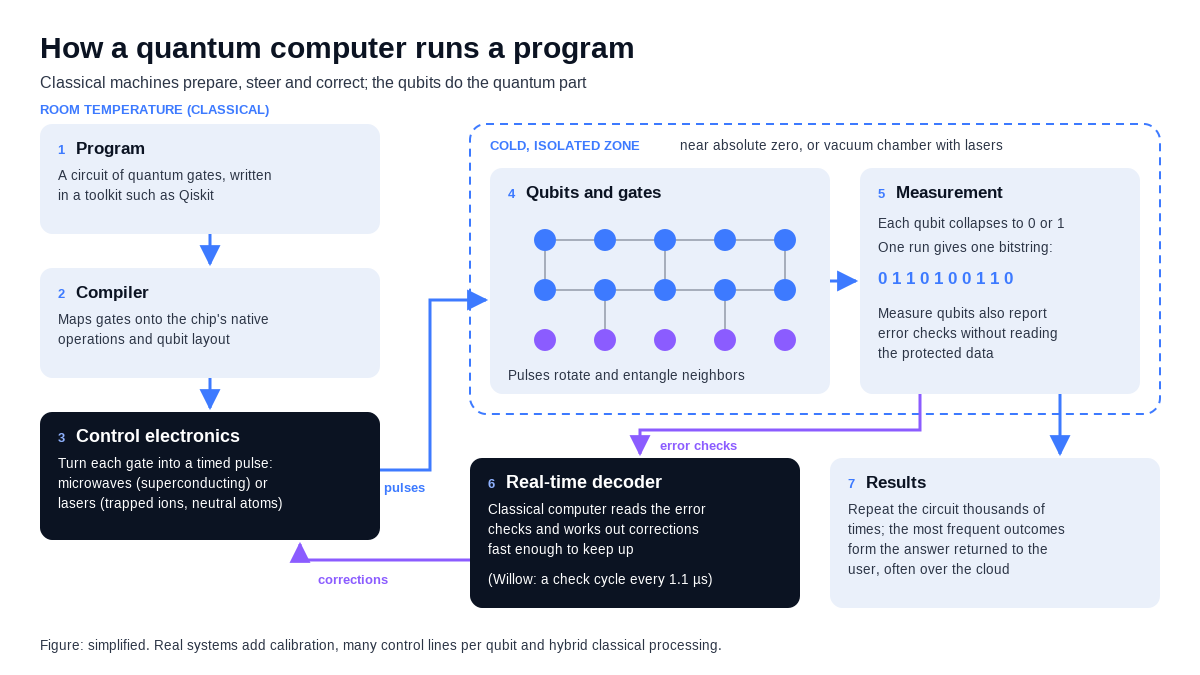
A quantum computer runs a program by preparing qubits, applying a precisely timed sequence of operations called gates, and then measuring the qubits to read out classical bits. Each step is handled by a stack of hardware: the qubits themselves, kept in an ultra-cold refrigerator or vacuum chamber; control electronics that steer them with microwave or laser pulses; and classical computers that compile programs, correct errors and process the results. A full run is repeated many times, because each measurement gives one probabilistic sample.
The stack at a glance
Think of a quantum computer as a co-processor, not a standalone machine. IBM describes a quantum processing unit (QPU) as the quantum chip plus the control electronics and the classical computing hardware needed for input and output [1]. Most users reach one over the cloud, because a complete system is far too large and delicate to sit on a desk [1].
Step 1: Making qubits
A qubit is any controllable two-level quantum system. Caltech notes that qubits can be made from atoms, ions, electrons, or engineered "artificial atoms" such as superconducting circuits [2]. The main approaches as of late 2026:
Qubit type | How it works | Strengths and trade-offs | Example (company- or lab-reported) |
|---|---|---|---|
Superconducting circuits | Tiny circuits with Josephson junctions, cooled near absolute zero [1] | Fast operations and fine-grained control [1]; need extreme cooling | Google Willow, 105 qubits [4]; IBM Nighthawk, 120 qubits [5] |
Trapped ions | Charged atoms held in electromagnetic traps, controlled with lasers | Long coherence and high-fidelity measurement, but slower operations [1] | Quantinuum Helios, 98 qubits [6] |
Neutral atoms | Uncharged atoms held by focused laser beams ("optical tweezers") | Very large arrays possible | Caltech array of 6,100 atoms [7] |
Quantum dots (spin qubits) | Single electrons captured in tiny semiconductor structures | Potential compatibility with chip manufacturing [1] | Research stage |
Photons | Particles of light | Natural fit for sending quantum information over fiber [1] | Used mainly in communication |
Topological qubits | Exotic quasiparticles meant to resist errors by design | Unproven; the evidence is debated | Microsoft Majorana 1 claim [8][9][13] |
A note on topological qubits: Microsoft announced Majorana 1 in February 2025 as "the world's first quantum processor powered by topological qubits" (company claim) [8]. The Nature paper published alongside it reports a parity measurement in a nanowire device, and itself says that measurement does not, on its own, distinguish Majorana zero modes from topologically trivial states [9]. On June 24, 2026, Nature published a formal "Matters Arising" by Henry F. Legg, who analysed the underlying transport data and argued that the parity readout happened in disordered regions that appear gapless, suggesting the signals have trivial origins [13]. Treat topological qubits as an unsettled research claim.
Step 2: Keeping them quiet
Qubits lose their quantum state when they interact with their surroundings, a process called decoherence [2]. So most of a quantum computer's bulk exists to isolate them.
- Superconducting chips sit inside refrigerators that cool them to roughly a hundred times colder than one degree above absolute zero. At that temperature their materials superconduct, and noise is low enough for the qubits to keep their quantum states [1].
- Trapped-ion and neutral-atom systems hold their atoms in ultra-high vacuum chambers and use lasers for trapping, cooling and control [7].
How long a qubit holds its state is a key specification. Google reports that Willow's T1 times, a measure of how long a qubit retains an excitation, are approaching 100 microseconds [4]. The Caltech team kept its 6,100 atoms in superposition for about 13 seconds [7]. IBM notes that trapped-ion qubits have long coherence times but run operations more slowly than superconducting qubits [1].
Step 3: Controlling them with gates
A quantum program is a circuit: a sequence of gates applied to qubits. Single-qubit gates rotate one qubit's state. Two-qubit gates create entanglement between qubits, and IBM calls them the fundamental entangling operations of quantum computation [5].
Physically, each gate is a pulse:
- For superconducting qubits, control electronics fire microwave pulses down cables into the refrigerator to hold, change and read out the qubits' states [1].
- For ions and atoms, precisely tuned lasers do the same job.
Connectivity matters too. On a chip, a qubit can typically interact only with its neighbors. IBM's Nighthawk links each of its 120 qubits to up to four nearest neighbors in a square grid, using 218 tunable couplers [5]. Better connectivity means fewer extra operations to move information around, which means fewer chances for error. IBM says Nighthawk can run circuits with up to 5,000 two-qubit gates [5].
Gate quality is measured as fidelity. Quantinuum reports 99.921% two-qubit and 99.9975% single-qubit gate fidelity for Helios [6]. Even 99.9% means roughly one error per thousand operations, which is why error correction (Step 5) is essential.
Step 4: Measuring the answer
At the end of the circuit, each qubit is measured and collapses to a 0 or 1. Measurement destroys the superposition, and an unknown quantum state can't be copied beforehand. That's the no-cloning theorem [11]. So a single run produces just one bitstring, a sample from the probability distribution the circuit created.
To get a useful answer, the same circuit is run thousands or millions of times and the results are tallied. A well-designed algorithm makes the correct answer show up far more often than the wrong ones. For more on why measurement behaves this way, see our explainer on qubits vs classical bits.
Step 5: Correcting errors in real time
Because every operation has some chance of failing, large computations need quantum error correction. Our quantum error correction explainer goes deeper. In outline:
- One logical qubit is spread across many physical data qubits.
- Extra measure qubits repeatedly check for signs of errors without reading the protected information directly.
- A classical decoder analyzes those checks and works out which corrections to apply, fast enough to keep up.
Google's Willow experiment shows the scale involved. Its distance-7 surface code used 49 data qubits, 48 measure qubits and 4 leakage-removal qubits to protect one logical qubit. It ran error-correction cycles every 1.1 microseconds, with an average decoder latency of 63 microseconds at distance 5 [3]. Going from distance 5 to distance 7 cut logical errors by a factor of 2.14, showing that adding qubits made the logical qubit better, not worse [3].
IBM's plan for its 2029 Starling system is a fault-tolerant machine that runs 100 million gates on 200 logical qubits (company target) [10].
Step 6: The classical software around it
Users write quantum programs in software development kits such as IBM's open-source Qiskit. IBM says Qiskit has more than 600,000 registered users [1]. A compiler translates the circuit into the specific gates and qubit layout of the target hardware. Classical computers then handle error mitigation, post-processing and, increasingly, hybrid algorithms that split work between quantum and classical processors [1].
Why it's so hard to scale
- More qubits mean more noise. Caltech notes that larger systems are harder to isolate, so errors grow with size [2].
- Wiring and control. Every qubit needs control lines or laser access, which gets harder with each added qubit.
- Error-correction overhead. Willow's distance-7 logical qubit used 101 physical qubits to protect a single logical qubit [3].
- Classical speed. Decoders must keep pace with microsecond-scale error-correction cycles [3].
The physics behind superconducting qubits earned the 2025 Nobel Prize in Physics. In 1984 and 1985, John Clarke, Michel Devoret and John Martinis showed quantum tunnelling and quantized energy levels in a superconducting circuit large enough to hold in the hand [12]. Turning that kind of circuit into a fault-tolerant computer is now an engineering problem as much as a physics one.
Frequently asked questions
What is inside a quantum computer?
A quantum chip or trap holding the qubits, a refrigerator or vacuum system to isolate them, control electronics that send microwave or laser pulses, and classical computers for compiling programs, decoding errors and processing results [1].
Why are quantum computers kept so cold?
Superconducting qubits work only near absolute zero, where their materials have no electrical resistance and thermal noise is minimal [1]. Ion- and atom-based machines use vacuum chambers and lasers instead [7].
How do you program a quantum computer?
You write a circuit of quantum gates in a toolkit such as Qiskit. A compiler maps it onto the hardware, and the circuit runs many times to build up a statistical answer [1].
Why does a quantum program need to run many times?
Each measurement returns one random sample, and an unknown quantum state can't be copied to read it twice [11]. Repeating the run reveals which answers are most likely.
Which type of qubit is best?
No approach has won. Superconducting qubits are fast, trapped ions offer high fidelity and long coherence, and neutral atoms scale to large arrays [1][6][7]. The best choice may depend on the application.
Sources
- IBM, "What is quantum computing?" IBM Think. https://www.ibm.com/think/topics/quantum-computing
- California Institute of Technology, "What Is Quantum Computing?" Caltech Science Exchange. https://scienceexchange.caltech.edu/topics/quantum-science-explained/quantum-computing-computers
- Google Quantum AI and Collaborators, "Quantum error correction below the surface code threshold," Nature 638, 920–926, published December 9, 2024. https://www.nature.com/articles/s41586-024-08449-y
- Neven, H., "Meet Willow, our state-of-the-art quantum chip," Google, December 9, 2024. https://blog.google/technology/research/google-willow-quantum-chip/
- IBM, "IBM Delivers New Quantum Processors, Software, and Algorithm Breakthroughs on Path to Advantage and Fault Tolerance," November 12, 2025. https://newsroom.ibm.com/2025-11-12-ibm-delivers-new-quantum-processors,-software,-and-algorithm-breakthroughs-on-path-to-advantage-and-fault-tolerance
- Quantinuum, "Quantinuum Announces Commercial Launch of New Helios Quantum Computer," November 5, 2025. https://www.quantinuum.com/press-releases/quantinuum-announces-commercial-launch-of-new-helios-quantum-computer-that-offers-unprecedented-accuracy-to-enable-generative-quantum-ai-genqai
- California Institute of Technology, "Caltech Team Sets Record with 6,100-Qubit Array," September 24, 2025. https://www.caltech.edu/about/news/caltech-team-sets-record-with-6100-qubit-array
- Microsoft Azure Quantum, "Microsoft unveils Majorana 1, the world's first quantum processor powered by topological qubits," February 19, 2025. https://azure.microsoft.com/en-us/blog/quantum/2025/02/19/microsoft-unveils-majorana-1-the-worlds-first-quantum-processor-powered-by-topological-qubits/
- Microsoft Azure Quantum et al., "Interferometric single-shot parity measurement in InAs–Al hybrid devices," Nature, published February 19, 2025 (Matters Arising published June 24, 2026). https://www.nature.com/articles/s41586-024-08445-2
- IBM Quantum, "IBM lays out clear path to fault-tolerant quantum computing," June 10, 2025. https://www.ibm.com/quantum/blog/large-scale-ftqc
- Watrous, J., "Limitations on quantum information," Basics of Quantum Information, IBM Quantum Learning. https://quantum.cloud.ibm.com/learning/en/courses/basics-of-quantum-information/quantum-circuits/limitations-on-quantum-information
- The Royal Swedish Academy of Sciences, "The Nobel Prize in Physics 2025," press release. https://www.nobelprize.org/prizes/physics/2025/press-release/
- Legg, H. F., "On the robustness of topological gap detection via transport," Matters Arising, Nature, published June 24, 2026. https://www.nature.com/articles/s41586-026-10567-8
