

Quantum Error Correction Explained: Logical Qubits and Thresholds
How quantum error correction turns noisy physical qubits into reliable logical qubits: surface codes, thresholds, decoders, qLDPC codes and recent results.
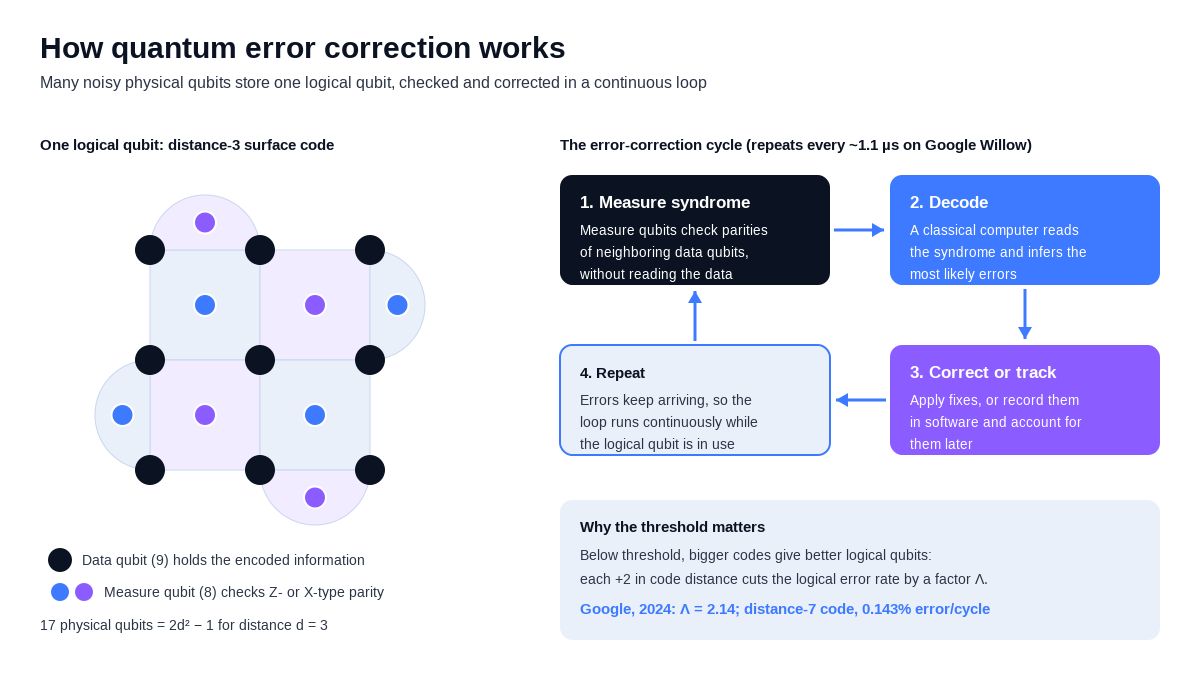
Quantum error correction (QEC) spreads the information of one reliable "logical" qubit across many noisy physical qubits. It repeatedly checks them for errors and fixes the errors faster than they build up. It matters because today's best physical operations fail roughly once in a thousand tries, while many useful algorithms need error rates closer to one in ten billion [1]. QEC is the bridge between those numbers. Since late 2024, experiments from Google, and from Microsoft with Quantinuum, have shown it starting to work as theory predicts, and IBM has demonstrated key hardware and decoding pieces [1][4][5].
This explainer covers how QEC works, what the "threshold" means, the main code families and what the 2024–2026 milestones do and don't prove. For the basics of qubits, start with our guide to how quantum computers work.
Why quantum computers need error correction
Qubits are fragile. Heat, stray electromagnetic fields, material defects and imperfect control pulses all disturb them. Google's Willow paper puts it plainly: the best many-qubit platforms have only recently reached 99.9% fidelity for entangling gates. That is "far short of the <10⁻¹⁰ error rates needed for many applications" [1].
Classical computers handle errors by copying bits and taking a majority vote. Quantum error correction has to work differently. Measuring a qubit directly destroys the quantum information it holds. So QEC measures only relationships between qubits, called parity checks or stabilizers. Those checks reveal whether and where an error happened without revealing the data itself.
How it works: the error-correction cycle
A QEC code runs in a loop, many times per second:
- Encode. One logical qubit is stored across a group of physical "data" qubits.
- Measure syndromes. Extra "measure" qubits check parities among neighboring data qubits. The pattern of results is called the syndrome.
- Decode. A classical computer reads the syndrome and infers the most likely errors.
- Correct or track. The system applies corrections, or more often just records them in software, and the cycle repeats.
Speed is critical. On Google's Willow chip, each cycle took about 1.1 microseconds. Its real-time decoder kept up over a million cycles with an average latency of 63 microseconds at distance 5 [1]. In November 2025 IBM reported decoding its qLDPC codes on classical hardware in under 480 nanoseconds [4].
The threshold and code distance
Two numbers describe how well a code works.
- Code distance (d) is the smallest number of physical errors that can corrupt the logical qubit without being detected. A distance-d code can correct up to (d − 1)/2 errors, rounded down. In a surface code, a distance-d logical qubit uses 2d² − 1 physical qubits [1].
- The threshold is the physical error rate below which adding more qubits makes the logical qubit better rather than worse. Above it, more qubits just add more places for errors.
Below threshold, the logical error rate falls exponentially as distance grows. Google measures this with a factor called Λ (lambda): how much the logical error rate drops each time the distance increases by two [1].
Milestones so far
Year | Who | Result | Source |
|---|---|---|---|
2024 | IBM | Designed qLDPC "bivariate bicycle" codes with a threshold near 0.7%; one code stores 12 logical qubits in 288 physical qubits | [2] |
Dec 2024 | Surface code below threshold on Willow: Λ = 2.14, distance-7 code on 101 qubits with 0.143% error per cycle | [1] | |
Nov 2025 | IBM | Loon test chip shows the hardware elements for fault tolerance; real-time qLDPC decoding under 480 ns | [4] |
Reported 2026 | Microsoft and Quantinuum | Nature paper: logical operations up to about 800× more reliable than the physical ones they're built from, on trapped-ion hardware | [5] |
Google's 2024 result was the first clear demonstration of the textbook behavior on a superconducting chip. Each step up in distance roughly halved the logical error rate. Its distance-7 logical qubit lived more than twice as long as its best physical qubit [1].
Main code families
Code family | How it works | Strengths | Trade-offs |
|---|---|---|---|
Surface code | 2D grid; each check touches only nearest neighbors | High threshold, simple layout, best-tested | Large overhead: hundreds to thousands of physical qubits per logical qubit [7] |
qLDPC codes (for example IBM's bivariate bicycle codes) | Each check touches a few qubits, some far apart | Far fewer physical qubits per logical qubit | Needs long-range connections on the chip [2][7] |
Color, carbon and other codes | Variants suited to specific hardware such as trapped ions | Can make some logical gates easier | Less mature at scale [5] |
The overhead difference is large. IBM's analysis found that encoding 12 logical qubits in separate surface-code patches would need more than 3,000 physical qubits to reach the same error suppression its 288-qubit qLDPC code targets [2]. qLDPC codes need connections between distant qubits. Physics World notes that neutral-atom machines, which can rearrange atoms, are naturally suited to that [7].
Beyond memory: doing calculations
Storing a qubit is only the first step. A useful machine must also run logical gates without spreading errors. Some gates are relatively easy to perform on encoded qubits. Others need special resource states, called "magic states," which are costly to prepare.
Much recent research targets that cost. Gidney's 2025 estimate, that RSA-2048 could be factored in under a week with fewer than a million noisy qubits, relies partly on a technique called magic state cultivation and on storing idle qubits more compactly [6]. That shows how QEC advances feed directly into what a future machine could do. Our quantum computing in cybersecurity explainer covers what that means for encryption.
Roadmaps
Company roadmaps are statements of intent, not guarantees:
- IBM plans Starling, a fault-tolerant machine with 200 logical qubits running 100 million operations, by 2029 in Poughkeepsie, New York. A later system called Blue Jay targets 2,000 logical qubits [3].
- Microsoft and Atom Computing are building Magne, a neutral-atom machine with more than 1,200 physical qubits for the Danish initiative QuNorth. It's expected online in early 2027, offering logical qubits on demand [5].
- Google says it is now focused on Milestone 3 of its hardware roadmap: a long-lived logical qubit [8].
Limitations and open problems
- Rare correlated errors. Google found error bursts of not-yet-understood origin occurring roughly once an hour. They set an error floor of about 10⁻¹⁰ in its repetition-code tests [1].
- Leakage. Qubits can "leak" out of their two working states. Willow dedicated extra qubits to removing leakage [1].
- Classical bottlenecks. Decoders must keep pace with roughly a million cycles per second, and eventually across thousands of logical qubits [1][4].
- Overhead. Even with better codes, recent estimates for breaking today's public-key encryption call for roughly 10,000 to 1 million physical qubits, depending on the hardware and how long the run is allowed to take [6][7]. For comparison, Google's Willow chip has 105 physical qubits [7], and Microsoft's planned Magne machine will have more than 1,200 [5].
Outlook
The field has moved from proving QEC can work to engineering it as a product. Microsoft describes the shift as moving "from setting individual records" to building testable, modular encoding and decoding software [5]. Over the next few years, watch for logical qubit counts in the tens to low hundreds, longer logical lifetimes and the first error-corrected computations that classical computers can't easily simulate. Those, more than raw physical qubit counts, are the real measure of progress.
Frequently asked questions
What is a logical qubit?
A logical qubit is a reliable qubit built from many physical qubits using an error-correcting code. Errors on individual physical qubits are detected and corrected so the encoded information survives. Google's distance-7 surface code used 101 physical qubits for one logical qubit [1].
What does "below threshold" mean?
It means the physical qubits are good enough that adding more of them to the code lowers the logical error rate instead of raising it. Google's Willow results were the first clear demonstration of this on superconducting qubits, with errors falling by a factor of 2.14 each time the code distance increased by two [1].
How many physical qubits does a logical qubit need?
It depends on the code and the target error rate. Surface codes typically need hundreds to thousands of physical qubits per logical qubit [7]. qLDPC codes can need far fewer: IBM's design stores 12 logical qubits in 288 physical qubits [2].
When will we have fault-tolerant quantum computers?
No one knows for sure. IBM targets a 200-logical-qubit machine by 2029 [3], and Microsoft expects its Magne system in early 2027 [5]. These are company plans, not demonstrated results.
Why can't quantum computers just copy qubits like classical computers?
Measuring a qubit's state collapses it, and a basic rule of quantum mechanics, the no-cloning theorem, forbids copying an unknown quantum state. So you can't duplicate quantum information the way you copy bits. Error correction instead measures parity relationships between qubits. Those reveal errors without disturbing the stored data.
Sources
- Google Quantum AI and collaborators, "Quantum error correction below the surface code threshold," Nature, published December 9, 2024. https://www.nature.com/articles/s41586-024-08449-y
- IBM researchers, "High-threshold and low-overhead fault-tolerant quantum memory," Nature, published March 27, 2024. https://www.nature.com/articles/s41586-024-07107-7
- IBM, "IBM Sets the Course to Build World's First Large-Scale, Fault-Tolerant Quantum Computer at New IBM Quantum Data Center," June 10, 2025. https://newsroom.ibm.com/2025-06-10-IBM-Sets-the-Course-to-Build-Worlds-First-Large-Scale,-Fault-Tolerant-Quantum-Computer-at-New-IBM-Quantum-Data-Center
- IBM, "IBM Delivers New Quantum Processors, Software, and Algorithm Breakthroughs on Path to Advantage and Fault Tolerance," November 12, 2025. https://newsroom.ibm.com/2025-11-12-ibm-delivers-new-quantum-processors,-software,-and-algorithm-breakthroughs-on-path-to-advantage-and-fault-tolerance
- Adam Paetznick and Ben W. Reichardt, "From research to product engineering: how groundbreaking logical-qubit demonstrations are shaping Microsoft's utility-scale quantum software platform," Microsoft Quantum, August 3, 2026. https://quantum.microsoft.com/en-us/insights/blogs/from-research-to-product-engineering-logical-qubit-demonstrations-shaping-microsoft-utility-scale-quantum-software-platform
- Craig Gidney, "How to factor 2048 bit RSA integers with less than a million noisy qubits," arXiv:2505.15917, May 2025. https://arxiv.org/abs/2505.15917
- Candice Chua, "New findings shorten the road to cryptographically relevant quantum computers," Physics World, May 26, 2026. https://physicsworld.com/a/new-findings-shorten-the-road-to-cryptographically-relevant-quantum-computers/
- Google, "Our Quantum Echoes algorithm is a big step toward real-world applications for quantum computing," October 22, 2025. https://blog.google/technology/research/quantum-echoes-willow-verifiable-quantum-advantage/
