

Direct Air Capture Technology: How It Works and What It Costs
How direct air capture pulls CO2 from the air: solid sorbents vs liquid solvents, energy needs, storage, the 45Q credit and real projects as of 2026.
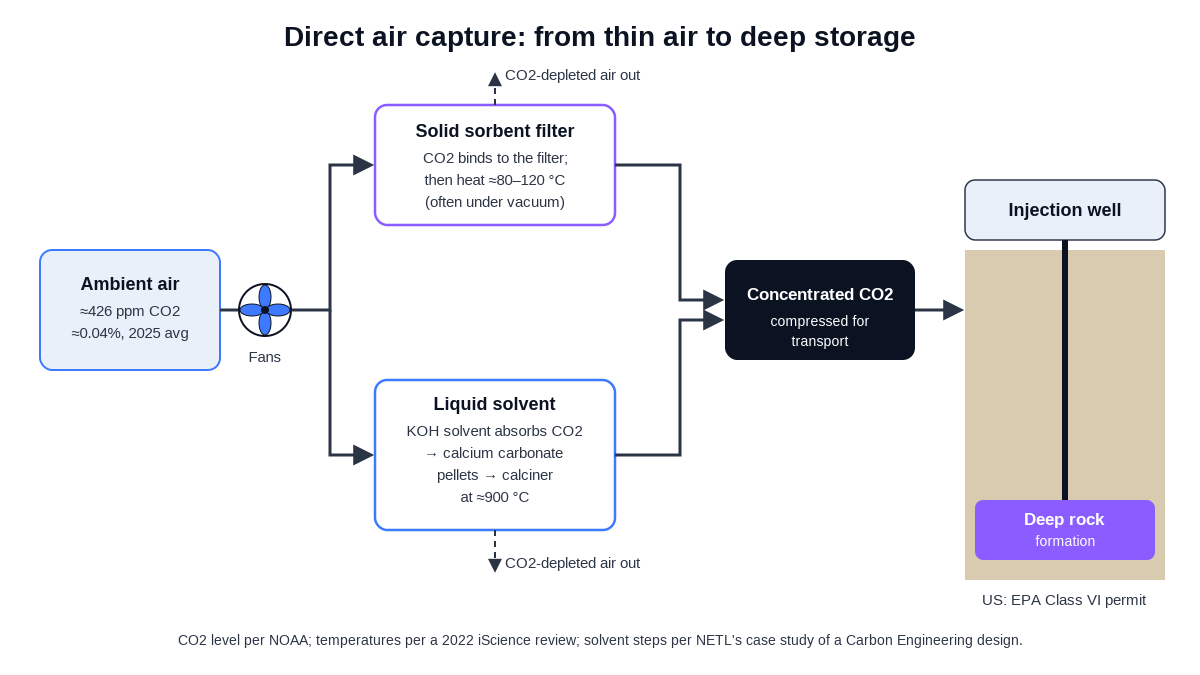
Direct air capture (DAC) is a technology that pulls carbon dioxide directly out of the surrounding air using chemical filters or liquids, then releases it as a concentrated stream that can be stored underground or used in products. Unlike capturing CO2 at a smokestack, DAC can remove emissions that already happened, from any source. The catch is that CO2 is dilute: the global average was about 426 parts per million in 2025, or roughly 0.04% of the air [1]. That makes capture energy-intensive and expensive. As of November 2026, only a handful of plants operate, and Climeworks' Mammoth in Iceland still runs far below its design capacity [5][9].
Why capturing CO2 from air is hard
At a coal plant, flue gas is about 12% CO2. Ambient air is nearly 300 times more dilute, and capture from air needs roughly three times more energy, according to a 2022 review in the journal iScience [4]. That one fact drives most of DAC's challenges:
- Huge air volumes. Fans must move enormous amounts of air through the capture material.
- Energy for regeneration. Releasing the captured CO2 from the filter or solvent takes heat. That's the most energy-demanding step [4].
- Cost. Developers' estimates of removal costs have spanned roughly $95–$600 per ton. NETL says differing assumptions make direct comparisons difficult [2].
How DAC works: the two main approaches
Every DAC system follows the same basic cycle: contact, capture, release, compress, store. The difference is the capture chemistry.
Solid sorbents
Air passes over a solid filter material that chemically binds CO2. When the filter is saturated, the unit is sealed and heated, often under vacuum, to release concentrated CO2. Then the cycle repeats. The same review puts regeneration at about 80–120°C for solid sorbents [4]. Lower temperatures mean the heat can come from sources such as waste heat or geothermal energy [4][8]. NETL has published independent performance and cost studies of generic sorbent-based DAC configurations [2].
Climeworks, which operates in Iceland, uses solid sorbent capture with thermal regeneration. It's one of two technology providers for Project Cypress, a DOE-funded DAC hub. The other, Heirloom, uses limestone that is repeatedly heated, hydrated and exposed to air [10].
Liquid solvents
Air is blown through contactors wetted with a strong alkaline solution. In the Carbon Engineering design that NETL modeled, the solution is potassium hydroxide [3]. In that system:
- Air contactors remove about 74.5% of the CO2 from the incoming air [3].
- Pellet reactors convert the captured carbon into calcium carbonate pellets [3].
- An oxy-fired calciner heats the pellets to release pure CO2 and regenerate calcium oxide [3]. This step runs at about 900°C [4].
- The CO2 is compressed for transport and storage [3].
In NETL's modeled design, the calciner is oxy-fired, with oxygen supplied by an air separation unit [3]. Supplying that much high-temperature heat is a major design challenge. Occidental's 1PointFive uses "advanced liquid sorbent technology" from its sister company Carbon Engineering at its STRATOS plant in Texas, and says the plant will use natural gas to reach calciner temperatures, co-capturing the resulting CO2 [7].
Feature | Solid sorbent DAC | Liquid solvent DAC |
|---|---|---|
Capture medium | Solid filter material | Alkaline solution (e.g., potassium hydroxide) [3] |
Regeneration temperature | About 80–120°C [4] | About 900°C (calciner) [4] |
Process style | Batch cycles in modular units | Continuous, chemical-plant style |
Heat sources | Low-temperature heat, e.g., geothermal or waste heat [4][8] | High-temperature heat; STRATOS burns natural gas in its calciner [7] |
Example | Climeworks (Mammoth, Iceland) [8] | 1PointFive STRATOS (Texas) [7] |
Where the CO2 goes
Captured CO2 counts as removal only if it stays out of the atmosphere. There are two main routes:
- Geological storage. CO2 is compressed and injected deep underground into rock formations. In the US, this requires an EPA Class VI well permit. On April 7, 2025, EPA issued final Class VI permits to Oxy Low Carbon Ventures for three wells in Ector County, Texas. They were the first Class VI permits EPA has issued in Texas [6]. In Iceland, Climeworks stores CO2 underground [8].
- Utilization. CO2 can be used to make products like synthetic fuels or concrete. GAO notes that CO2 in synthetic fuels is released again when the fuel is burned, while CO2 used in concrete is permanently mineralized [5].
Real-world projects (as of November 2026)
- US operating capacity is small. GAO, citing IEA data, reports that as of March 2026 the US had 33 operating carbon capture facilities. Four were direct air capture facilities. As of 2026, three more DAC facilities were under construction [5].
- STRATOS (Ector County, Texas). As of November 2026, 1PointFive's project page says it is building STRATOS to capture up to 500,000 tons of CO2 a year once fully operational, on a 65-acre site [7].
- Mammoth (Iceland). Climeworks switched on Mammoth in May 2024 with a nameplate capacity of up to 36,000 tons of CO2 per year, about ten times its earlier Orca plant [8]. Actual output has been far lower: Climeworks reports 675 tons of net CO2 removal in the first half of 2026, up from 119 tons in the same period of 2025. The company says it has prioritized improving performance and cutting costs over maximizing output [9].
- DOE DAC hubs. DOE's Office of Clean Energy Demonstrations funds regional DAC hubs. In March 2024 it awarded more than $50 million for the initial phase of Project Cypress, covering planning, design and community and labor engagement. Project Cypress plans to send captured CO2 to a sequestration partner with a permit for permanent geological storage [10]. In October 2025, DOE weighed cancelling the awards for Project Cypress and the South Texas DAC Hub, but in April 2026 Reuters reported that DOE confirmed both hubs were on a list of nearly 2,000 projects that would keep their funding. Each had received only its first $50 million tranche at that point [11].
The gap between nameplate and actual output at Mammoth shows why DAC claims need careful reading. Design capacity isn't delivered removal.
Policy: the 45Q tax credit
The main US incentive is the Section 45Q carbon oxide sequestration credit. As amended by the One Big Beautiful Bill Act in 2025, credit amounts are generally $180 per metric ton for direct air capture and $85 per metric ton for point-source capture, regardless of whether the carbon is stored or used, according to GAO [5]. Before that law, used CO2 earned a lower rate than stored CO2. GAO describes the change as creating "parity in credit values across uses" [5]. The full credit amounts depend on meeting prevailing wage and apprenticeship requirements [5]. The amended rates apply to facilities or equipment placed in service after July 4, 2025, construction must begin before 2033, and the credit can be claimed for 12 years after a facility enters service [5]. These are the rules as of November 2026.
Benefits
- Removes past emissions from the atmosphere, not just future ones.
- Location-flexible. Plants can be sited near clean energy and good storage geology, not just near emitters.
- Measurable. Captured and stored tons can be metered, unlike some nature-based removal methods.
Limitations and risks
- High energy use. Regeneration is the most energy-demanding step [4]. If that energy comes from fossil fuels without capture, net removal shrinks.
- High cost. Developer estimates of $95–$600 per ton [2] are far above many other climate measures.
- Scale. Today's facilities capture tiny amounts compared with global emissions [5][9].
- Policy dependence. Economics rely heavily on 45Q and on buyers of carbon removal credits.
- No substitute for cuts. Counting on future removal is not a reason to delay reducing emissions now.
How to evaluate a DAC announcement
- Nameplate or measured? Ask for actual tons removed, not design capacity [9].
- Net or gross? Net removal subtracts emissions from the energy and materials used.
- Where does the CO2 go? Permanent geological storage [6] versus products that re-release it [5].
- What powers it? Low-carbon heat and electricity are essential for meaningful net removal.
- Who verifies it? Look for independent measurement, reporting and verification.
Outlook
DAC is moving from pilots to the first large plants, led by STRATOS in Texas [7]. Its long-term role depends on cutting energy use and costs, proving durable storage at scale, and sustained policy support. Expect it to complement emission cuts rather than replace them. For related technologies, see carbon capture and storage, green vs blue hydrogen and geothermal energy, a possible low-carbon heat source for sorbent systems.
Frequently asked questions
What is direct air capture in simple terms?
A machine that uses fans and chemical filters or liquids to pull CO2 out of ordinary air. The captured CO2 is then released in concentrated form and stored underground or used in products [3][4].
How is DAC different from carbon capture and storage (CCS)?
CCS usually captures CO2 at a concentrated source like a power plant or factory, where flue gas is about 12% CO2. DAC captures it from ambient air at about 0.04%, which takes roughly three times more energy [4]. DAC can address emissions from any source, including past emissions.
How much does direct air capture cost?
Developer estimates have ranged from about $95 to $600 per ton of CO2. NETL cautions that varying assumptions make comparisons difficult [2]. In the US, the 45Q credit pays up to $180 per ton for DAC [5].
What is the largest direct air capture plant?
By design capacity, 1PointFive's STRATOS in Texas, which is designed to capture up to 500,000 tons a year once fully operational and was still being built as of November 2026, according to its project page [7]. Climeworks' Mammoth in Iceland is designed for up to 36,000 tons a year [8] but removed 675 net tons in the first half of 2026 [9].
Is direct air capture worth it?
It depends on cost, energy source and permanence. DAC can remove CO2 that's hard to avoid otherwise, but it's expensive and energy-intensive today [2][4]. It is best treated as a complement to cutting emissions, not a substitute.
Sources
- NOAA Global Monitoring Laboratory. "Trends in Atmospheric Carbon Dioxide: Global annual mean data." https://gml.noaa.gov/webdata/ccgg/trends/co2/co2_annmean_gl.txt
- U.S. DOE National Energy Technology Laboratory. "NETL Explores Sorbent-Based Direct Air Capture Systems for the Removal of Atmospheric CO2." August 3, 2022. https://netl.doe.gov/node/11941
- U.S. DOE National Energy Technology Laboratory. Case study of a solvent-based direct air capture system. https://netl.doe.gov/node/12180
- "Current status and pillars of direct air capture technologies." iScience 25(4):103990, February 2022. PubMed Central. https://pmc.ncbi.nlm.nih.gov/articles/PMC8927912
- U.S. Government Accountability Office. "Carbon Capture Tax Credit: Actions Needed to Improve Federal Administration and Evaluation of Tax Expenditure" (GAO-26-107711). August 6, 2026. https://files.gao.gov/reports/GAO-26-107711/index.html
- U.S. Environmental Protection Agency. "EPA Issues Final Permits for Geologic Sequestration of Carbon Dioxide in Texas." April 7, 2025. https://epa.gov/newsreleases/epa-issues-final-permits-geologic-sequestration-carbon-dioxide-texas
- 1PointFive. "STRATOS: Ector County Direct Air Capture Facility." https://www.1pointfive.com/projects/stratos
- Climeworks. "Climeworks switches on world's largest direct air capture plant." May 8, 2024. https://climeworks.com/press-release/climeworks-switches-on-worlds-largest-direct-air-capture-plant-mammoth
- Climeworks. "How Mammoth is unlocking a step change in performance & reducing costs." https://climeworks.com/blog/mammoth-direct-air-capture-performance-update
- U.S. Department of Energy, Office of Clean Energy Demonstrations. "OCED Issues $50M to Direct Air Capture Hub Project Cypress." March 27, 2024. https://www.energy.gov/node/4839455
- Reuters, via Pipeline & Gas Journal. "U.S. DOE Restores Funding for Carbon Capture Hubs in Texas, Louisiana." April 19, 2026. https://pgjonline.com/news/2026/april/us-doe-restores-funding-for-carbon-capture-hubs-in-texas-louisiana