

Grid-Scale Energy Storage: Beyond Lithium-Ion Batteries
Grid-scale storage beyond lithium-ion: pumped hydro, compressed air, flow batteries, hydrogen and iron-air compared on efficiency, duration and cost.
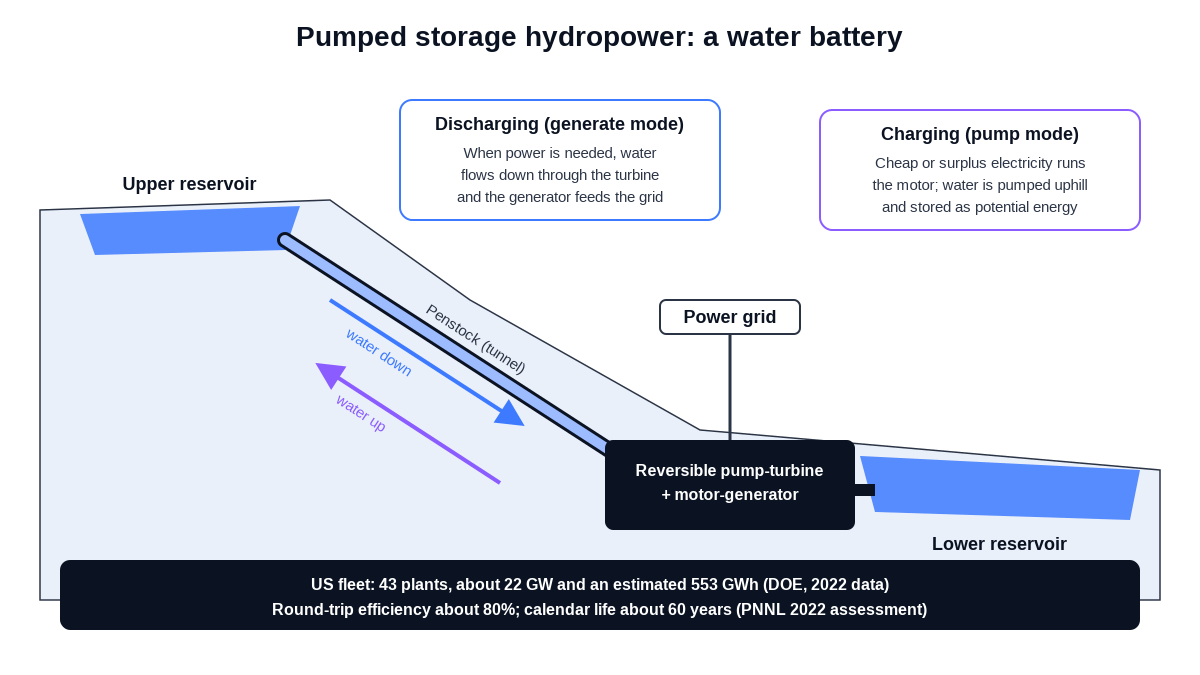
Grid-scale energy storage means systems large enough to absorb and release electricity for a power grid, typically measured in megawatts of power and megawatt-hours of energy. Batteries, mostly lithium-ion [6], are where the growth is: US utility-scale battery capacity reached nearly 52 GW by mid-2026 [2]. But the grid's oldest and largest store of energy is pumped storage hydropower, with about 22 GW of power and an estimated 553 GWh of energy across 43 US plants as of 2022 [1]. Other technologies, including compressed air, flow batteries, hydrogen and iron-air batteries, target the longer durations that four-hour lithium-ion systems can't cover economically.
This guide compares the full range. For a deep dive on lithium-ion systems specifically, see our battery energy storage systems explainer.
Power, energy and duration
Three numbers describe any storage system:
- Power (MW): how fast it can deliver electricity.
- Energy (MWh): how much it can store in total.
- Duration (hours): energy divided by power, meaning how long it can run at full output. PNNL defines duration as "the ratio of rated energy to rated power" [3].
A 100 MW / 400 MWh battery runs for four hours at full power. The US pumped storage fleet's estimated 553 GWh over 22 GW [1] works out to an average of roughly 25 hours. That's why pumped hydro still holds much more energy than its power rating suggests.
The fourth number is round-trip efficiency (RTE): the share of electricity put in that comes back out [3]. Higher RTE means less energy wasted in each cycle.
Why the grid needs more than four hours
Short-duration storage (a few hours) shifts midday solar into the evening peak. That's where most new batteries earn their money. Longer gaps are harder:
- Multi-day lulls in wind and sun, especially in winter.
- Extreme weather events that stress the grid for days.
- Seasonal mismatches between when renewables produce and when demand peaks.
Covering these with four-hour batteries would mean buying far more battery energy than you'd use most of the year. That's the gap long-duration technologies target.
The main technologies compared
Technology | How it stores energy | Round-trip efficiency (PNNL, 2021 values) | Notable characteristics |
|---|---|---|---|
Lithium-ion (LFP/NMC) | Electrochemical cells | 86% AC at inverter; 82.6% at transformer [3] | Dominant for 2–4 hour storage [6] |
Pumped storage hydropower | Pumps water uphill, releases it through turbines | 80% [3] | 60-year calendar life; needs suitable sites [3] |
Compressed air (CAES) | Compresses air into caverns, expands it through turbines | Varies by design: 46–54% diabatic; up to about 70% adiabatic [4] | Low cost per kWh at large scale and long duration [3] |
Vanadium redox flow | Liquid electrolytes in external tanks | 71% DC; 65% at transformer [3] | Electrolyte cycle life "unlimited" [3]; tank size sets energy, stack size sets power |
Gravitational / thermal | Lifting masses; storing heat | Gravitational 83% [3] | Emerging; site- and design-specific |
Hydrogen | Electrolysis, storage, then fuel cell | 31% at transformer [3] | Very long duration possible; low efficiency |
Iron-air | Reversible rusting of iron using oxygen from air [8] | Not in PNNL's 2022 set | Designed for about 100 hours of discharge [5][8] |
PNNL's 2022 assessment also compared levelized cost of storage, the lifetime cost per kWh delivered. For large 1,000 MW, 10-hour systems at 2021 costs, CAES had the lowest cost at $0.10/kWh, followed by pumped storage at $0.11/kWh. Gravitational, thermal, LFP, vanadium flow and NMC fell in a tight $0.13–$0.20/kWh range. Hydrogen was highest at $0.35/kWh because of low efficiency and high stack costs [3]. These are modeled 2021 values, so treat them as a relative ranking rather than current prices.
Pumped storage hydropower
Pumped storage uses two reservoirs at different elevations. When electricity is cheap or abundant, it pumps water uphill. When power is needed, the water flows back down through turbines. The diagram above shows the cycle.
- US scale: 43 plants, 22 GW and about 553 GWh. In 2022, pumped storage was 70% of US utility-scale storage power capacity, down from 93% in 2019 as batteries grew [1].
- Strengths: high efficiency (about 80%), very long life (60 years) and low lifetime cost at scale [3].
- Limits: it needs specific geography, large civil works and long permitting.
EIA's 2022 data show the asymmetry well: the pumped storage fleet had 22,008 MW of power, against 8,842 MW and 11,105 MWh for batteries that year [6].
Compressed air energy storage (CAES)
CAES compresses air into underground caverns using surplus electricity. It later releases the air through a turbine to generate power. DOE lists operating plants including [4]:
- Huntorf, Germany: the first utility-scale CAES project, from 1978. It's a 321-MW plant with 532,000 cubic meters of underground storage. It's "diabatic," meaning it burns fuel to reheat the air during expansion.
- McIntosh, Alabama: a 110-MW plant with 270,000 cubic meters of storage.
- Newer "adiabatic" designs that store the heat of compression instead of burning fuel, such as Hydrostor's 2.2-MW/10-MWh system in Ontario.
CAES's appeal is low cost at large scale and long duration [3]. Its drawback is that it depends on suitable geology, or on purpose-built storage.
Flow batteries
In a flow battery, energy is stored in liquid electrolytes held in external tanks and pumped through a cell stack. Power depends on the stack size. Energy depends on the tank size, so the two scale independently. PNNL's vanadium redox flow figures show lower efficiency than lithium-ion: 71% DC-to-DC and 65% at the transformer. But it notes the electrolyte has unlimited cycle life [3].
Hydrogen storage
Electricity can split water into hydrogen, which can be stored, sometimes in salt caverns, and turned back into electricity with fuel cells or turbines. PNNL's round-trip figure is only about 31% [3]. Hydrogen's case rests on very long-duration and seasonal storage, and on uses outside the power sector. Our explainer on green vs blue hydrogen covers production.
Iron-air and other multi-day batteries
Iron-air batteries work by reversible rusting. Form Energy says its battery breathes in oxygen from the air and converts iron metal to rust while discharging, then turns the rust back to iron while charging. The company says the system can cost-effectively store and discharge energy for up to 100 hours [8]. Its first commercial deployment is the Cambridge Energy Storage Project in Minnesota, developed by Great River Energy and Form Energy since 2020. It's a 1.5-MW, grid-connected system designed to deliver its rated power continuously for 100 hours. That's far longer than the four-hour window typical of utility-scale lithium-ion [5]. Watch for real-world operating data from pilots like this before drawing conclusions about cost and performance.
Where US storage is heading (as of 2026)
- Batteries are booming. US utility-scale battery capacity was 43.6 GW at the end of 2025. Operators added 8.3 GW more in the first half of 2026, reaching nearly 52 GW. They planned 26 GW in 2027 and 14 GW in 2028 [2].
- Batteries now exceed pumped storage in power, but not necessarily in energy. If the US battery fleet averaged four hours (an assumption, not a reported figure), 52 GW would hold about 208 GWh. That's well below pumped storage's estimated 553 GWh (a 2022 figure) [1][2].
- Solar and storage are built together. Battery storage made up 28% of planned 2026 US capacity additions, second only to solar [7].
How to choose a storage technology
- What duration do you need? For 2–4 hours, lithium-ion is the default. In PNNL's 2021 estimates for a 100 MW, 4-hour system, LFP had the lowest installed cost after diabatic CAES, which needs suitable geology [3]. For 10–100+ hours, look at pumped hydro, CAES, flow or iron-air [3][5].
- How often will it cycle? Frequent cycling favors high efficiency and long cycle life [3].
- What does the site allow? Pumped hydro and CAES need specific geography or geology [4].
- How mature is the technology? Pumped hydro and lithium-ion have long track records. Many long-duration options are still at pilot scale [5].
Outlook
Expect lithium-ion to keep dominating short-duration storage. Long-duration technologies will compete for the multi-day and seasonal role as wind and solar shares rise. Smarter grids and vehicle batteries can add flexibility too. See smart grid technology and vehicle-to-grid technology.
Frequently asked questions
What is the largest form of grid energy storage in the US?
By stored energy, pumped storage hydropower has long led: in 2022 it held 96% of US utility-scale storage energy capacity, with about 22 GW and an estimated 553 GWh across 43 plants [1]. By power capacity, batteries have overtaken it, reaching nearly 52 GW by mid-2026 [2].
What is long-duration energy storage?
Storage that can discharge for many hours or days, beyond the roughly four hours typical of utility-scale lithium-ion. Examples include pumped hydro, compressed air, flow batteries and iron-air batteries designed for about 100 hours [3][5].
Which grid storage technology is most efficient?
Among the technologies PNNL assessed, lithium-ion (LFP and NMC) has the highest round-trip efficiency, at about 84% for a 100 MW, 10-hour system. Gravitational storage (83%) and pumped storage (80%) follow closely. Hydrogen is lowest at about 31% [3].
Why not just use more lithium-ion batteries?
For multi-day gaps, you'd need far more battery energy than you'd use most of the year, which is expensive. Long-duration technologies aim to store energy more cheaply per kWh, even if they're less efficient [3].
How does compressed air energy storage work?
Surplus electricity compresses air into underground caverns. Later the air is released through a turbine to generate power. Older plants like Huntorf and McIntosh burn fuel to reheat the air. Newer adiabatic designs store the compression heat instead [4].
Sources
- Oak Ridge National Laboratory for the U.S. Department of Energy. "U.S. Hydropower Market Report (2023 edition), Executive Summary." https://www.energy.gov/sites/default/files/2023-10/U.S.%20Hydropower%20Market%20Report%202023%20Edition%2C%20Executive%20Summary.pdf
- U.S. Energy Information Administration. "Battery storage capacity averaged 70% growth over the last three years." Today in Energy, August 7, 2026. https://www.eia.gov/todayinenergy/detail.php?id=67925
- Pacific Northwest National Laboratory for the U.S. Department of Energy. "2022 Grid Energy Storage Technology Cost and Performance Assessment." August 2022. https://www.energy.gov/sites/default/files/2022-09/2022%20Grid%20Energy%20Storage%20Technology%20Cost%20and%20Performance%20Assessment.pdf
- U.S. Department of Energy. "Technology Strategy Assessment: Compressed Air Energy Storage." July 2023. https://www.energy.gov/sites/default/files/2023-07/Technology%20Strategy%20Assessment%20-%20Compressed%20Air%20Energy%20Storage_0.pdf
- Great River Energy. "Cambridge Energy Storage Project." https://greatriverenergy.com/what-we-do/cambridge-energy-storage-project
- U.S. Energy Information Administration. "Energy storage for electricity generation." https://www.eia.gov/energyexplained/electricity/energy-storage-for-electricity-generation.php
- U.S. Energy Information Administration. "New U.S. electric generating capacity expected to reach a record high in 2026." Today in Energy, February 20, 2026. https://www.eia.gov/todayinenergy/detail.php?id=67205
- Form Energy. "Battery Technology." https://formenergy.com/technology/battery-technology/