

Hydrogen Fuel Cells Explained
How a hydrogen fuel cell turns hydrogen and air into electricity, water and heat, how the six main types compare, and what DOE says still needs work.
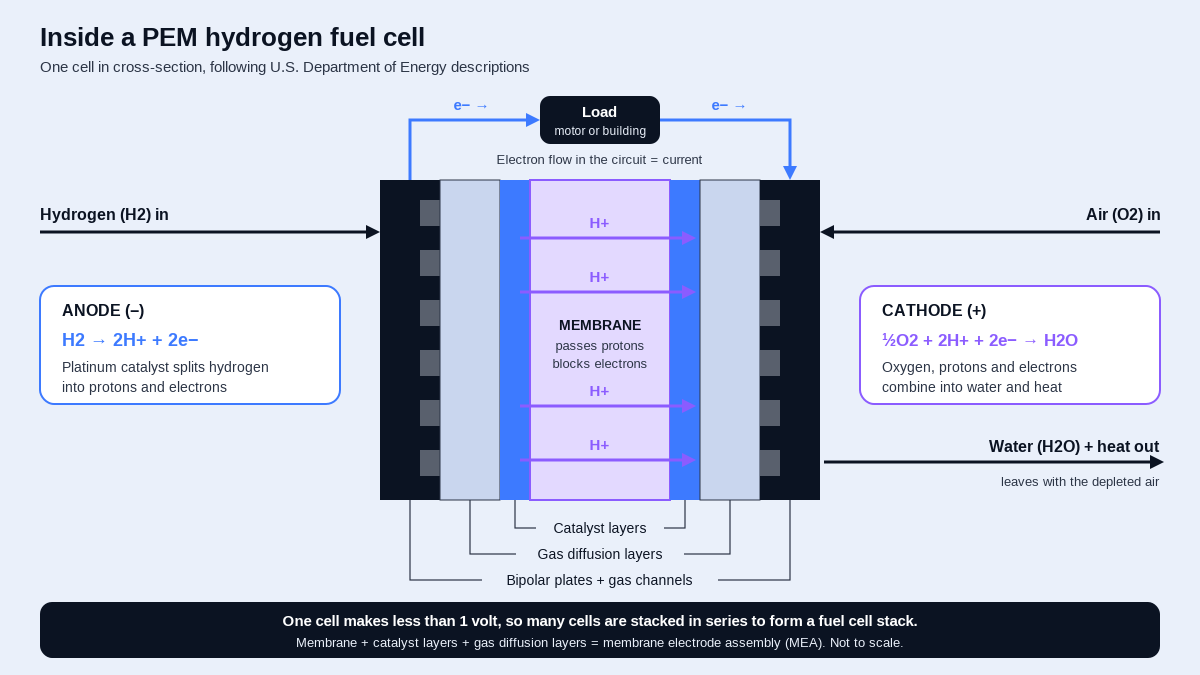
A hydrogen fuel cell is an electrochemical device that combines hydrogen and oxygen from the air to produce electricity, with water and heat as the only by-products [1]. There's no combustion. A catalyst splits hydrogen into protons and electrons, the electrons flow through an outside circuit as electric current, and everything recombines with oxygen on the far side as water. Unlike a battery, a fuel cell doesn't run down or need recharging; it keeps producing power as long as fuel keeps flowing [1].
This explainer covers how fuel cells convert hydrogen into power. For how the hydrogen itself is made, and why the production method decides its climate footprint, see our guide to green hydrogen vs blue hydrogen.
How a fuel cell works, step by step
Every fuel cell has the same basic sandwich: a negative electrode (the anode), a positive electrode (the cathode) and an electrolyte between them [1]. The most common type for vehicles, the proton exchange membrane (PEM) fuel cell, uses a thin solid polymer as its electrolyte [2]. Here's what happens inside one cell:
- Hydrogen arrives at the anode. Gas flows through channels to the anode side [1].
- The catalyst splits it. A catalyst at the anode "separates hydrogen molecules into protons and electrons" [1]. In chemical shorthand: H₂ → 2H⁺ + 2e⁻.
- Protons cross the membrane. The membrane conducts only positively charged ions and blocks electrons [3], so the protons pass straight through.
- Electrons take the long way. Blocked by the membrane, the electrons travel through an external circuit to the cathode. That flow is the electric current that runs a motor or a building [1].
- Water forms at the cathode. Air supplies oxygen to the cathode, where it combines with the arriving protons and electrons to form water and heat [1]: ½O₂ + 2H⁺ + 2e⁻ → H₂O.
The diagram shows the same process in a single PEM cell.
From one cell to a stack
A single cell is weak. DOE notes that "each individual MEA produces less than 1 V under typical operating conditions" [3]. To reach useful voltages, manufacturers connect many cells in series by stacking them on top of each other [3]. The result, the fuel cell stack, is the part a car or generator actually uses.
Inside a PEM fuel cell: the parts
DOE breaks a PEM cell into a handful of layers [3]:
Part | What it does [3] |
|---|---|
Membrane electrode assembly (MEA) | "The heart of a PEM fuel cell": the membrane, catalyst layers and gas diffusion layers bonded together |
Polymer electrolyte membrane | Conducts protons, blocks electrons; for transportation it is thin, in some cases under 20 microns |
Catalyst layers | Typically nanometer-sized platinum particles on a high-surface-area carbon support |
Gas diffusion layers | Usually carbon paper partly coated with PTFE; spread reactant gases to the catalyst and carry away product water |
Bipolar plates | Separate neighboring cells, conduct current between them and contain the gas flow channels |
Gaskets | Seal the edges of the MEA so gases don't leak |
The platinum catalyst matters for cost. DOE lists the platinum-based catalyst as a key disadvantage of PEM cells [2], which is why reducing platinum-group metal (PGM) loading is a formal DOE target (see below).
The six main types of fuel cells
Fuel cells are classified mainly by their electrolyte, which sets their operating temperature, catalyst needs and best uses. This comparison draws on DOE's "Types of Fuel Cells" page [2]; blank cells mean DOE doesn't state a figure there.
Type | Electrolyte | Operating temperature | Efficiency (as stated by DOE) | Typical uses |
|---|---|---|---|---|
Proton exchange membrane (PEM) | Solid polymer | Around 80°C (176°F) | Not stated on the page | Cars, buses, heavy-duty trucks; some stationary |
Direct methanol | (Fed methanol rather than hydrogen) | Not stated | Not stated | Portable devices |
Alkaline | Potassium hydroxide solution, or alkaline polymer membrane | Not stated | Above 60% demonstrated in space | Spacecraft historically; small power uses |
Phosphoric acid | Liquid phosphoric acid | Not stated | 37–42% electricity only; over 85% with combined heat and power | Stationary power, some buses |
Molten carbonate | Molten carbonate salt mixture | 650°C (about 1,200°F) | Approaching 65% with a turbine; over 85% using waste heat | Utility, industrial and military power plants |
Solid oxide | Hard, non-porous ceramic | Up to 1,000°C (1,830°F) | Around 60% electric; could top 85% with heat capture | Utility and stationary power |
Two patterns jump out:
- Low-temperature cells (PEM) start fast and are compact. DOE credits PEM cells with high power density, low weight and volume, and quick startup [2]. That's why vehicles use them.
- High-temperature cells (solid oxide, molten carbonate) are fuel-flexible. They don't need precious-metal catalysts and can reform natural gas or biogas internally [2]. The trade-off is slow startup and demanding materials, which suits them to always-on stationary power, not cars [2]. That's the category behind many data center power deals; see our coverage of Bloom Energy and AI data center power.
A seventh variant, the reversible fuel cell, runs in both directions: it can use surplus electricity from solar or wind to split water into hydrogen, then turn that hydrogen back into power later, acting as long-duration storage [2].
Fuel cell vs battery vs engine
Fuel cell | Battery | Combustion engine | |
|---|---|---|---|
Energy source | Hydrogen (or other fuel) stored in a tank | Electricity stored chemically in the cell | Fuel burned in cylinders |
Runs down? | No, as long as fuel is supplied [1] | Yes, needs recharging | No, as long as fuel is supplied |
Point-of-use emissions (on hydrogen) | Water and heat [1] | None | Exhaust gases and pollutants |
Moving parts | Few; quiet [1] | None in the cell | Many |
A fuel cell electric vehicle (FCEV) combines elements of both: it uses an electric motor like any EV, but generates electricity onboard from hydrogen, with a battery that captures braking energy and supplies short bursts of extra power [6]. Our EV beginner's guide and EV vs hybrid vs plug-in hybrid explainers cover the battery side.
Where fuel cells are used
DOE lists transportation, buildings (industrial, commercial and residential) and long-term grid energy storage in reversible systems as the main applications, with systems "as large as a utility power station and as small as a laptop computer" [1].
- Passenger cars. Light-duty FCEVs store hydrogen in 10,000 psi tanks, and retail dispensers can fill them in 3 to 5 minutes [7]. The catch is infrastructure: as of 2024, the Alternative Fuels Data Center counted 54 retail hydrogen stations open to the public in California and one in Hawaii, with more planned elsewhere [7]. For a sense of scale, the AFDC notes that the energy in 1 kilogram of hydrogen is about the same as the energy in 1 gallon of gasoline [7].
- Heavy-duty trucks. DOE's fuel cell R&D now puts its main emphasis on heavy-duty applications, where it sees the largest potential cuts in carbon and criteria-pollutant emissions [5].
- Stationary power. Phosphoric acid, molten carbonate and solid oxide cells serve buildings and utilities [2].
- Space. Alkaline fuel cells supplied electricity and water to U.S. spacecraft [2].
Benefits
- High efficiency. DOE says fuel cells can convert fuel's chemical energy directly to electricity with efficiencies "capable of exceeding 60%" [1], and some types top 85% when their waste heat is used [2].
- Clean at the point of use. Running on hydrogen, "the only products are electricity, water, and heat," with no smog-forming pollutants at the point of operation [1].
- Quiet and simple. Few moving parts [1].
- Fast refueling for vehicles. Three to five minutes for a light-duty tank [7].
- Scalable. From portable devices to power stations [1].
Limitations and risks
- The hydrogen supply chain. A fuel cell is only as clean as its hydrogen. DOE notes that "about 95% of all hydrogen is produced from steam reforming of natural gas" [4], and the AFDC cautions that some production methods generate air pollution [7].
- Cost. DOE's 2024 program plan puts the 2023 status of heavy-duty fuel cell systems at $170 per kilowatt, against a 2030 target of $80/kW [5].
- Durability. The same plan lists heavy-duty durability at more than 10,000 hours in 2023, against a 2030 target of 25,000 hours [5].
- Platinum. PEM catalysts rely on platinum or platinum alloys [2].
- Fuel purity. If hydrogen comes from hydrocarbons, carbon monoxide can poison PEM catalysts, requiring extra cleanup equipment [2].
- Refueling infrastructure. Public retail stations are concentrated in California [7].
- High-temperature durability. Molten carbonate cells last about 40,000 hours, roughly five years, because heat and corrosive electrolyte wear them out [2].
What DOE is targeting
The clearest public yardstick for fuel cell progress is DOE's own target table. These figures come from the 2024 Multi-Year Program Plan of DOE's Hydrogen and Fuel Cell Technologies Office [5] (as of November 2026, DOE's fuel cell pages sit under its Alternative Fuels and Feedstocks Office); DOE notes the $80/kW figure assumes high-volume production.
Application | Metric | 2023 status | 2030 target | Ultimate target |
|---|---|---|---|---|
Heavy-duty trucks | System cost | $170/kW | $80/kW | $60/kW |
Heavy-duty trucks | Durability | >10,000 h | 25,000 h | 30,000 h |
Heavy-duty trucks | Peak efficiency | 64% | 68% | 72% |
Heavy-duty trucks | PGM loading | >0.4 mg/cm² | ≤0.3 mg/cm² | ≤0.25 mg/cm² |
Stationary power | System cost | $1,200–2,500/kW | $1,000/kW | $750/kW |
Stationary power | Durability | 40,000–80,000 h | 80,000 h | 130,000 h |
Reversible fuel cells | Round-trip efficiency | ~37% | 60% | 70% |
The gaps tell the story. Heavy-duty fuel cells need to roughly halve in cost and more than double their proven lifetime by 2030 to meet DOE's own competitiveness bar. Treat these as targets, not predictions.
How to judge a fuel cell claim
- Which fuel cell type? PEM, solid oxide and molten carbonate cells have very different temperatures, costs and uses [2].
- Electric efficiency or total efficiency? Combined heat and power figures (over 85%) aren't comparable to electricity-only figures (about 37% to 60%) [2].
- Where does the hydrogen come from? Zero tailpipe emissions say nothing about production emissions [4][7].
- Status or target? DOE publishes both [5]. Make sure you know which one a press release quotes.
Frequently asked questions
Does a hydrogen fuel cell produce any emissions?
At the point of use, a fuel cell running on hydrogen produces only electricity, water and heat [1]. Emissions depend on how the hydrogen was produced; most hydrogen today comes from natural gas [4].
Is a fuel cell the same as a battery?
No. Both are electrochemical, but a battery stores its energy internally and must be recharged, while a fuel cell keeps producing electricity as long as it's supplied with fuel [1].
Why do fuel cells use platinum?
Platinum catalyzes the reactions at the electrodes of PEM cells [2][3]. It's also expensive, so DOE sets targets to cut the amount used per square centimeter [5].
How efficient are fuel cells?
DOE says fuel cells can exceed 60% efficiency converting fuel to electricity, and some high-temperature types exceed 85% total efficiency when their waste heat is captured [1][2].
How long does it take to refuel a hydrogen car?
Retail hydrogen dispensers can fill a light-duty vehicle's 10,000 psi tanks in 3 to 5 minutes, according to the Alternative Fuels Data Center [7].
What's the difference between a fuel cell and an electrolyzer?
They run the same chemistry in opposite directions. A fuel cell combines hydrogen and oxygen to make electricity and water, while electrolysis uses electricity to split water into hydrogen and oxygen [2][4]. Reversible fuel cells can do both [2].
Sources
- U.S. Department of Energy, Alternative Fuels and Feedstocks Office, "Fuel Cells." https://www.energy.gov/eere/fuelcells/fuel-cells
- U.S. Department of Energy, Alternative Fuels and Feedstocks Office, "Types of Fuel Cells." https://www.energy.gov/eere/fuelcells/types-fuel-cells
- U.S. Department of Energy, Alternative Fuels and Feedstocks Office, "Parts of a Fuel Cell." https://www.energy.gov/eere/fuelcells/parts-fuel-cell
- U.S. Department of Energy, Alternative Fuels and Feedstocks Office, "Hydrogen Fuel Basics." https://www.energy.gov/eere/fuelcells/hydrogen-fuel-basics
- U.S. Department of Energy, "Hydrogen and Fuel Cell Technologies Office Multi-Year Program Plan," Section 5: Fuel Cell Technologies, 2024. https://www.energy.gov/sites/default/files/2024-05/hfto-mypp-fuel-cell-technologies.pdf
- U.S. Department of Energy, Alternative Fuels Data Center, "How Do Fuel Cell Electric Vehicles Work Using Hydrogen?" https://afdc.energy.gov/vehicles/how-do-fuel-cell-electric-cars-work
- U.S. Department of Energy, Alternative Fuels Data Center, "Hydrogen Basics." https://afdc.energy.gov/fuels/hydrogen-basics