How Autonomous AI Agents Work
Inside an autonomous AI agent run: triggers, the gather-act-verify loop, exit conditions, long-running state, approvals and how autonomy is measured.
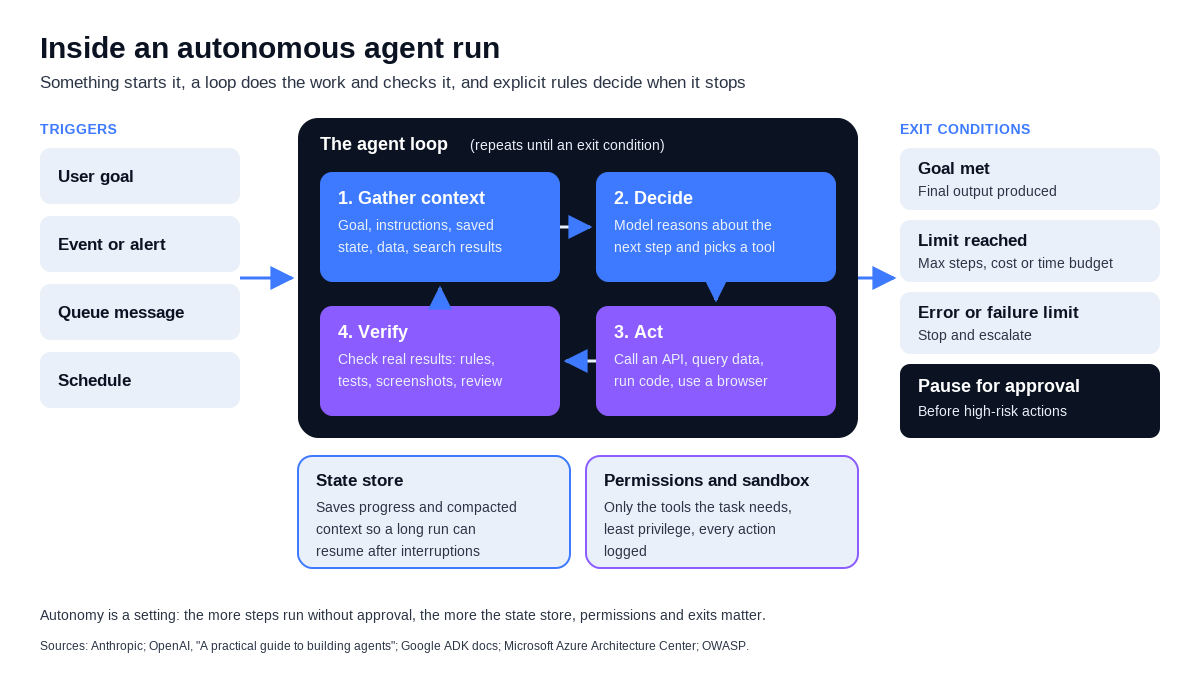
An autonomous AI agent works by running a loop: it gathers context, decides on a next step, acts through a tool, checks the result and repeats until an exit condition is met. Anthropic describes agents as "typically just LLMs using tools based on environmental feedback in a loop" [1]. What makes one autonomous is not a special model but how the loop is set up: what can start it, what it is allowed to do without asking, how it keeps track of progress over long tasks, and what stops it.
This guide walks through a single autonomous run from trigger to finish. If you are new to the idea, read What Is Agentic AI? first; for the terminology debate, see AI Agents vs Agentic AI.
What "autonomous" means here
Autonomy is a matter of degree. In a paper published in the Knight First Amendment Institute's "AI and Democratic Freedoms" essay series, researchers define five levels of agent autonomy by the role a person plays: operator, collaborator, consultant, approver and observer [7]. At the low end, the person drives and the AI helps. At the high end, the agent acts and the person only watches. They argue the level "can be treated as a deliberate design decision, separate from its capability" [7].
So "autonomous agent" usually means an agent configured at the approver or observer end: it runs many steps on its own and involves people only at checkpoints, on exceptions or after the fact.
Step 1: Something starts the run
Agents do not have to wait for a chat message. Common triggers:
- A user goal, such as "reconcile last month's invoices."
- An event, such as a new file, a database change or an alert. Google's Agent Development Kit calls agents that respond this way "ambient agents," which "run as background processes to process data, monitor events, and respond asynchronously without human intervention" [5].
- A queue message, such as an incoming support ticket [5].
- A schedule, such as a nightly report or periodic check [5].
Because nobody is watching an event-triggered agent, its results must go somewhere: logs with alerts, a message topic or a ticketing system [5].
Step 2: The core loop
Inside the run, most agent designs follow some version of the same cycle. Anthropic summarizes the one used in Claude Code as "gather context -> take action -> verify work -> repeat" [2].
Gather context
The agent reads what it needs: the goal, instructions, prior state and relevant data. It may search files, query APIs or delegate searches to sub-agents that return only relevant excerpts [2]. Our guide to agent memory and context management covers this stage in depth.
Decide
The model reasons about what to do next. The influential ReAct approach interleaves "reasoning traces and task-specific actions," so reasoning helps the model "induce, track, and update action plans as well as handle exceptions" [4]. See AI Agent Planning and Reasoning for planning strategies.
Act
The agent calls a tool: an API, a database query, a code runner, a browser or a file operation. The tool runs outside the model, and its output comes back as new information. Our explainer on tools and function calling shows the mechanics.
Verify
This is the step that separates reliable agents from demos. Anthropic stresses gaining "'ground truth' from the environment at each step (such as tool call results or code execution) to assess its progress" [1]. Its agent SDK guidance lists three ways to check work: clearly defined rules (code linting is "an excellent form of rules-based feedback"), visual feedback such as screenshots, and having another model judge the output, which Anthropic calls "generally not a very robust method" [2]. Agents that check their own output "catch mistakes before they compound" [2].
Step 3: Knowing when to stop
An autonomous loop needs explicit exit conditions. OpenAI's guide describes a "run" as "a loop that lets agents operate until an exit condition is reached," listing common exits as tool calls, "a certain structured output, errors, or reaching a maximum number of turns" [3]. In OpenAI's Agents SDK, for example, the loop ends when a final-output tool is invoked or when the model replies without calling any tool [3].
Anthropic notes the task "often terminates upon completion, but it's also common to include stopping conditions (such as a maximum number of iterations) to maintain control" [1]. In practice, production agents combine several:
Exit condition | Why it exists |
|---|---|
Goal met (final output produced) | Normal completion [3] |
Maximum steps or turns | Prevents endless loops [1][3] |
Cost or time budget | Keeps spending predictable |
Unrecoverable error | Avoids repeated failing actions [3] |
Failure threshold exceeded | Escalates to a person after repeated misses [3] |
High-risk action reached | Pauses for human approval [3] |
Step 4: Staying on track over long tasks
Short runs fit in one context window. Long ones do not, and they get interrupted. Three techniques keep long runs coherent:
- Compaction. Summarize older history as the context fills. Anthropic's agent SDK "automatically summarizes previous messages when the context limit approaches" [2]. Microsoft recommends summarization or "selective pruning" between agents as context accumulates [6].
- Durable state. Store "task progress, intermediate results, and conversation history in a durable store" so agents can "resume work after interruptions" [6]. Microsoft also advises scoping persisted state "to the minimum necessary information" to cut token use and privacy risk [6].
- Sub-agents. Hand self-contained subtasks to separate agents with their own context, returning only the results [2]. Our guide to multi-agent systems covers when that is worth the overhead.
Step 5: Guardrails that make autonomy safe
More autonomy means mistakes and attacks have bigger consequences. OWASP's guidance on "excessive agency" traces the root cause to "excessive functionality," "excessive permissions" or "excessive autonomy" [8]. Each has a matching control:
- Limit functionality. Give the agent only the tools the task needs [8].
- Limit permissions. Grant tools only the minimum permissions they need, for example read-only access when the task only reads [8].
- Limit autonomy. Require approval for consequential actions. OpenAI recommends human intervention when an agent exceeds failure thresholds or attempts high-risk actions, such as "canceling user orders, authorizing large refunds, or making payments" [3].
- Layer guardrails. OpenAI describes guardrails as "a layered defense mechanism," combining model-based checks, rules such as regex filters and moderation [3].
- Log everything so every action can be reviewed after the fact.
Prompt injection is the threat to plan for: OWASP notes excessive agency can be triggered by prompt injection from a malicious user, a compromised tool or, in multi-agent systems, a compromised peer agent [8]. Our guide to AI agent security and governance covers defenses, and human-in-the-loop AI covers approval design.
How autonomous are agents today?
Two measurements give a sense of the frontier as of 2026:
- Computer-use tasks. On OSWorld, which tests agents on real tasks across operating systems, the 2026 AI Index reports agents went from 12% to about 66% task success, but they "still fail roughly 1 in 3 attempts on structured benchmarks" [10].
- Task length. METR measures the length of software tasks, in human expert time, that agents can complete with 50% reliability. Its original March 2025 analysis found that length doubling about every seven months over six years [9]. A January 2026 update with a larger task suite (Time Horizon 1.1) estimated a faster doubling time of 131 days, about four months, for models since 2023 [11].
Both point the same way: agents can now finish real multi-step work, but not reliably enough to run unsupervised on anything consequential. Anthropic warns that autonomy means "higher costs, and the potential for compounding errors," and recommends extensive testing in sandboxed environments with guardrails [1].
A worked example: an overnight data-quality agent
- Trigger: a schedule starts the agent at 2 a.m. [5].
- Gather: it reads yesterday's sales tables and the validation rules.
- Decide and act: it runs queries to find duplicates and missing values, then drafts fixes.
- Verify: it reruns the validation rules on a copy of the data; any failure sends it back to step 3 [2].
- Guardrail: applying fixes to production is a high-risk action, so it files a ticket with proposed changes for an engineer to approve [3].
- Exit: after the ticket is filed, or after 30 steps, or if the database is unreachable, it stops and logs a summary [1][3].
At this configuration the engineer is an approver [7]. After months of clean results, a team might let the agent apply low-risk fixes directly and only report them.
Frequently asked questions
What makes an AI agent autonomous?
The degree to which it can run many steps without human input. That depends on configuration: what triggers it, which tools it can use, which actions need approval and when it stops [3][7].
Can autonomous agents run without any human?
Technically, yes. Ambient agents can respond to events and run on schedules with no one in the loop [5]. Whether they should depends on the stakes; most guidance recommends approvals for high-risk actions [3].
How do agents avoid infinite loops?
With exit conditions such as a maximum number of turns, errors and failure thresholds, alongside a clear definition of done [1][3].
How do agents handle tasks longer than their context window?
By compacting older context into summaries, saving progress to durable storage and delegating subtasks to sub-agents [2][6].
Are autonomous agents reliable yet?
Improving quickly but not fully. Agents still fail about one in three attempts on structured benchmarks [10], which is why verification and oversight remain essential [1].
Sources
- Anthropic, "Building effective agents." https://www.anthropic.com/engineering/building-effective-agents
- Anthropic, "Building agents with the Claude Agent SDK" (September 29, 2025). https://www.anthropic.com/engineering/building-agents-with-the-claude-agent-sdk
- OpenAI, "A practical guide to building agents." https://cdn.openai.com/business-guides-and-resources/a-practical-guide-to-building-agents.pdf
- Yao et al., "ReAct: Synergizing Reasoning and Acting in Language Models," arXiv:2210.03629. https://arxiv.org/abs/2210.03629
- Google, Agent Development Kit, "Trigger actions with ambient agents." https://adk.dev/runtime/ambient-agents/
- Microsoft Azure Architecture Center, "AI agent orchestration patterns." https://learn.microsoft.com/en-us/azure/architecture/ai-ml/guide/ai-agent-design-patterns
- Feng, McDonald and Zhang, "Levels of Autonomy for AI Agents," arXiv:2506.12469. https://arxiv.org/abs/2506.12469
- OWASP GenAI Security Project, "LLM03:2026 Excessive Agency" (OWASP Top 10 for LLM Applications 2026; the same risk was LLM06 in the 2025 list). https://genai.owasp.org/llm2026/llm032026-excessive-agency/
- METR, "Measuring AI Ability to Complete Long Software Tasks" (March 2025). https://metr.org/blog/2025-03-19-measuring-ai-ability-to-complete-long-tasks/
- Stanford HAI, "The 2026 AI Index Report." https://hai.stanford.edu/ai-index/2026-ai-index-report
- METR, "Time Horizon 1.1" (January 29, 2026). https://metr.org/blog/2026-01-29-time-horizon-1-1/