Multi-Agent Architecture for Enterprises
A reference architecture for enterprise multi-agent AI: orchestration patterns, MCP and A2A, agent identity, state, observability, cost and failure modes.
An enterprise multi-agent architecture splits work across several specialized AI agents, coordinated by an orchestration layer, with shared services for identity, tools, state, monitoring and governance. Done well, it lets a large organization reuse agents across teams, keep each agent's access narrow and scale to tasks too big for one agent. Done badly, it multiplies cost and creates a distributed system nobody can debug. Microsoft's architecture guidance puts the first rule plainly: "Use the lowest level of complexity that reliably meets your requirements" [1].
This guide lays out a reference architecture layer by layer. For the basics of multi-agent systems, read Multi-Agent Systems Explained; for a step-by-step build process, see Building Enterprise AI Agents.
First decide whether you need multiple agents
Microsoft describes a spectrum: a direct model call, a single agent with tools, then multi-agent orchestration, with each level adding "coordination overhead, latency, and cost" [1]. Its advice: if a single agent can reliably solve the problem, use one, because "decision-making and flow-control overhead often exceed the benefits of breaking the task into multiple agents" [1].
Multi-agent designs earn their keep in three situations:
- Breadth. Work that splits into independent threads. Anthropic found its multi-agent research system (Claude Opus 4 leading Claude Sonnet 4 subagents) outperformed single-agent Claude Opus 4 by 90.2% on its internal research evaluation, especially on "breadth-first queries that involve pursuing multiple independent directions simultaneously" [2].
- Boundaries. Security boundaries, network line of sight or similar constraints that make a single agent infeasible [1].
- Ownership. Different teams owning different capabilities, such as HR, finance and IT agents, that need to work together.
The cost is real. In Anthropic's data, agents used about 4x more tokens than chat interactions and multi-agent systems about 15x more [2]. Multi-agent systems, it concludes, need tasks "where the value of the task is high enough to pay for the increased performance" [2].
The reference architecture
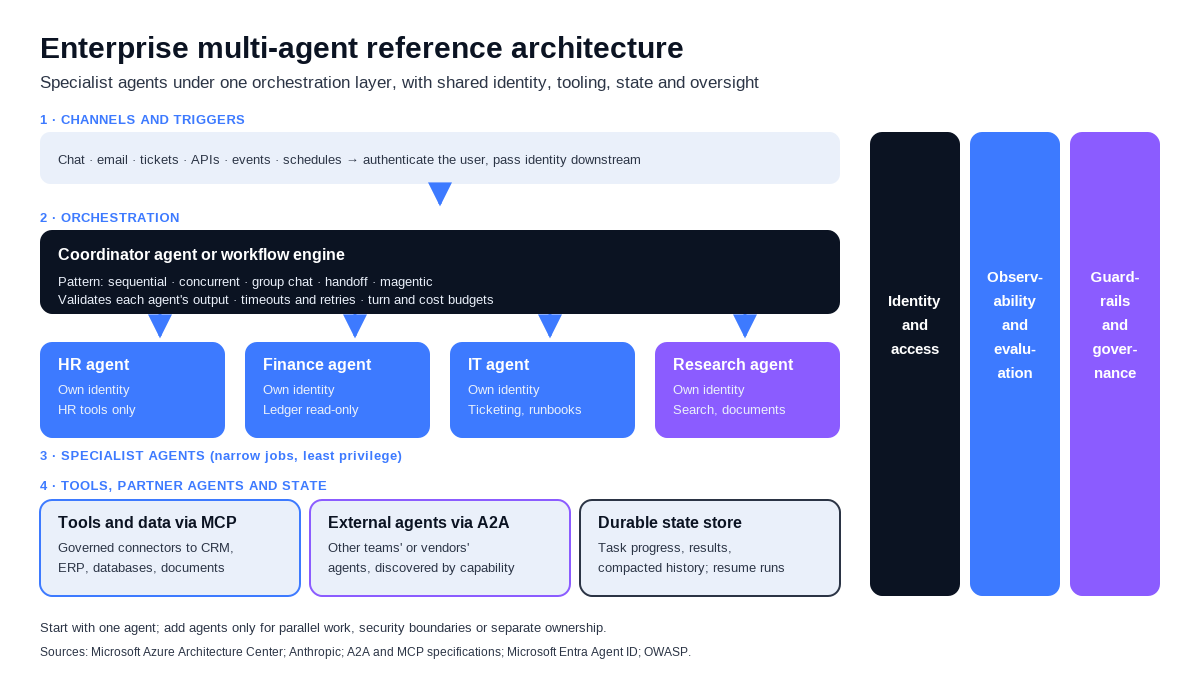
A production design has seven layers. The diagram shows how they fit together.
1. Channels and entry points
Users reach the system through chat, email, ticketing tools or APIs; events and schedules can also start work. This layer authenticates the user and passes their identity downstream, which matters later for data access.
2. Orchestration
The orchestrator decides which agents run, in what order and with what context. It can be deterministic code (a workflow engine) or a coordinator agent that plans dynamically. Anthropic's distinction applies: workflows follow "predefined code paths," while agents "dynamically direct their own processes" [7]. Many enterprise systems mix both: a fixed workflow for the regulated steps and an agent for open-ended research inside one step.
3. Specialist agents
Each agent gets a narrow job, its own instructions, its own tools and, ideally, its own identity. Microsoft lists "adding agents that don't provide meaningful specialization" as a common antipattern [1]. A useful test: if two agents share the same tools and data, they probably should be one agent.
4. Tools and data (MCP)
Agents reach enterprise systems through tools. The current MCP specification (version 2026-07-28, as of November 2026) describes the Model Context Protocol as "an open protocol that enables seamless integration between LLM applications and external data sources and tools" [6]. Standardizing on MCP lets platform teams publish a governed tool once and let many agents use it. See What Is Model Context Protocol (MCP)?.
5. Agent-to-agent communication (A2A)
Inside one application, agents can pass messages through the orchestrator. Across teams, vendors or frameworks, you need a protocol. A2A, at version 1.0.0 as of November 2026, is "an open standard designed to facilitate communication and interoperability between independent, potentially opaque AI agent systems" [5]. It lets agents discover each other's capabilities, negotiate formats and manage collaborative tasks [5]. Our guide to agent-to-agent communication compares A2A with in-app handoffs.
6. State and memory
Long-running, multi-step work needs durable state. Microsoft recommends persisting "task progress, intermediate results, and conversation history in a durable store" so agents can resume after interruptions, while scoping stored state "to the minimum necessary information" [1]. Context also grows quickly in multi-agent systems; monitor its size and compact it between agents [1].
7. Cross-cutting services
Identity, observability and governance span every layer. They are what make the difference between a prototype and an enterprise system, so they get their own sections below.
Choosing an orchestration pattern
Microsoft's Azure Architecture Center documents five orchestration patterns [1]:
Pattern | How it works [1] | Good enterprise fit | Watch out for |
|---|---|---|---|
Sequential | Agents in a fixed pipeline; each processes the previous output | Document processing, approvals, compliance checks | One weak step degrades everything after it |
Concurrent | Several agents work on the same task at once; results are aggregated | Multi-perspective review, research, risk assessment | Resource spikes; conflicting results |
Group chat | Agents discuss in a shared thread run by a chat manager | Quality gates, debate, review boards | Long, costly conversations |
Handoff | Each agent handles a task or transfers it to a better-suited agent | Customer support triage, IT service desks | Loops and lost context between handoffs |
Magentic | A manager agent builds and refines a task ledger for open-ended problems | Incident response, complex investigations | Hardest to predict, test and govern |
Pick the simplest pattern that fits. Microsoft warns against "using a complex pattern when basic sequential or concurrent orchestration would suffice" [1]. For how frameworks implement these patterns, see AI Agent Orchestration Frameworks Compared.
Identity and access: treat agents as identities
In an enterprise, every agent that touches data or systems is a non-human identity. Microsoft's guidance lists security measures for orchestrations, including authentication between agents, audit trails, least privilege for agents and orchestrators, and handling "the user's identity across agents" [1].
The last point is the trickiest. Agents often need broad access to knowledge stores to serve all users, "but they must not return data that's inaccessible to the user," so "security trimming must be implemented in every agent in the pattern" [1].
Identity vendors are building dedicated tooling. Microsoft Entra Agent ID, for example, extends Entra to AI agents, which Microsoft says need "purpose-built identity constructs to authenticate, authorize, govern, and protect these nonhuman identities." It brings together identity management, access protection, governance and compliance for agents, and as of November 2026 Microsoft says it is available for all Entra customers, while extending Entra security features to agents requires Microsoft Agent 365 [4]. Whatever you use, give each agent its own identity rather than a shared service account. See Identity and Access Management (IAM) Explained and Zero Trust Security Architecture.
Reliability: it is a distributed system
Multi-agent systems inherit "classical distributed systems problems such as node failures, network partitions, message loss, and cascading errors" [1]. Microsoft's recommended mitigations [1]:
- Timeouts and retries for every agent call.
- Graceful degradation when one agent fails.
- Surfacing errors instead of hiding them.
- Validating each agent's output before passing it on, since "low-confidence, malformed, or off-topic responses can cascade through a pipeline."
- Avoiding shared mutable state between concurrent agents.
Research also maps how these systems fail. A study of more than 1,600 annotated traces across seven popular multi-agent frameworks identified 14 failure modes in three categories: system design issues, inter-agent misalignment and task verification [3]. Its authors note that performance gains from multi-agent setups on popular benchmarks "are often minimal" [3].
Observability and evaluation
You cannot run what you cannot see. Microsoft recommends instrumenting "all agent operations and handoffs," tracking performance and resource use per agent, designing testable interfaces for individual agents and adding integration tests for whole workflows [1]. Because outputs are nondeterministic, it recommends scoring rubrics or model-as-judge evaluations "rather than exact-match assertions" [1].
In practice, that means a trace for every request showing each agent invoked, each tool call, tokens used and the final outcome, plus dashboards for cost per task and failure rates by agent. Our explainer on observability vs monitoring covers the underlying ideas.
Governance and security
Apply content guardrails "at multiple points in the orchestration, including user input, tool calls, tool responses, and final output," because intermediate agents can introduce or propagate harmful content [1]. Keep humans in the loop for consequential actions; several orchestration patterns support human participation directly [1].
Agentic systems also have their own threat catalog. OWASP published a Top 10 for Agentic Applications in December 2025, developed with more than 100 experts [8]. Map your architecture against it. For controls in depth, see AI Agent Security and Governance.
Cost control
Multi-agent orchestrations "multiply model invocations," and the pattern you choose drives cost [1]. Practical levers:
- Use smaller models for narrow agents and reserve frontier models for coordination or hard reasoning.
- Pass summaries, not full transcripts, between agents [1].
- Cap turns and budgets per agent and per task.
- Measure value per task. Given the 15x token multiplier Anthropic observed [2], confirm the business value justifies it.
A phased rollout plan
- Start with one agent on a well-scoped task and build evaluation and tracing from day one [1].
- Add a second agent only for a clear reason: a security boundary, a distinct team or parallelizable work [1][2].
- Introduce a deterministic workflow around agents for regulated steps [7].
- Standardize integration with MCP for tools and A2A for cross-team agents [5][6].
- Give every agent an identity with least-privilege access and audit logging [1][4].
- Expand autonomy gradually, based on measured reliability rather than demos.
Frequently asked questions
What is a multi-agent architecture?
A design in which several specialized AI agents, each with its own instructions and tools, work together under an orchestration layer to complete tasks too large or varied for one agent [1].
When should an enterprise use multiple agents instead of one?
When work splits into independent parallel threads, when security or ownership boundaries require separation, or when different teams own different capabilities. Otherwise, Microsoft recommends the simplest approach that works [1].
What is the difference between MCP and A2A?
MCP connects AI applications to tools and data sources [6]. A2A connects independent agents to each other so they can discover capabilities and collaborate on tasks [5]. Enterprise systems often use both.
How much more do multi-agent systems cost?
It varies, but Anthropic reported multi-agent systems used about 15 times more tokens than chat interactions in its data [2].
Why do multi-agent systems fail?
Research on more than 1,600 traces found failures cluster around system design, misalignment between agents and weak task verification [3]. Distributed-systems issues like timeouts and cascading errors add to that [1].
Sources
- Microsoft Azure Architecture Center, "AI agent orchestration patterns." https://learn.microsoft.com/en-us/azure/architecture/ai-ml/guide/ai-agent-design-patterns
- Anthropic, "How we built our multi-agent research system." https://www.anthropic.com/engineering/multi-agent-research-system
- Cemri et al., "Why Do Multi-Agent LLM Systems Fail?" arXiv:2503.13657. https://arxiv.org/abs/2503.13657
- Microsoft Learn, "What is Microsoft Entra Agent ID?" https://learn.microsoft.com/en-us/entra/agent-id/what-is-microsoft-entra-agent-id
- A2A Project, "Agent2Agent (A2A) Protocol Specification" (version 1.0.0). https://a2a-protocol.org/latest/specification/
- Model Context Protocol, "Specification (2026-07-28)." https://modelcontextprotocol.io/specification/2026-07-28
- Anthropic, "Building effective agents." https://www.anthropic.com/engineering/building-effective-agents
- OWASP GenAI Security Project, "OWASP Top 10 for Agentic Applications for 2026" (December 9, 2025). https://genai.owasp.org/resource/owasp-top-10-for-agentic-applications-for-2026/