Zero Trust Security Architecture
What Zero Trust architecture means under NIST SP 800-207: the seven tenets, the policy engine, administrator and enforcement point, and how to adopt it.
Zero Trust is a security model that refuses to trust any user, device or connection just because of where it sits on the network. Under NIST's definition, every request to an enterprise resource is authenticated and authorized, per session, against a dynamic policy, before access is granted [1][2]. A Zero Trust architecture (ZTA) is the set of components and workflows that makes that happen: a policy decision point that decides, and policy enforcement points that carry out the decision in front of each resource.
Why the old perimeter model broke
Traditional network security worked like a castle with a moat. Firewalls guarded the edge, and anything inside the corporate network was largely trusted. NIST's SP 800-207, published in August 2020 by Scott Rose, Oliver Borchert, Stu Mitchell and Sean Connelly, explains why that stopped working: remote users, bring-your-own-device and cloud-based assets that aren't inside an enterprise-owned boundary [1].
NIST uses an airport to explain the problem [2]. Passengers pass through one security checkpoint, then move freely around the terminal, where everyone is treated as trusted. That terminal is an "implicit trust zone." The checkpoint can't apply any further rules to people already past it. An attacker who gets through once, with a stolen password or an infected laptop, inherits that trust.
Zero Trust's answer is to shrink the implicit trust zone as close to zero as possible by "moving the PDP/PEPs closer to the resource" [2]. Instead of one checkpoint at the terminal entrance, every gate checks every boarding pass, every time.
The seven tenets of Zero Trust
NIST defines Zero Trust through seven basic tenets. It openly acknowledges these are "the ideal goal" and that not every tenet may be fully achievable in its purest form [2]. Paraphrased:
- Everything is a resource. All data sources and computing services count, including SaaS, small sensors and, if the enterprise chooses, personal devices that access enterprise resources.
- All communication is secured regardless of network location. A request from inside the corporate network must meet the same requirements as one from a coffee shop. Network location alone doesn't imply trust.
- Access is granted per session. Trust is evaluated before access, with least privilege, and access to one resource doesn't automatically grant access to another.
- Access is decided by dynamic policy. Inputs include the identity of the client, the application, the state of the requesting device and, potentially, behavioral and environmental attributes such as time, location or reported active attacks.
- The enterprise monitors the integrity and security posture of all assets. No asset is inherently trusted. Unpatched, compromised or unmanaged devices may be treated differently, up to being denied entirely.
- Authentication and authorization are dynamic and strictly enforced before access. NIST expects identity, credential and access management (ICAM), multifactor authentication (MFA) for some or all resources, and continual monitoring with possible reauthentication during a session.
- The enterprise collects as much information as possible about assets, network traffic and access requests, and uses it to improve policy.
NIST also notes that these tenets apply to an organization's own workforce and partners, not to anonymous public or consumer-facing services, because an organization can't impose internal policies on the general public [2].
The logical components: PDP and PEP
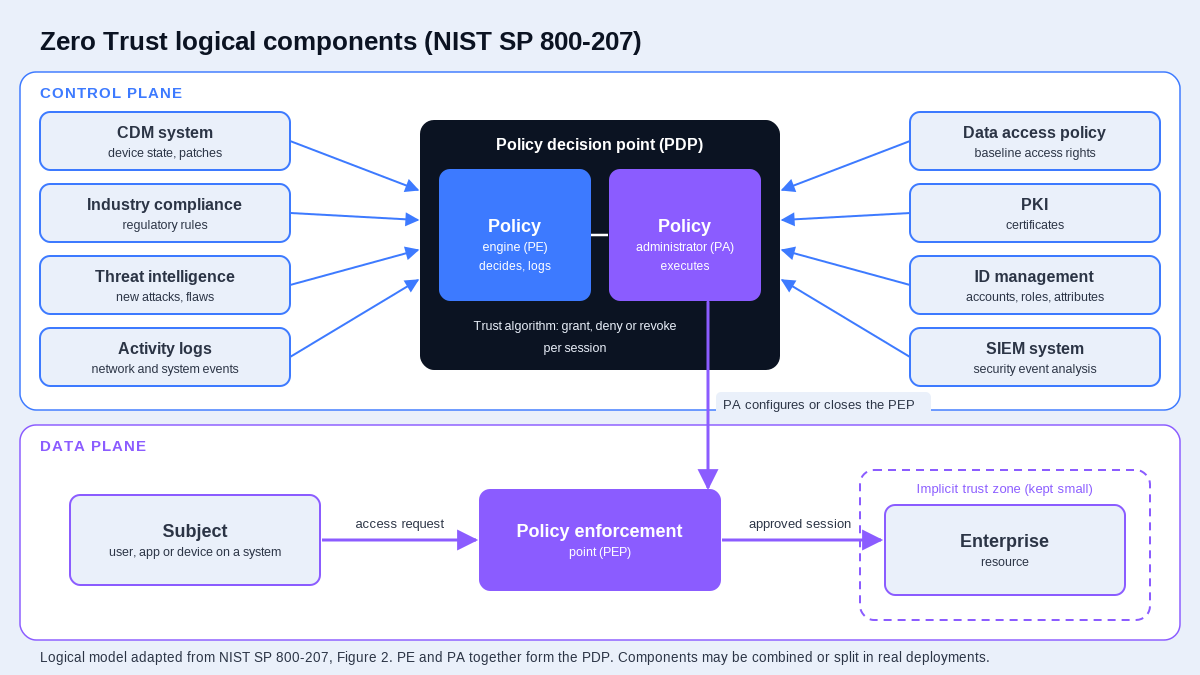
At the heart of SP 800-207 is a simple model. A subject (a user, or an application or device acting on someone's behalf) wants to reach a resource. Access goes through a policy decision point (PDP) and a matching policy enforcement point (PEP) [2].
NIST then splits the PDP into two logical components [2]:
Policy engine (PE)
The policy engine makes "the ultimate decision to grant access to a resource for a given subject" [2]. It feeds enterprise policy plus external inputs into a trust algorithm and decides to grant, deny or revoke access. It also logs each decision.
Policy administrator (PA)
The policy administrator executes the engine's decision. It establishes or shuts down the communication path between subject and resource by sending commands to the relevant PEPs, and it generates any session-specific authentication token or credential [2]. If a session is approved, the PA configures the PEP to let it start; if approval is later withdrawn, the PA tells the PEP to cut the connection. Some products combine the PE and PA into one service, but NIST treats them as two logical roles [2].
Policy enforcement point (PEP)
The PEP enables, monitors and eventually terminates connections between a subject and a resource [2]. NIST notes it may be one component or split into two: a client side (such as an agent on a laptop) and a resource side (such as a gateway in front of an application), or a single portal that acts as gatekeeper. Beyond the PEP sits the small trust zone that hosts the resource.
Control plane and data plane
The ZTA components talk to each other over a separate control plane, while application data flows on a data plane [2]. The PA instructs the PEP over the control plane; the user's actual traffic passes through the PEP on the data plane. Keeping these separate is what lets an organization change policy in real time without touching application traffic paths.
The data sources behind each decision
The policy engine doesn't decide in a vacuum. NIST lists the inputs that feed it [2]:
Data source | What it tells the policy engine |
|---|---|
Continuous diagnostics and mitigation (CDM) | Device state: patch level, approved software, known vulnerabilities |
Industry compliance system | Rules required by regulations such as FISMA or sector requirements |
Threat intelligence feeds | Newly discovered attacks, vulnerabilities and malware |
Network and system activity logs | Near-real-time view of security posture |
Data access policies | Baseline access rights for accounts and applications |
Enterprise PKI | Certificates issued to resources, subjects and services |
ID management system | User accounts, roles, attributes and assigned assets |
SIEM | Security events used to refine policy and warn of attacks |
Three ways to build it
NIST describes three main approaches. Each implements all the tenets but leans on a different component as the main policy driver, and NIST says "a full ZT solution will include elements of all three" [2].
Approach | Main policy driver | Typical PEP | Good fit |
|---|---|---|---|
Enhanced identity governance | Identity and assigned attributes | Resource or portal that checks identity | Open networks, visitors, SaaS-heavy organizations |
Micro-segmentation | Placement of resources in protected segments | Next-generation firewalls, smart switches, host agents | Data centers, server-to-server traffic |
Network infrastructure and software-defined perimeter | Network overlay controlled by the PA | Agent plus gateway forming a secure channel | Remote access, cloud virtual networks |
NIST flags a downside of the identity-led approach: if basic network connectivity is granted to everyone, attackers can still attempt reconnaissance or denial-of-service attacks, so monitoring is still required [2]. For micro-segmentation, it warns that using static, unmanaged gateways is technically possible but "a very poor choice" because of the administration cost and slow adaptation [2].
NIST also describes four deployment patterns for placing PEPs: device agent and gateway, enclave-based gateways, a resource portal, and device application sandboxing [2].
Zero Trust in U.S. policy
Zero Trust became federal policy in the United States after Executive Order 14028 in May 2021. The Office of Management and Budget's memorandum M-22-09, dated January 26, 2022, set a federal Zero Trust strategy and required agencies to meet specific goals by the end of fiscal year 2024 [3].
M-22-09 organizes those goals around the five pillars of CISA's Zero Trust Maturity Model: Identity, Devices, Networks, Applications and Workloads, and Data, with three cross-cutting themes: Visibility and Analytics, Automation and Orchestration, and Governance [3]. Its practical demands are concrete. Agency staff, contractors and partners must use phishing-resistant MFA, and agencies must encrypt DNS requests and HTTP traffic within their environments [3]. It also states that "users should log into applications, rather than networks" [3].
As of November 2026, CISA's maturity model is at version 2.0 and describes four maturity stages: Traditional, Initial, Advanced and Optimal [4]. Private companies aren't bound by M-22-09, but the CISA model is a free, public yardstick for measuring progress.
Zero Trust versus a traditional VPN
Perimeter plus VPN | Zero Trust | |
|---|---|---|
Unit of access | The network | An individual resource, per session |
Trust basis | Being on the inside | Identity, device posture and context, checked every time |
After login | Broad lateral reach | Only the resources policy allows |
Device health | Often not checked | A core input to the decision |
Changes mid-session | Rare | Policy can revoke access during a session |
The table reflects SP 800-207's tenets [2]. A VPN can still be part of a Zero Trust design as a secure transport, but it stops being the thing that grants trust.
Real-world relevance
- Ransomware defense. The joint CISA, FBI, NSA and MS-ISAC #StopRansomware Guide lists implementing a Zero Trust architecture among its recommended practices, alongside network segmentation and least privilege [5]. Limiting what a stolen account can reach is exactly what slows an intrusion down. Our explainer on how ransomware attacks work covers the full chain.
- Cloud and SaaS. NIST notes that the identity-led approach suits organizations that use cloud services where they can't install their own security components, such as many SaaS offerings [2]. See our guide to cloud computing for how responsibility splits between provider and customer.
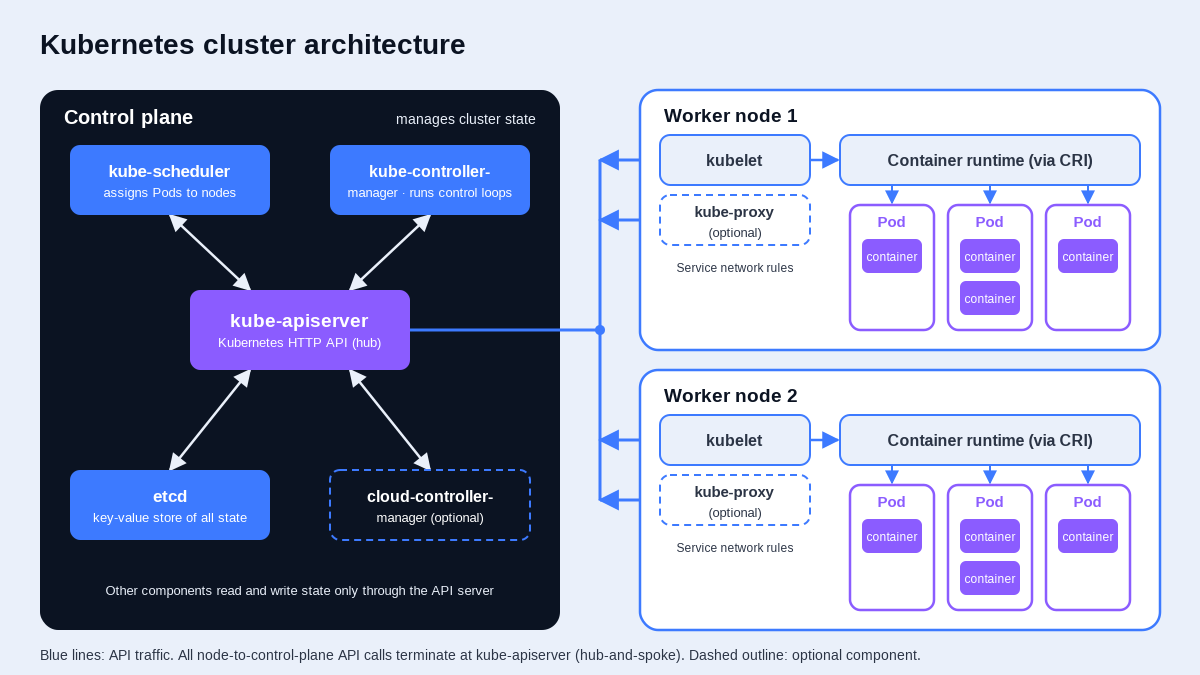
- Container platforms. The same principles show up inside infrastructure. Kubernetes, for instance, routes all node API traffic through one API server that should require authentication and authorization, and its docs warn against trusting some internal connections over untrusted networks without certificate verification [6]. Our Kubernetes architecture explainer goes deeper.
Benefits
- Smaller blast radius. A compromised account or device should only reach what it was already allowed to reach [2].
- Consistent rules wherever users are. Office, home and cloud get the same policy, because location no longer grants trust.
- Better visibility. Tenet 7's data collection turns access decisions into a continuous source of security telemetry [2].
- Real-time response. Because the PA can tell a PEP to cut a session, new threat intelligence can change access while it's happening [2].
Limitations and risks
NIST is unusually candid about the weaknesses [2]:
- The decision point becomes the crown jewel. A misconfigured or compromised PE or PA could disrupt operations or grant access that shouldn't exist. NIST says configuration changes must be logged and audited.
- Availability. If attackers disrupt PEPs or the PE/PA, legitimate users can't reach resources either.
- Stolen credentials still work, within limits. MFA reduces the risk, but an attacker holding a valid account and device can still reach whatever that account is entitled to. Zero Trust limits the reach; it doesn't make credential theft harmless.
- Visibility gaps. Some, possibly most, traffic may be opaque to network analysis tools, for example encrypted traffic or traffic from assets the enterprise doesn't own.
- Vendor lock-in. Reliance on proprietary data formats or products can make components hard to swap.
- Migration takes years. NIST says it is unlikely any significant enterprise can migrate "in a single technology refresh cycle," and that ZTA and perimeter-based workflows may coexist indefinitely [2].
How to start
NIST's own migration steps are a good practical sequence [2]:
- Identify actors. Know your users, service accounts and their privileges.
- Identify assets. Build an inventory of devices, physical and virtual, including the ones you don't own but that touch your resources.
- Identify key processes and risks. Pick business workflows and rank them by risk.
- Write policies for a first candidate workflow.
- Choose candidate solutions that fit your existing identity, device management and logging systems.
- Deploy and monitor. NIST suggests running a new workflow in a reporting-only mode for a while, still enforcing basics such as denying requests that fail MFA, so you can learn normal behavior before tightening policy.
- Expand workflow by workflow.
If you only do one thing this quarter, follow M-22-09's lead: move your workforce to phishing-resistant MFA and consolidate identity systems so the same protections apply everywhere [3].
Outlook
Zero Trust has shifted from a buzzword to a published standard backed by federal deadlines. Our expectation, extrapolated from NIST's own tenets rather than any official forecast, is more automation: richer device and behavioral signals feeding the policy engine, and access decisions that update continuously. The constraint, as NIST makes clear, is organizational rather than technical: knowing your assets, users and workflows well enough to write good policy [2].
Frequently asked questions
Is Zero Trust a product I can buy?
No. NIST defines Zero Trust as a set of principles and an architecture made of logical components [1][2]. Products can serve as a policy engine, policy administrator or enforcement point, but no single purchase delivers the whole model.
What is the difference between a PDP and a PEP?
The policy decision point decides whether a subject may access a resource; NIST splits it into the policy engine, which decides, and the policy administrator, which carries out the decision. The policy enforcement point sits in the traffic path and opens, monitors and closes the actual connection [2].
Does Zero Trust mean users must log in constantly?
Not necessarily. NIST describes continual monitoring with possible reauthentication triggered by policy, for example after a time limit, a request for a new resource or anomalous activity [2]. Well-designed systems use device and context signals so most checks are invisible to the user.
Do private companies have to adopt Zero Trust?
As of November 2026, M-22-09's requirements apply to U.S. federal agencies, not private companies [3]. Many private organizations still use NIST SP 800-207 and CISA's maturity model as voluntary guidance [1][4].
Does Zero Trust replace firewalls?
No. Firewalls and gateways often become policy enforcement points, especially in the micro-segmentation approach [2]. What changes is that they enforce per-session decisions from a policy engine instead of trusting everything inside a perimeter.
How long does a Zero Trust migration take?
There's no standard timeline. NIST says significant enterprises are unlikely to migrate in a single technology refresh cycle and may run hybrid Zero Trust and perimeter workflows indefinitely [2].
Sources
- NIST, "SP 800-207, Zero Trust Architecture," August 2020. https://csrc.nist.gov/pubs/sp/800/207/final
- NIST, SP 800-207 full text (PDF). https://nvlpubs.nist.gov/nistpubs/SpecialPublications/NIST.SP.800-207.pdf
- Office of Management and Budget, "M-22-09, Moving the U.S. Government Toward Zero Trust Cybersecurity Principles," January 26, 2022. https://www.whitehouse.gov/wp-content/uploads/2022/01/M-22-09.pdf
- CISA, "Zero Trust Maturity Model." https://www.cisa.gov/zero-trust-maturity-model
- CISA, FBI, NSA and MS-ISAC, "#StopRansomware Guide," October 2023. https://www.cisa.gov/stopransomware/ransomware-guide
- The Kubernetes Authors, "Communication between Nodes and the Control Plane." https://kubernetes.io/docs/concepts/architecture/control-plane-node-communication/