

Neuromorphic Computing Explained: Brain-Inspired Chips
How neuromorphic chips use spiking neurons, event-driven processing and memory next to compute, what Loihi 2, NorthPole and SpiNNaker 2 show, and the limits.
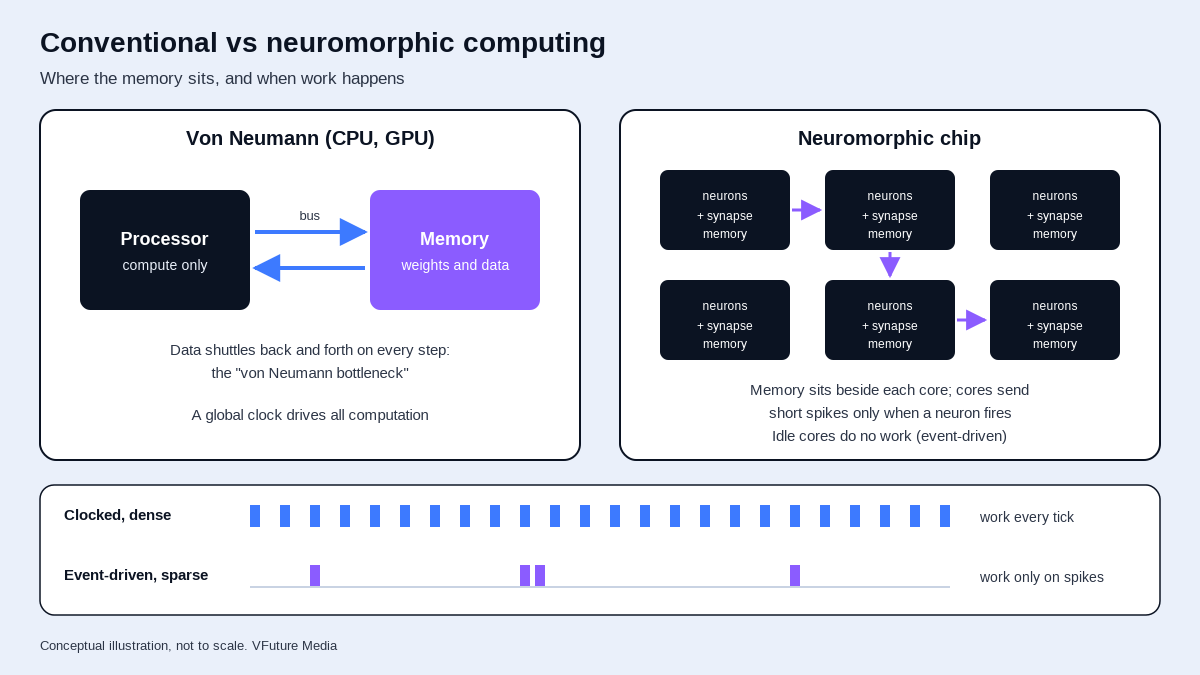
Neuromorphic computing is an approach to chip design that borrows principles from the brain. Instead of a processor fetching data from separate memory on every clock tick, neuromorphic chips spread many small cores across the chip, keep memory right next to the compute, and have artificial neurons communicate through brief "spikes" sent only when something changes. The aim is to run certain AI and sensing tasks with far less energy. As of November 2026, the largest systems are research machines, not mainstream products.
The problem it tries to solve
Almost every computer today follows the von Neumann design: a processor and a separate memory, connected by a bus. IBM describes the resulting von Neumann bottleneck: it takes time and energy to keep shuffling data back and forth between memory and processing [2]. For AI, which moves enormous numbers of model weights, that data movement can cost more energy than the arithmetic itself.
The brain works differently. Neurons store their connections (synapses) locally, work in parallel, and are mostly quiet, firing only when their input crosses a threshold. Neuromorphic engineers try to capture some of those properties in silicon. Intel's description of the approach: integrate memory and computing with highly granular parallelism to minimize data movement [1].
How neuromorphic chips work
Spiking neurons
Most neuromorphic chips run spiking neural networks (SNNs). A spiking neuron accumulates input over time and emits a spike, a short event, when it crosses a threshold. Information is carried in whether and when spikes happen, not in a continuous stream of numbers.
That contrasts with the artificial neural networks behind today's AI (see machine learning vs deep learning vs AI), where every neuron in a layer computes a value on every pass.
Event-driven and asynchronous
Because neurons only communicate when they spike, a neuromorphic chip does work only when something happens. Intel describes its Loihi 2 processors as using asynchronous, event-based spiking neural networks, integrated memory and computing, and sparse, continuously changing connections, with neurons communicating directly rather than through memory [1]. If the input is a mostly static camera scene, most of the chip stays idle.
Memory beside compute
Each core holds the state of its neurons and the weights of their synapses locally. There's no trip to external memory for every operation, which is where much of the claimed energy saving comes from [1][2].
The landmark systems
System | Organization | What it is | Key published facts |
|---|---|---|---|
Loihi 2 / Hala Point | Intel, deployed at Sandia National Laboratories | Spiking neuromorphic research system | 1,152 Loihi 2 chips, up to 1.15 billion neurons and 128 billion synapses, maximum 2,600 W [1] |
SpiNNaker 2 / NERL Braunfels | SpiNNcloud, at Sandia | Mesh of Arm cores with acceleration for spiking and deep networks | 24 boards of 48 chips, able to model 175 million neurons [3] |
NorthPole | IBM Research | Brain-inspired inference chip with memory interleaved with compute | 12 nm, 22 billion transistors, 256 cores [2] |
Intel Hala Point. Announced in April 2024 and initially deployed at Sandia, Hala Point packs 1,152 Loihi 2 processors into a chassis Intel compares to the size of a microwave oven, with 140,544 neuromorphic cores [1]. Intel calls it a research prototype [1]. The company claims that Loihi-based systems can perform AI inference and solve optimization problems using 100 times less energy at speeds as much as 50 times faster than conventional CPU and GPU architectures, citing its own published research [1]. Those are Intel's figures.
SpiNNaker 2. SpiNNaker stands for Spiking Neural Network Architecture. It builds a large mesh out of low-power Arm cores, and SpiNNaker 2 adds acceleration for both spiking and conventional deep networks [3]. Sandia received a three-frame system, NERL Braunfels, in early 2025 [3].
IBM NorthPole. NorthPole, described in Science in October 2023, takes a different route. IBM describes it as a digital AI inference chip that runs conventional neural networks, borrowing the brain's idea of putting memory and compute together [2]. IBM says NorthPole beat other chips on energy efficiency, space efficiency and latency on the ResNet-50 and YOLOv4 vision models in its tests, and is roughly 4,000 times faster than IBM's earlier TrueNorth chip [2]. IBM is clear that it is not a jack of all trades: it is built for inference on models that fit in its on-chip memory [2].
What neuromorphic computing is good for
- Always-on sensing at the edge. Event-driven chips suit inputs that change sparsely over time, such as audio, vibration or event cameras. Intel's Hala Point announcement highlights processing without batching, which matters for real-time inputs like camera video [1].
- Optimization problems, which Intel cites as one of Loihi's strongest areas [1].
- Scientific simulation. Sandia reports fitting a fruit-fly brain map (connectome) of about 140,000 neurons and 50 million synapses, onto 12 Loihi 2 chips, running more than 100 times faster than numerical simulation on conventional hardware [3]. Sandia is also exploring numerical methods such as random-walk simulations on SpiNNaker 2 [3].
- Low-latency inference for fixed vision models, as in IBM's NorthPole results [2].
Limitations and open problems
- No agreed benchmarks. A 2025 community paper in Nature Communications says the field lacks standardized benchmarks, which makes it hard to measure progress or compare with conventional methods [4]. Its NeuroBench framework is an attempt to fix that [4]. Until results are reported on common benchmarks, treat efficiency multipliers with caution.
- No formal definition. The same paper lists the lack of a formal definition as a challenge: the variety of brain-inspired approaches makes it hard to agree on criteria for what should be benchmarked [4].
- Software and training. A 2022 review in Nature Computational Science notes that much of the work in the field has focused on hardware, and discusses opportunities to develop algorithms and applications for these systems [5]. Spiking networks are harder to train than standard deep networks, and developer tools are far less mature than the GPU ecosystem.
- Fit with today's AI. Large language models are dense, memory-hungry and built for GPUs. IBM says it is exploring mapping decoder-only LLMs onto NorthPole systems [2], but neuromorphic chips haven't displaced GPUs for mainstream AI.
- Research status. Hala Point is a research prototype [1], and the largest systems described here are research machines.
Neuromorphic vs GPUs vs other AI chips
GPU | Neuromorphic chip | |
|---|---|---|
Computation | Dense, clocked, batch-friendly | Sparse, event-driven, often asynchronous |
Memory | Separate high-bandwidth memory | Distributed beside each core |
Best at | Training and running large dense models | Sparse, real-time, low-power workloads |
Software maturity | Very mature | Early |
For a wider view of AI hardware, see our AI chips vs CPUs vs GPUs vs TPUs guide and the upcoming GPU architecture explainer.
Outlook
Energy is the strongest argument for neuromorphic research. As AI's power demand grows (see our upcoming explainer on AI data centers and energy), the industry is looking hard at anything that reduces data movement. Expect brain-inspired ideas, especially memory placed next to compute, to keep spreading into mainstream chips even if fully spiking systems remain specialized. Intel, for its part, says it hopes lessons from Hala Point lead to practical advances such as LLMs that learn continuously from new data [1]. That's a stated research goal, not a product plan. Broader adoption probably depends on two things: common benchmarks [4] and software that makes these chips easy to program.
Frequently asked questions
What is neuromorphic computing in simple terms?
Chip design inspired by the brain. Many small cores hold their own memory and communicate through brief spikes only when something changes, rather than a central processor constantly fetching data from separate memory [1][2].
What is a spiking neural network?
A neural network in which neurons accumulate input and fire discrete spikes when a threshold is crossed. Information is carried by the presence and timing of spikes, which lets hardware stay idle when nothing is happening.
Is neuromorphic computing used today?
Mostly in research. Systems like Intel's Hala Point and SpiNNaker 2 machines run at Sandia National Laboratories for scientific and AI research [1][3]. The largest systems described here are research machines rather than mainstream commercial products (as of November 2026).
Is neuromorphic computing more energy efficient than GPUs?
For some sparse, real-time workloads, companies report large gains. Intel, for example, claims up to 100 times less energy for certain tasks [1]. But the field lacks standard benchmarks for fair comparisons [4], and GPUs remain far better for training and running large dense models.
What is the von Neumann bottleneck?
The time and energy cost of constantly moving data between a processor and separate memory in conventional computers [2]. Neuromorphic chips reduce it by placing memory next to the compute.
Is IBM's NorthPole a neuromorphic chip?
It's brain-inspired, since it interleaves memory and compute, but IBM presents it as a digital inference chip for conventional neural networks such as ResNet-50 and YOLOv4 rather than as a spiking system. IBM describes it as an extension of its earlier TrueNorth work, aimed at efficient inference [2].
Sources
- Intel, "Intel Builds World's Largest Neuromorphic System to Enable More Sustainable AI," press release, April 17, 2024 (company's own claims). https://www.intc.com/news-events/press-releases/detail/1691/intel-builds-worlds-largest-neuromorphic-system-to
- IBM Research, "IBM Research's new NorthPole AI chip," October 19, 2023 (company's own claims). https://research.ibm.com/blog/northpole-ibm-ai-chip
- Sandia National Laboratories, "Advancing neuromorphic computing at the Neural Exploration and Research Lab," HPC annual report. https://www.sandia.gov/news/publications/hpc-annual-reports/article/advancing-neuromorphic-computing-at-the-neural-exploration-and-research-lab/
- Jason Yik et al., "The neurobench framework for benchmarking neuromorphic computing algorithms and systems," Nature Communications, February 11, 2025. https://www.nature.com/articles/s41467-025-56739-4
- Catherine D. Schuman et al., "Opportunities for neuromorphic computing algorithms and applications," Nature Computational Science, January 31, 2022. https://www.nature.com/articles/s43588-021-00184-y
