SIEM Explained: How Security Information and Event Management Works
How a SIEM collects, normalizes and correlates logs, how detection rules and retention work, what it costs to run, and how to pick logs and a platform.
A SIEM (security information and event management) system collects logs and security events from across an organization, normalizes them into a common format, correlates them to spot attacks, and keeps them for investigation and compliance. NIST's short definition is a program that provides centralized logging for many log types [1]. In practice, a SIEM is the place where a security team searches "what happened, where, and when" across every system at once.
If you're deciding between SIEM, EDR and XDR, start with our XDR vs EDR vs SIEM comparison. This article goes deeper on SIEM itself: how the pipeline works, which logs matter, and what drives cost.
The SIEM pipeline, step by step
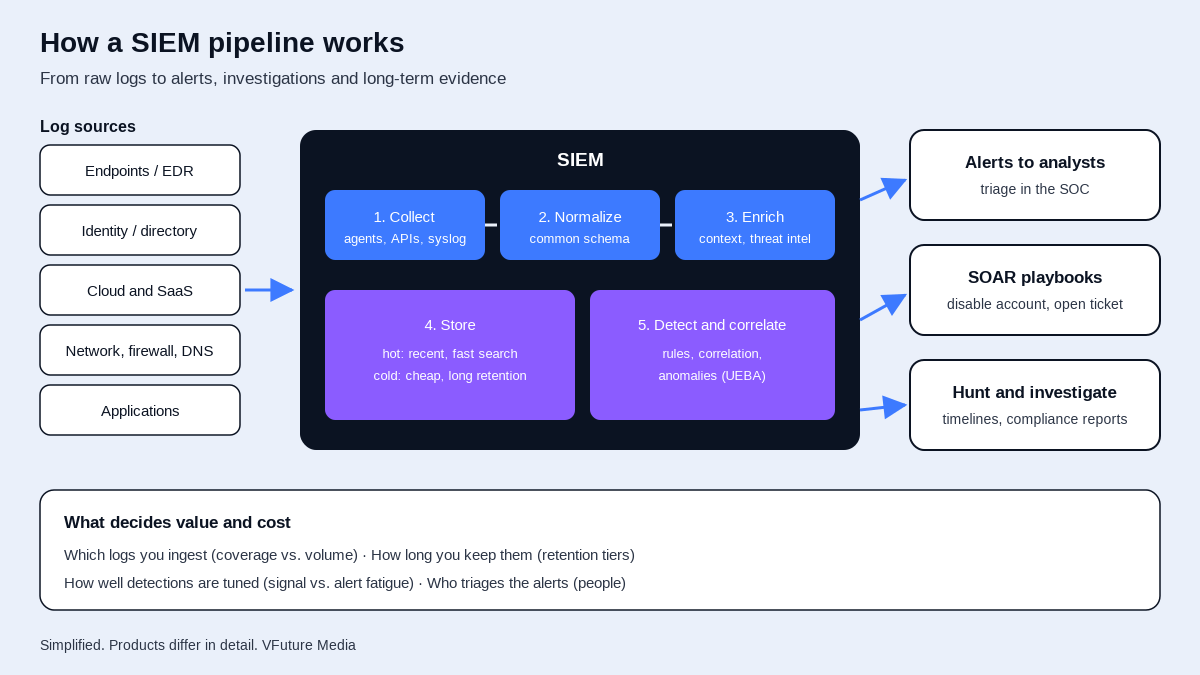
Every SIEM, whether it runs on premises or as a cloud service, moves data through roughly the same stages (see the diagram).
1. Collect. Agents, APIs, syslog and cloud connectors pull events from endpoints, identity providers, cloud platforms, firewalls and applications. NIST's log-management guide covers building this kind of log management infrastructure across an enterprise [2], and its draft update defines log management as generating, transmitting, storing, accessing and disposing of log data [3].
2. Parse and normalize. Every product logs differently. One firewall calls it src_ip, another SourceAddress. The SIEM parses each format and maps fields to a common schema, so one query works across sources. Open schemas such as OCSF (Open Cybersecurity Schema Framework) aim to make this vendor-agnostic [6].
3. Enrich. Events gain context: which user owns this laptop, is this server critical, does this IP address appear in threat intelligence?
4. Store. Recent data sits in fast, searchable "hot" storage. Older data moves to cheaper cold or archive storage.
5. Detect and correlate. Rules run against incoming data. A single failed login means little. Fifty failed logins followed by a success from a new country, then a mailbox forwarding rule, is a pattern. Correlation links those events into one alert.
6. Triage and respond. Analysts in the security operations center investigate alerts. Many teams pair the SIEM with SOAR (security orchestration, automation and response), which runs playbooks such as disabling an account or opening a ticket. Microsoft Sentinel, for example, builds its playbooks on Azure Logic Apps workflows [9].
7. Hunt, investigate and report. Stored data supports proactive threat hunting, forensic timelines after an incident, and compliance reports.
Which logs matter most
The hardest SIEM decision isn't the product. It's what to send to it. Ingesting everything is expensive and noisy; ingesting too little leaves blind spots.
CISA and Australia's ACSC addressed this directly in May 2025. Their SIEM and SOAR guidance includes a separate practitioner document, "Priority Logs for SIEM Ingestion," on deciding which data sources to collect first [4]. Common high-value sources include:
Source | What it reveals | Example detection |
|---|---|---|
Identity provider and directory | Sign-ins, MFA events, privilege changes | Impossible travel, new admin role assigned |
EDR and endpoint logs | Processes, scripts, persistence | Credential-dumping tool launched |
Cloud control plane | API calls, configuration changes | Logging disabled, new access key created |
Email and collaboration | Phishing, forwarding rules | Inbox rule forwarding mail externally |
Firewalls, VPN, DNS | Connections in and out | Traffic to a known command-and-control domain |
Business applications | Data access and export | Bulk download of customer records |
A practical test: for each attack technique you care about, can you name the log that would show it? MITRE ATT&CK, a knowledge base of adversary tactics and techniques based on real-world observations [8], is the usual map for that exercise.
Detection rules and correlation
Detections are the SIEM's brain, and writing them has become its own discipline, often called detection engineering.
- Rules match specific conditions, such as a known malicious process name.
- Correlation rules link several events across sources and time windows.
- Anomaly detection (often called UEBA, user and entity behavior analytics) flags departures from a baseline, such as a user suddenly accessing systems they never touch.
- Threat intelligence matching compares events against lists of known-bad indicators.
Rules don't have to be written from scratch. Sigma is an open, generic signature format for describing log events, and its public repository holds community detection rules that can be converted to many SIEM query languages [7]. Good teams treat detections like code: version them, test them against sample attacks, measure false positives and retire rules that never fire.
For how AI is changing triage and detection, see our upcoming AI-powered cybersecurity explainer.
Retention: how long to keep logs
Retention depends on regulation, contracts and your own investigation needs. Attackers can sit in a network for months before anyone notices, so short retention can mean the evidence is gone by the time you look.
For US federal agencies, OMB memo M-21-31 (August 2021) set a logging maturity model from EL0 (not effective) to EL3 (advanced) [5]. For many log categories it requires 12 months in active storage and a further 18 months in cold storage [5]. Agencies were told to reach EL1 within one year and EL3 within two [5]. Private companies aren't bound by the memo, but it's a widely cited benchmark.
NIST is also updating its guidance. SP 800-92 Rev. 1, a "Cybersecurity Log Management Planning Guide," was released as an initial public draft in October 2023 [3]. As of November 2026, NIST's site still lists it as a draft, so the 2006 SP 800-92 remains the final version [2][3].
What drives SIEM cost
We won't quote prices, because they vary widely and change often. The cost drivers are consistent, though:
- Data volume. Many SIEMs charge by data ingested or stored. Verbose sources such as DNS, firewall and cloud flow logs can dominate.
- Retention. Keeping a year or more of searchable data multiplies storage costs.
- People. Someone has to onboard sources, tune detections and triage alerts. That's usually the largest long-run cost.
- Architecture. Many organizations now route logs through a pipeline or security data lake and send only high-value data into the SIEM, keeping the rest in cheaper storage for occasional search.
Benefits
- One place to search across every system during an incident.
- Cross-source correlation that no single tool can do alone.
- Compliance evidence and audit trails, with defined retention.
- Visibility into systems without agents, such as network devices, SaaS apps and legacy systems that only emit logs.
Limitations and risks
- Garbage in, garbage out. Missing, misparsed or unsynchronized logs break detections quietly.
- Alert fatigue. Untuned rules flood analysts, and real attacks get missed in the noise.
- Cost creep. Data volumes grow faster than budgets.
- Not a response tool on its own. A SIEM tells you something happened; acting on endpoints needs EDR or SOAR. Our upcoming EDR explainer covers that side.
- Logs can be tampered with. Attackers often try to disable logging. Forward logs off the host quickly and alert when a source goes silent.
How to choose a SIEM
- Where is your data? If most of it lives in one cloud or productivity suite, that vendor's SIEM may ingest it more cheaply and easily. Check real connector coverage for your other sources.
- Query language and skills. Analysts will live in it. Try your own investigations during a trial.
- Detection content. How much is built in, how is it mapped to ATT&CK, and can you import Sigma rules?
- Scale and pricing model. Model a year of your actual log volume, including growth.
- Retention options. Is there a cheaper tier for long-term data, and can you still search it?
- SOAR and case management. Built in, or a separate product?
- Managed option. If you can't staff a 24/7 SOC, a managed detection and response service running the SIEM may be more realistic.
Outlook
SIEM is splitting into layers: open schemas and data pipelines underneath, cheaper data-lake storage, and detection and response on top, increasingly merged with XDR. Vendors are also adding AI assistants for writing queries and summarizing incidents. These promise faster triage, but their accuracy should be tested on your own data. The fundamentals CISA and NIST stress, collecting the right logs and keeping them for as long as you need them [3][4], won't change.
Frequently asked questions
What does a SIEM actually do?
It centralizes logs from many systems, normalizes them, runs detection and correlation rules, raises alerts, and stores data for investigations and compliance [1][2].
What is the difference between SIEM and SOAR?
A SIEM detects and stores. SOAR automates the response, running playbooks automatically when an alert or incident fires, for example opening a ticket in a ticketing system [4][9]. Many platforms now bundle both.
How long should SIEM logs be kept?
It depends on your regulatory and contract obligations. US federal agencies follow OMB M-21-31, which for many log types means 12 months of active storage plus 18 months of cold storage [5].
Is a SIEM still needed if I have XDR?
Often, yes. XDR mainly correlates data from its own vendor's security tools, while a SIEM ingests logs from almost anything, including custom apps and legacy systems, and handles long retention. Our XDR vs EDR vs SIEM guide covers when each fits.
What is a SIEM correlation rule?
A rule that links several events, often from different sources, into one alert. An example is a burst of failed logins followed by a successful one and then a new mailbox forwarding rule for the same user.
What is Sigma?
An open, generic format for writing detection rules about log events, designed to be shared and converted into different SIEM query languages [7].
Sources
- NIST, Computer Security Resource Center Glossary, "Security Information and Event Management (SIEM)." https://csrc.nist.gov/glossary/term/security_information_and_event_management
- Karen Kent and Murugiah Souppaya, NIST, "SP 800-92, Guide to Computer Security Log Management," September 2006. https://csrc.nist.gov/pubs/sp/800/92/final
- NIST, "SP 800-92 Rev. 1 (Initial Public Draft), Cybersecurity Log Management Planning Guide," October 11, 2023. https://csrc.nist.gov/pubs/sp/800/92/r1/ipd
- CISA, with the Australian Signals Directorate's ACSC and partners, "Guidance for SIEM and SOAR Implementation," May 27, 2025. https://www.cisa.gov/resources-tools/resources/guidance-siem-and-soar-implementation
- Office of Management and Budget, "M-21-31, Improving the Federal Government's Investigative and Remediation Capabilities Related to Cybersecurity Incidents," August 27, 2021. https://bidenwhitehouse.archives.gov/wp-content/uploads/2021/08/M-21-31-Improving-the-Federal-Governments-Investigative-and-Remediation-Capabilities-Related-to-Cybersecurity-Incidents.pdf
- OCSF project, "Open Cybersecurity Schema Framework." https://ocsf.io/
- SigmaHQ, "Sigma: Main Sigma Rule Repository." https://github.com/SigmaHQ/sigma
- The MITRE Corporation, "MITRE ATT&CK." https://attack.mitre.org/
- Microsoft, "What is Microsoft Sentinel SIEM?" (vendor documentation). https://learn.microsoft.com/en-us/azure/sentinel/overview