XDR vs EDR vs SIEM: How They Differ and When You Need Each
EDR watches endpoints, XDR correlates security layers, SIEM centralizes logs. How their data sources, scope and response differ, and how to choose one.
EDR (endpoint detection and response) watches individual devices such as laptops and servers in depth and lets defenders isolate them. SIEM (security information and event management) collects logs from almost everything in the environment into one place for correlation, search and retention. XDR (extended detection and response) sits between them: it takes the detect-and-respond model of EDR and extends it across several security layers, typically endpoints, identities, email and cloud apps, correlating alerts into incidents [3][1][6]. Most mature security teams end up using more than one.
The short version
EDR | XDR | SIEM | |
|---|---|---|---|
Core idea | Deep visibility and response on endpoints [3] | Detection and response correlated across several security products [6][8] | Centralized logging and correlation for many log types [1] |
Main data sources | Endpoint telemetry: processes, network connections, file and registry changes, logins [7] | Endpoint plus identity, email, cloud app and sometimes network telemetry [6][8] | Any log source: firewalls, identity, cloud, applications, endpoints, custom sources [5][9] |
Scope | Devices with an agent installed | The security layers the XDR product integrates | Whatever you choose to ingest |
Response | Isolate device, stop and quarantine files, run scans [7] | Coordinated actions across domains, such as disabling accounts and isolating devices [6][7] | Usually via SOAR playbooks and integrations [4][5] |
Typical retention | Months of endpoint telemetry (product-specific) [7] | Weeks to months of raw signals (product-specific) [6] | Set by you, often driven by compliance |
Biggest strength | Depth on the host | Fewer, richer incidents with less tuning | Breadth, custom detections and audit history |
Biggest weakness | Blind beyond endpoints | Breadth depends on one vendor's integrations | Cost, tuning and staffing effort |
What is EDR?
The U.S. Office of Management and Budget gave a clear working definition in its October 2021 memo M-22-01: "EDR combines real-time continuous monitoring and collection of endpoint data (for example, networked computing devices such as workstations, mobile phones, servers) with rules-based automated response and analysis capabilities" [3]. The memo, which implements Executive Order 14028, directed federal agencies to adopt EDR and called it "an essential component for transitioning to zero trust architecture, because every device that connects to a network is a potential attack vector" [3]. Our Zero Trust architecture guide explains that wider model.
In practice, EDR is an agent on each device that records behavior, not just known-bad files. Microsoft's documentation for its Defender for Endpoint product (vendor documentation) gives a representative list: process information, network activity, kernel and memory signals, user logins, and registry and file system changes [7]. That telemetry lets analysts reconstruct an attack step by step. Microsoft says it stores the data for six months [7].
The response side is what separates EDR from older antivirus. Typical actions include isolating a device from the network, stopping and quarantining a file, and running a scan [7]. During a ransomware outbreak, isolating the first infected laptop in minutes can stop encryption from spreading; our ransomware explainer walks through why that window matters.
One subtle point: EDR isn't a full audit log. Microsoft states that its EDR "is not intended to be an auditing or logging solution that records every operation," and that the sensor throttles high volumes of repeated events [7]. If you need a complete, tamper-resistant record for compliance or forensics, that's a SIEM or log-management job.
What is SIEM?
NIST's glossary, drawing on its 2006 log-management guide SP 800-92, defines SIEM software as "a program that provides centralized logging capabilities for a variety of log types" [1][2]. Modern SIEMs add correlation rules, analytics, threat intelligence, hunting queries and dashboards on top of that collection layer.
The defining feature is breadth. Microsoft's documentation for Sentinel (vendor documentation) describes connectors for its own services and third-party products, plus standard formats such as Syslog, Common Event Format and REST APIs for anything else [5]. Elastic (vendor documentation) similarly describes its SIEM as ingesting data through many integrations and detecting threats with prebuilt rules, custom rules and machine learning [9].
Because data arrives in different shapes, SIEMs normalize it. Sentinel, for example, normalizes at ingestion and query time into a common schema [5]. Analytics rules then "connect the dots" by combining low-fidelity alerts about different entities into higher-fidelity incidents [5].
SIEM is often paired with SOAR (security orchestration, automation and response). In May 2025, CISA and Australia's ASD published joint guidance on buying and running both, describing SIEM as giving better insight into network activity so threats can be spotted quickly, and SOAR as running predefined responses automatically when anomalies are detected [4]. The suite includes a separate practitioner document on which logs to prioritize for SIEM ingestion [4].
What is XDR?
XDR is the youngest of the three terms and the least standardized. We found no NIST or CISA definition comparable to the ones above (as of November 2026), so the clearest descriptions come from vendors.
CrowdStrike's explainer (vendor content) describes XDR as using "EDR capabilities to extend protection beyond endpoints," to networks, cloud workloads, servers, email and more [8]. Microsoft describes Defender XDR (vendor documentation) as a suite that "natively coordinates detection, prevention, investigation, and response across endpoints, identities, email, and applications" [6].
The value is in correlation and coordinated response. Microsoft's documentation gives a concrete example: if a malicious file is found on an endpoint, the XDR layer tells the email security product to find and remove that file from every mailbox [6]. Its "automatic attack disruption" feature correlates high-confidence signals across products to contain an in-progress attack, for instance by disabling a compromised account and isolating devices [6][7].
Two practical points shape XDR buying decisions:
- Integration breadth varies. Some XDR products correlate mainly the vendor's own tools; Microsoft notes its XDR correlates signals only "from Microsoft security products that you have licensed" [6]. Others, such as CrowdStrike's Falcon Insight XDR by that vendor's description, also take in third-party telemetry [8]. Check exactly which of your tools a product can read.
- Retention is usually shorter than a SIEM's. Microsoft's XDR, for example, offers query access to 30 days of raw signals for hunting [6].
How SIEM, EDR and XDR differ in data sources and scope
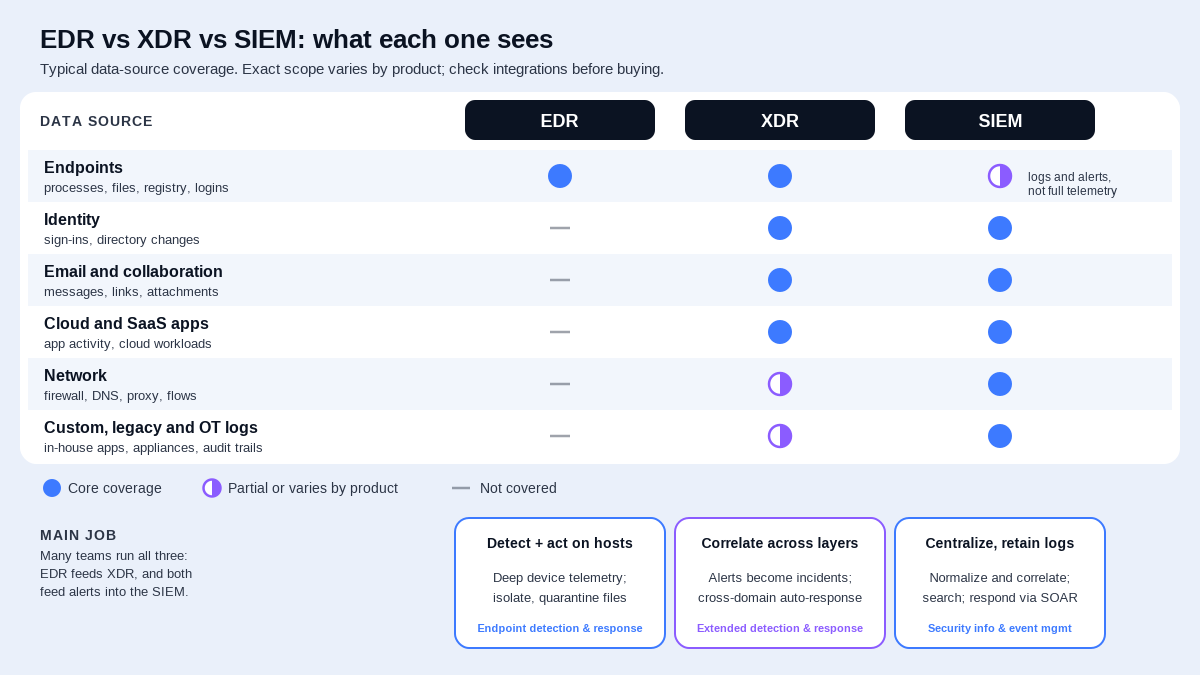
The diagram for this article maps it out. Think of a building's security:
- EDR is a guard posted inside each office, watching everything that happens in that room and able to lock the door.
- XDR is a security desk wired to the office guards, the badge readers and the mailroom, able to spot that a stolen badge, a suspicious parcel and an odd office break-in are one incident, and to act on all three.
- SIEM is the central records room and analyst team that receives logs from every camera, door, lift, contractor system and visitor book, keeps them for years, and can answer almost any question if someone writes the query.
Real-world uses
- Federal endpoint visibility. M-22-01 told agencies to give CISA access to their enterprise EDR deployments, or work with CISA on future options, to support host-level visibility, attribution and response across government [3].
- Ransomware containment. Isolating devices and disabling accounts automatically, as in Microsoft's attack-disruption feature, targets attacks such as ransomware and business email compromise [7].
- Compliance and investigations. SIEMs retain and correlate logs from sources XDR rarely covers, such as custom applications, network devices and legacy systems [1][5].
- Identity-centric detection. Sign-in anomalies and suspicious directory changes are core signals for both XDR and SIEM; our explainer on identity and access management covers why identity has become a primary attack surface.
Benefits and trade-offs
EDR
- Benefits: deep host visibility, fast containment, and a federal requirement for U.S. agencies under EO 14028 and M-22-01 [3].
- Trade-offs: sees only devices with an agent; blind to SaaS, identity providers and unmanaged devices.
XDR
- Benefits: correlated incidents instead of separate alert queues, cross-domain automated response, less custom rule-writing [6].
- Trade-offs: coverage depends on the vendor's integrations; deeper commitment to one ecosystem; shorter default retention [6].
SIEM
- Benefits: the widest coverage, custom detections, long-term retention and a single place to search [1][5].
- Trade-offs: CISA and ASD published separate executive and practitioner guidance on procuring and running SIEM and SOAR platforms [4], a sign of how much planning they need. In practice, ingestion volumes drive cost, rules need constant tuning, and the platform is only as good as the analysts using it.
How to decide
- Start with endpoints. If you don't yet have EDR on laptops and servers, that's usually the first gap to close. As OMB put it, every device that connects to a network is a potential attack vector [3].
- Count your security vendors. If most of your email, identity and endpoint security comes from one ecosystem, that vendor's XDR may give you correlated incidents quickly [6]. If your stack is mixed, check which third-party sources an XDR can read [8].
- Check your log obligations. Regulatory retention, audit requirements or many custom and on-premises systems point to a SIEM [1][2].
- Be honest about staffing. SIEMs reward teams that can write and tune detections. Smaller teams may get more from XDR, or from a managed detection and response service that operates these tools for them.
- Plan for both. A common pattern is EDR inside XDR for fast detection and response, feeding alerts into a SIEM for broad correlation, retention and SOAR playbooks [4][5][6].
Outlook
The categories are converging. Microsoft's documentation states that after March 31, 2027, Sentinel will no longer be supported in the Azure portal and will be available only in the Defender portal alongside its XDR tools [5]. Elastic likewise presents SIEM, endpoint security and cloud security as parts of one platform [9]. We expect buyers to evaluate "security operations platforms" rather than separate SIEM and XDR products, though that's our reading of vendor direction rather than a sourced forecast. The underlying questions won't change: what data you collect, how long you keep it, and how fast you can act on it.
For the reliability-focused cousin of this topic, monitoring application health rather than threats, see our upcoming observability vs monitoring explainer.
Frequently asked questions
Does XDR replace SIEM?
Not usually. XDR correlates and responds across the security products it integrates, while a SIEM ingests almost any log source and keeps it for as long as you need [1][6]. Many organizations run both, with XDR alerts flowing into the SIEM.
Is EDR the same as antivirus?
No. Antivirus mainly blocks known malicious files. EDR continuously records endpoint behavior and adds investigation and response capabilities such as isolating a device [3][7]. Many modern products bundle both.
What is the difference between XDR and EDR?
EDR focuses on endpoints. XDR uses EDR as a foundation and adds telemetry from other layers such as identity, email and cloud apps, correlating them into single incidents with coordinated responses [6][8].
What is SOAR, and how does it relate to SIEM?
SOAR stands for security orchestration, automation and response. It runs predefined responses automatically when anomalies are detected [4]. It's often built into or paired with a SIEM; in Microsoft Sentinel, for example, a playbook can open a ticket in a system such as ServiceNow whenever a particular alert fires [5].
Do small businesses need a SIEM?
Not always. A small organization with a modern EDR or XDR product and limited staff may get better protection from those tools, or a managed service, than from running a SIEM. A SIEM becomes more important when compliance requires long log retention or when you need to correlate many non-security sources [1][4].
Is there an official definition of XDR?
Not from NIST or CISA as of November 2026, as far as we could find. Definitions come from vendors and analysts, which is one reason product capabilities vary so much [6][8].
Sources
- NIST, Computer Security Resource Center Glossary, "Security Information and Event Management (SIEM)," citing SP 800-92. https://csrc.nist.gov/glossary/term/security_information_and_event_management
- Karen Kent and Murugiah Souppaya, NIST, "SP 800-92, Guide to Computer Security Log Management," September 2006. https://csrc.nist.gov/pubs/sp/800/92/final
- Office of Management and Budget, "M-22-01, Improving Detection of Cybersecurity Vulnerabilities and Incidents on Federal Government Systems through Endpoint Detection and Response," October 8, 2021. https://bidenwhitehouse.archives.gov/wp-content/uploads/2021/10/M-22-01.pdf
- CISA, with the Australian Signals Directorate's ACSC and partners, "Guidance for SIEM and SOAR Implementation," May 27, 2025. https://www.cisa.gov/resources-tools/resources/guidance-siem-and-soar-implementation
- Microsoft, "What is Microsoft Sentinel SIEM?" (vendor documentation). https://learn.microsoft.com/en-us/azure/sentinel/overview
- Microsoft, "What is Microsoft Defender XDR?" (vendor documentation). https://learn.microsoft.com/en-us/defender-xdr/microsoft-365-defender
- Microsoft, "Overview of endpoint detection and response capabilities," Microsoft Defender for Endpoint (vendor documentation). https://learn.microsoft.com/en-us/defender-endpoint/overview-endpoint-detection-response
- CrowdStrike, "What is extended detection and response (XDR)?" (vendor explainer). https://www.crowdstrike.com/en-us/cybersecurity-101/endpoint-security/extended-detection-and-response-xdr/
- Elastic, "Elastic Security" (vendor documentation). https://www.elastic.co/docs/solutions/security